
The end of the old Sinaloa Cartel
The sentence imposed on ‘El Mayo’ Zambada certifies the death of the criminal organization he and ‘El Chapo’ Guzmán led, which was as violent and unstable as its successors


Past years on the calendar hold a multitude of bloody dates linked to the Sinaloa Cartel. The constant news coverage these days, however, fuels the impression that everything is now more violent, worse, bloodier; that there are no longer any codes, that the motto “live fast and leave a good-looking corpse” prevails. The past is idealized — a strange phenomenon — and the 1970s and early 1980s appear in the collective imagination of Mexico’s criminal underworld as a balanced earthly paradise, an aspiration, yet another expression of the current nostalgia for those times and the taste for all things vintage. The recent life sentence handed down to “El Mayo” Zambada sheds light on this situation, but it proves deceptive upon closer examination.
Zambada was born in 1948 or 1949 in a different Mexico, closer to the Revolution and the Cristero War (1926-1929) than to smartphones. He grew up in a southern Culiacán village, El Alamo, and drifted into criminal circles almost by accident. The country of his childhood and youth was still an enigma. Historian Pablo Piccato wrote in his book Historia Mínima de la Violencia en México (A Brief History of Violence in Mexico) that “the post-revolutionary state could not establish an uncontested reality; rather it consolidated on an understanding that there were multiple ways of interpreting the law.” Drug trafficking did not imply a moral choice: it resolved the dilemma between surviving and letting yourself die, or barely getting by. Whether it was legal or not lay outside the decision-making process.
Widespread land redistribution was new to the country, thanks to President Lázaro Cárdenas, who had updated the revolutionary tenets of Emiliano Zapata and his allies. Sinaloa learned that water could be stored to transform the present and the future, that the countryside was not just subsistence but could represent wealth. The young Zambada witnessed the first years of operation of the Sanalona dam, in a village near El Alamo, which transformed southern Culiacán and enabled the takeoff of industrial-scale agriculture in the area. He saw how the López Portillo dam, inaugurated in the early 1980s, completed the transformation and irrigated the valleys further south.
Between the inaugurations of one reservoir and another, Zambada sealed his fate. Some biographies recount that between the late 1970s and early 1980s, he lived for a time in Southern California, where he learned the ropes of the northern side of the drug trade. Others point out that the young man had gotten his start years earlier in the heroin trade, a product of the mountains north of Culiacán — specifically Badiraguato, the birthplace of his future partner, Joaquín “El Chapo” Guzmán, and his cousins, who were also partners but later became enemies: the Beltrán Leyva brothers. Those three surnames — Guzmán, Zambada, and Beltrán — form the three vertices of the founding triangle of the Sinaloa Cartel.
There was never an idyllic balance among the factions; if anything, there was the certainty that the peripheral groups were worse than they were. This was the case, for example, with the Carrillos, who controlled drug trafficking in Ciudad Juárez, in the northern state of Chihuahua on the U.S. border, and who had been at odds with the three families since 2004. That year, hitmen assassinated Rodolfo Carrillo Fuentes, marking the definitive breakdown of an alliance formed years earlier. The war between the Juárez Cartel and the Sinaloa Cartel — which peaked between 2008 and 2011 — forever transformed the dynamics of drug trafficking networks in Mexico, due to the parties involved (including authorities), the arms race among the factions, and the emergence of groups specializing in combat, known as “protection rackets.”

It is true that the broad-strokes history of drug trafficking in Mexico highlights the rise of Los Zetas as the start of change, but in parallel what happened in Juárez was taking place, where at that time there were more than 3,000 murders a year. And behind Juárez were El Chapo Guzmán, enjoying life at liberty after his first prison escape in 2001, and El Mayo Zambada, always discreet, never arrested until the end, in July 2024. Violence and business marked those years, paced by the two partners, who later split from the Beltráns, with whom they also fought. In the sentencing memorandum published by the Department of Justice this week, prosecutors said the cartel used to receive between 15 and 20 light aircraft every night, each loaded with between one and one and a half tons of cocaine.
More extravagant than El Mayo — blinded by the narrative of his own life — El Chapo Guzmán was the first to fall, marking the beginning of the end for the Sinaloa Cartel. Mexican authorities, who had collaborated with the group during Felipe Calderón’s administration (2006–2012) under the leadership of his security czar, Genaro García Luna, stepped up their efforts in the years that followed. They should have caught El Chapo twice; the first time, he slipped through their fingers again — the cinematic story of the tunnel beneath a maximum-security prison. While El Chapo was being hunted and El Mayo was holding on, the sons of both men were growing up in the business, operating in spheres separate from their fathers,’ indifferent to the loyalty they had built together.
The epitome of that estrangement is the betrayal by one of El Chapo’s sons, Joaquín Guzmán López, against El Mayo. The never-arrested, always-discreet, ranching enthusiast and theoretical defender of the rural world, El Mayo succumbed to a historic hunt because of an internal weakness. After a criminal career spanning more than 50 years, El Mayo fell into the clutches of the U.S. judicial system — a highly controversial affair due to the manner in which it unfolded: he was allegedly kidnapped by Joaquín Guzman López in Sinaloa and flown by light aircraft to face justice in the U.S. Was the betrayal orchestrated from Washington? Did they agree to the kidnapping in exchange for benefits for the Guzmán family? These are questions that remain unanswered.
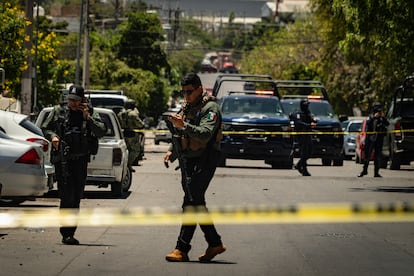
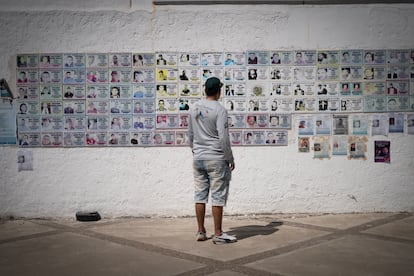
The war between El Chapo’s sons and El Mayo’s loyalists — a response to the former’s betrayal of the latter — marks the final decline of the old Sinaloa Cartel, whose demise takes on a quantum nature. Does the cartel even exist? Is what remains, what is left, the Sinaloa Cartel? These are superfluous questions in the face of the wave of violence gripping the state — two years that have left thousands dead and missing. The old no longer exists; the new has yet to emerge, still weighed down by the bullets. The drug world is shifting from agricultural to synthetic drugs. El Mayo won’t be there to see it.
Sign up for our weekly newsletter to get more English-language news coverage from EL PAÍS USA Edition









































