
‘El Limones’ and the growing union disguise of Mexican organized crime
The arrest of an operative of the powerful CATEM labor union with links to the Sinaloa Cartel increases the pressure on the government in its challenge to curb the cartels


The year is drawing to a close at an interesting time for Mexico, as both the government and organized crime try to strengthen their positions ahead of the midpoint of President Claudia Sheinbaum’s term. The executive branch is rapidly accumulating power, thanks to key changes at the Attorney General’s Office (FGR) and the groundwork laid in previous months, primarily the National Intelligence Center (CNI) and the Financial Intelligence Unit (UIF) of the Ministry of Finance. However, the challenge is immense. Criminals and gangs are increasingly sophisticated in their disguises and protections, while simultaneously strengthening their connections to those in power. Now, criminal organizations are masquerading as unions or using legitimate organizations to exploit the legal economy, leaving citizens and business owners in precarious situations.
Alerted by citizens and local authorities, the government is monitoring and attempting to dismantle these groups. At least, that’s the impression given by its operations in recent months, the most recent being the arrest of Edgar N., alias “El Limones,” in the La Laguna region of northeastern Mexico. El Limones was a member of one of the Sinaloa Cartel’s branches in the area, known as Los Cabrera, while also holding a position within the regional structure of one of the country’s largest labor unions, CATEM. The Security Cabinet, headed by the powerful Secretary of Security, Omar García Harfuch, also arrested five of his associates and froze several bank accounts belonging to the criminal network, which extorted ranchers and merchants, stole fuel, and laundered money for Los Cabrera.
According to the federal government, El Limones “received millions of dollars in deposits of unjustified origin, made transfers to companies linked to money laundering, and participated in the purchase and sale of real estate, luxury vehicles, jewelry, watches, and gambling.” To carry out all of this, the alleged criminal wore the shirt of CATEM, both literally and figuratively. CATEM is a labor union with millions of members, founded 15 years ago by Pedro Haces, one of the ruling party Morena’s leading parliamentary figures. This week, Haces posted a video on social media attempting to distance himself from El Limones, separating union activity from the extortionate plundering carried out by this individual and his group. But Haces’s message quickly became outdated in the face of the flood of photos on social media showing him with Limones, and Limones with union officials in La Laguna.
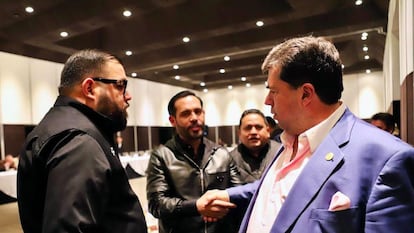
The situation is not easy for the government, which is trying to eradicate the problem without fatally wounding one or another faction within Morena — a surgery of extreme complexity. Individuals like El Limones thrive thanks to their ability to connect with political power, whether it emanates from the administration or the unions. The passage of time only increases the complexity of the problem and deepens the criminals’ connections. Given the difficulties, the temptation to not intervene looms large. The arrest of the leaders is a first step. Trial and conviction are the only ways to suture the wounds and bolster the healing of Mexico’s battered state.
Given the paths Sheinbaum and Harfuch have forged through the jungles of corruption and crime proliferating across the country, it seems the government understands the depth of the problem. The reality of the enemy transcends the classic, Manichean image of the evil drug lord. On the contrary, organized crime, comprised of individuals familiar with administrative bureaucracies, understands the value of a good disguise and uses it effectively. Crime operates from within the state, from its institutions. And it occurs at the local, state, and federal levels. Thus, where populism proposes heavy-handed tactics, the solution appears far more subtle and painful, for it involves attacking itself.
Other government operations in recent months reflect the evolving role of organized crime in unions. In the last six months, for example, the capture of Alejandro Gilmare, alias “Choko,” a former ministerial police officer from the State of Mexico, has drawn attention. He led an organization called La Chokiza, which presented itself to the public as a kind of informal union. Based in Ecatepec, the state’s most populous municipality, La Chokiza offered its members legal advice, advertising for their businesses, protection against extortion, and other services. They were very popular. The mayor of Ecatepec, Azucena Cisneros, a member of the Morena party, recorded a video with Gilmare celebrating the organization’s anniversary. Gilmare himself had a romantic relationship with Sandra Cuevas, the former mayor of the Cuauhtémoc borough in Mexico City.
But the reality was that El Choko and his associates were using his brand’s positive image for their illicit activities. Now, authorities are accusing Gilmare of extortion, homicide, and property theft, as well as other former members of the gang. El Choko’s trajectory offers a somewhat depressing lesson about how easily such individuals amass power and how slowly — overwhelmed or negligent — the authorities act to stop them. In any case, his arrest reinforces the government’s message against this type of criminal activity and against extortion in general, a growing problem in the country that has prompted legislative reviews and special operations in various regions.
Ecatepec offers other examples, such as Guillermo Fragoso, a veteran of criminal unionism in the area. Wanted by authorities for extortion and kidnapping, Fragoso was La Chokiza’s rival. He was first a member of the Libertad union, which grew under the protection of the municipal government before Cisneros’ arrival. He later created others, such as the Union of National Unions and Organizations (USON) and the March 25th Union. Like Limones, Fragoso skillfully built a network of relationships with political power beyond Ecatepec, which allowed him to advance for years. His name even appears in the investigation against the owner of Miss Universe, Raúl Rocha, and his criminal network. Its leaders, Jacobo Reyes and Jorge Alberts, speak of him as a facilitator, someone who can lend them “people,” introduce them to mayors, and help them move weapons.
Sign up for our weekly newsletter to get more English-language news coverage from EL PAÍS USA Edition









































