
From kitsch to organized crime: Miss Universe controversy uncovers a network of drug trafficking, weapons, and fuel theft
Raúl Rocha, the president of the beauty pageant, has in one week gone from being accused of rigging the prize in favor of the Mexican winner to being pursued for leading a criminal network with links within the Mexican Attorney General’s Office
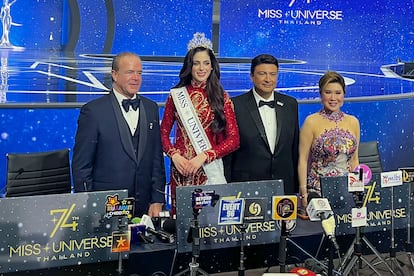

Every step Fátima Bosch has taken toward the Miss Universe crown has been accompanied by controversy. But the tangle of scandals, misunderstandings, and accusations has grown rapidly, escalating from kitsch to organized crime. At the center of the spotlight is the pageant’s president, Raúl Rocha. In less than a week since the winner was announced, the Mexican businessman has faced a barrage of criticism for favoritism and admitted to having a multi-million dollar contract with the oil giant Pemex, where Bosch’s father is an executive. On Wednesday, it was also revealed that Rocha has an arrest warrant in his name on accusations of leading a drug, arms, and fuel trafficking network on the border between Mexico and Guatemala. According to court documents obtained by this newspaper, police officers and officials from the Mexican Attorney General’s Office (FGR) are also involved.
The bizarre case has even reached the National Palace. President Claudia Sheinbaum initially defended Bosch’s victory against accusations of fraud and praised the winner’s speech, which included feminist undertones. However, as the controversy has grown, Sheinbaum has tempered her enthusiasm and asked the Attorney General’s Office to clarify the situation.
Last Friday, Bosch excitedly accepted the award, wearing her silver crown and a red and gold sequined dress. A nod, the winner said, to “corn, the gold of Mexico.” Criticism of preferential treatment toward Bosch, who comes from a wealthy family in southern Mexico with political and economic influence, had been brewing for some time. In September, during the pageant that crowned her as Mexico’s candidate for Miss Universe, 27 of the 31 contestants walked off the stage during the crowning ceremony.
In Thailand, the host country of the global award, the controversy resurfaced. The local organizer reprimanded the Mexican contestant for not posting any content from Thailand on her social media. Bosch responded: “He called me stupid. It’s unacceptable. We are empowered women; no one can silence our voices.” The day before her victory was confirmed, two of the eight jury members resigned. One of them, the Franco-Lebanese musician Omar Harfouch, stated on his Instagram account that an impromptu jury had been formed to select the 30 finalists from among the 120 participating countries. “They are people with a significant conflict of interest.”
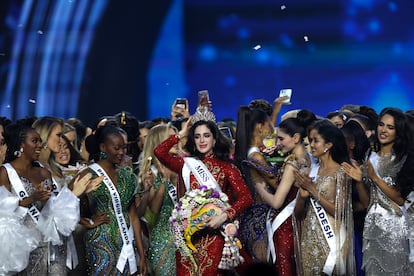
As the week progressed, the plot thickened. The accusations against Rocha entered a new phase when it was revealed that one of his companies has a contract with Pemex worth nearly 750 million pesos ($40.9 million). And that Miss Universe’s father, Bernardo Bosch, has been working as an executive at the Mexican state-owned oil company for almost three decades.
Rocha, owner of a business conglomerate that includes everything from casinos to fuel distribution, acknowledged the contract. But he defended himself by arguing that he had signed it in 2023, a year before he became the owner of the beauty pageant through his company, Legacy Holding Group, which acquired 50% of the Miss Universe Organization for $16 million. To further complicate matters, Pemex publicly congratulated the winner. Later, they denied any involvement and justified the congratulations as being “made within the context of popular enthusiasm for her victory.”
The arrest warrant issued against Rocha for organized crime is, for now, the culmination of a whirlwind week that threatens to escalate. A federal judge in Querétaro issued the warrant, which this newspaper has obtained, at the request of the Specialized Prosecutor’s Office for Organized Crime (FEMDO), which began investigating the businessman in 2024. Specifically, he is accused of being part of a network dedicated to smuggling hydrocarbons, weapons, and drugs into Mexico from Guatemala via boats on the Usumacinta River, the natural border between the two countries, and subsequently transported in tanker trucks from Chiapas and Tabasco to Querétaro.
According to the FGR investigation, the buyers in the network are the Jalisco New Generation Cartel in Querétaro and La Unión Tepito in Mexico City. When asked about the case by this newspaper, Rocha denied any involvement in the scheme. “It is completely false that I have an arrest warrant,” stated the businessman, who is also Mexico’s Honorary Consul in Guatemala.
In addition to Rocha, the arrest warrant includes more than a dozen names, among them officials and police officers from FEMDO. For example, prosecutor Mari Carmen Ramírez Rodríguez, who appears in the complaint with the aliases “La Fiscal” or “La Lic.” Or the commander of the same prosecutor’s office, Paul Manrique Miranda, also cited with the alias “El Comandante.”
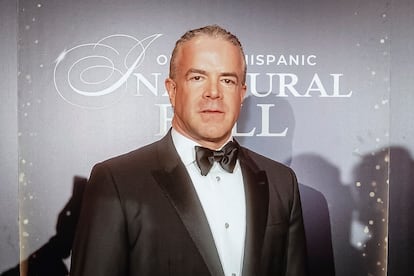
President Sheinbaum has remained cautious for the time being, neither confirming nor denying the accusations against Rocha. “If there is an investigation into this person, then the Attorney General’s Office has to inform us; it came out in the media today, but they have to be informed,” she said at her morning press conference Wednesday. In a brief statement issued a few hours after the president’s remarks, the Attorney General’s Office simply stated that the investigation into Rocha is ongoing and that “additional information related to the investigation files is being gathered.”
Combating fuel theft, or huachicol, is one of the government’s priorities, especially after another trafficking network embedded in the upper echelons of the Mexican Navy was uncovered just a couple of months ago.
Some media outlets even claim that Rocha has reached an agreement with the FGR, becoming a kind of protected witness and thus avoiding arrest. What began almost as a gossip scandal in the entertainment world has escalated in just one week to the forefront of Mexican politics, and all indications are that there are still more chapters to come.
Sign up for our weekly newsletter to get more English-language news coverage from EL PAÍS USA Edition









































