
MAGA movement leans on protests against Claudia Sheinbaum to push for military intervention in Mexico
Extremist commentators and Donald Trump himself are spreading misinformation and exaggerations about the protests to bolster justifications for a direct attack on the cartels
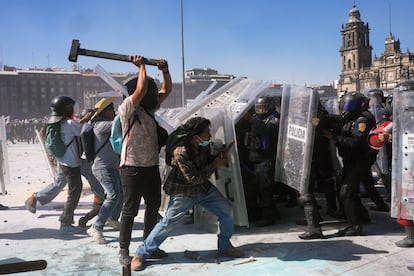

The protests against Claudia Sheinbaum’s government, which shook Mexico City last Saturday and have been called again for November 20, have been claimed by various actors and groups with diverse interests, including north of the border. In the United States, they have been picked up on by some digital media outlets and commentators from the Trumpian MAGA movement — such as Steve Bannon and Alex Jones, both known for spreading misinformation — to denounce Mexico’s supposed transformation into a “narco-terrorist state.” In a context where the United States has declared war precisely on “narco-terrorism” in Latin America and has already sunk more than 20 alleged drug-running boats in the waters of the Caribbean and the Pacific, resulting in at least 80 extrajudicial killings, the implication is clear: they are calling for Mexico to be the next target.
Donald Trump spelled it out for reporters at the White House on Monday, when asked if he would consider action in Mexico. “To stop drugs? It’s OK with me. Whatever we have to do to stop drugs… I looked at Mexico City over the weekend. This is some big problems over there. If we had to, would we do there what we’ve done to the waterways? You know, there’s almost no drugs coming into our waterways any more.” While Sheinbaum flatly rejected the idea of a direct U.S. military incursion into Mexican territory, and Secretary of State Marco Rubio also ruled out any unilateral U.S. action, interventionist rhetoric is growing among the president’s electoral base.
Some anonymous and smaller social media accounts have shared messages about it, but most of the coverage of the Mexican protests within the MAGA ecosystem has been on Bannon’s and Jones’s programs. Bannon’s War Room is among the top 10 most-listened-to political podcasts — though its content is more akin to a television news program — while Jones’s InfoWars website receives over five million monthly visits, according to the analyst firm Semrush. Both have been repeatedly denounced for spreading fake news, to the point that Jones has been convicted and his official accounts have been removed from numerous social media platforms. However, this doesn’t seem to have impacted their audiences, and their platforms directly influence public opinion within far-right sectors in the United States.
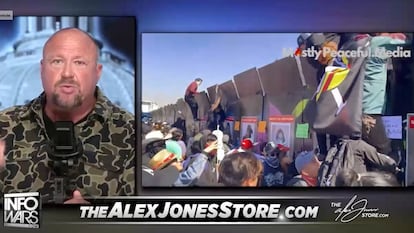
At this point, each side’s narrative lays the groundwork for a U.S. military intervention, albeit with different arguments. Jones, on the one hand, has asserted that the protests against Sheinbaum have spread throughout Mexico and that millions of Mexicans have united in what he calls a popular “revolution,” when the official attendance figure for Saturday’s demonstration was 17,000 people. According to his account, a U.S. military incursion would be necessary to ensure a transitional government allied with Trump.
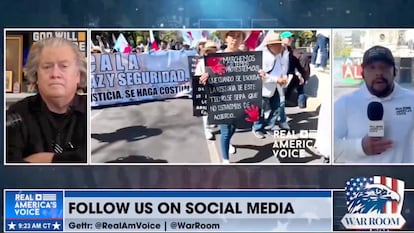
In Bannon’s program, however, the contextualization is more comprehensive, emphasizing two things in particular: the generational component of the protests, initially attributed to Generation Z, though they have since expanded beyond that group; and the catalyst for dissatisfaction with Sheinbaum that was the assassination of the mayor of Uruapan, Carlos Manzo, in Michoacán. In this case, U.S. intervention has been presented as a direct demand from the Mexican population for Trump to act to remove Sheinbaum’s government, supposedly under the direct control of the same “narco-terrorism” that victimizes Americans through the flow of drugs, particularly fentanyl.
Both versions are far removed from reality. Sheinbaum is one of the most popular leaders globally, with approval ratings nearing 80%, and there is currently no existential risk to her government, although Manzo’s death, the insecurity in several states due to cartel activity, and the corruption scandals within her party are having a negative impact on public opinion. For his part, Trump says he is “not happy with Mexico,” despite the fact that security cooperation between the two countries has strengthened throughout this year and Sheinbaum’s administration has championed the fight against organized crime as a top priority.
Indeed, extending a hand to further strengthen this collaboration has been the message from the Mexican president in response to questions about a possible U.S. intervention. Sheinbaum was emphatic in her rejection, given that U.S. approval would be legally required for any military incursion into her country. The U.S. Congress would also have to approve any attack or special operations in Mexico; President Trump has asserted that it would be easy to secure the support of legislators from both parties. In fact, several Republican congressmen have been proposing direct attacks on the cartels for years, and some have reiterated this stance, notably Dan Crenshaw, a Republican from Texas, who leads a legislative committee on combating the cartels.
Given the comments from Sheinbaum and Rubio, direct intervention in Mexican territory still seems a distant possibility. But the domestic political context in the U.S. could be fueling a scenario in which attacking Mexico is presented as a relatively easy way for Trump to score points with his base.
As the saga surrounding Jeffrey Epstein’s papers nears its climax, requiring only the president’s signature for their public release, and as various rifts within the Republican base continue to deepen, a direct attack on the cartels in Mexico is a measure with broad support within the party and among its voters that could both divert public attention and appease a significant portion of Trump supporters. While there are no recent polls on the matter, a Reuters survey conducted in 2023 — when Joe Biden was president and the fentanyl epidemic was at its peak — found that 64% of Republicans favored sending troops to Mexico to combat the cartels. The party’s near-unanimous support for the recent attacks on alleged drug-trafficking vessels suggests that figure could now be even higher.
Although Trump has not accused Sheinbaum of being connected to or belonging to drug trafficking groups, as he has done with the presidents of Venezuela and Colombia, Nicolás Maduro and Gustavo Petro, respectively, he has asserted that he would be “proud” to directly attack the cartels. “I’ve been talking with Mexico; they know how I stand. We’re losing hundreds of thousands of people to drugs. We’ve stopped the waterways, but we know every route. We know every route, we know the addresses of every drug lord,” he stated on Monday, despite the lack of evidence that attacks on drug boats have had an impact on the supply of drugs into the United States.
“We know their address, we know their front door. We know everything about every one of them. They’re killing our people. That’s like a war. Would I do it? I’d be proud to,” Trump stated. The stage for a military intervention, set by the MAGA universe and Trump himself, has been laid. The final outcome is less clear.
Sign up for our weekly newsletter to get more English-language news coverage from EL PAÍS USA Edition









































