
Mexico pushes back against Trump’s insistence on military intervention
President Sheinbaum is walking a tightrope between firmness and patience to dodge the US leader’s recurring proposal to send troops to subdue the drug cartels
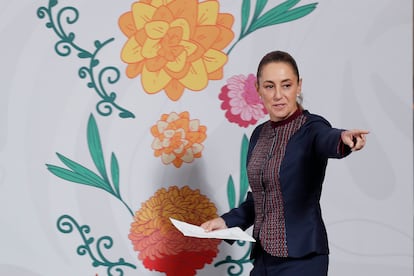

Mexico has dug in its heels against Donald Trump’s repeated attempts to intervene in its neighbor’s territory under the pretext of combating drug trafficking. Mexican President Claudia Sheinbaum has patiently rejected, time and again, in a firm but measured tone, the U.S. president’s constant offers for the U.S. military to conduct operations beyond its borders to subdue the drug cartels.
“It’s not that we don’t want support, but not with foreign troops,” the president reiterated this Tuesday, recalling that the last time the United States entered Mexico, “they took half of the territory.” Sheinbaum is hardening her position while continuing to perform diplomatic balancing acts in the face of Trump’s attacks, which call into question the Mexican government’s security strategy, in what is increasingly looking like an affront to its sovereignty.
Ever since Trump first mentioned sending troops to Mexico during his second presidential campaign, the country has been preparing to counter every hint of interference in its security policy. Even after announcing his intention to seek reelection in 2024, the Republican has repeatedly stated that, if necessary, he would be prepared to send the U.S. military across the border to combat drug cartels. Sheinbaum has consistently countered the U.S. president’s threats. However, Trump’s rhetoric has escalated as he intensifies his aggressive foreign policy with extrajudicial attacks on alleged drug boats and flexes his muscles in the Pacific Ocean and the Caribbean. These operations have put him at odds with the government of Gustavo Petro in Colombia and have further strained relations with Nicolás Maduro in Venezuela. Now, Mexico must confront the ever-present specter of U.S. interventionism.
To counter her counterpart’s bluster, Sheinbaum has clung to repeating her solution like a mantra: sovereignty, cooperation, and collaboration. Sheinbaum has agreed to the exchange of intelligence between the two countries to manage joint operations against drug cartels, but she is not willing to relinquish control of operations on Mexican soil.
“[Trump] has suggested it on several occasions, saying, ‘We offer you a U.S. military intervention in Mexico, whatever you need to combat the criminal groups.’ But I have told him every time that we can collaborate, that they can help us with any information they have, but that we operate in our own territory,” is the gist of the Mexican president’s reply to Trump’s insinuations, which began last February when he declared the cartels terrorist organizations. “We will never be subordinate. Mexico is a free, sovereign, and independent country, and we do not accept interference,” she said at the time.
However, Trump has not wavered in his offer, which has become a challenge to Sheinbaum’s composure in the face of the domestic opposition’s pressure to allow the United States to address Mexico’s security crisis and the growing frustration of a society plagued by violence. At the beginning of the year, Mexico’s concessions — sending 10,000 troops to the border to reinforce immigration enforcement and extraditing cartel leader Rafael Caro Quintero — not only quelled the trade war but also temporarily quieted calls for military intervention.
The calm lasted until May, when The Wall Street Journal reported that during a phone call between the two presidents on April 16, Trump pressured Sheinbaum to accept U.S. military assistance and take a harder line in her security policy.
“No, President Trump,” Sheinbaum stated, reiterating her proposal for a collaborative approach. “You in your territory, we in ours. We can share information, but we will never accept the presence of the United States military on our territory,” she said.
Trump claimed that the president’s refusal of his assistance was due to her being paralyzed by fear of the drug traffickers who control her country. “If Mexico wanted help with the cartels, we would be honored to go in and do it,” the Republican leader boasted.
But Sheinbaum refused to engage. “It’s not worth it,” she replied, adding that she did not want to engage in a public spat with the U.S. president. “Why create a disagreement?” she asked.
U.S. Secretary of State Marco Rubio’s visit to Mexico in September, which coincided with the start of operations to sink suspected drug-running boats, solidified the bridge of collaboration that Sheinbaum had been building to combat drug trafficking. “No government is cooperating more with us than the Mexican government,” said Rubio, citing as an example the extradition of 55 high-level Mexican drug traffickers to the U.S.
Since then, Rubio has stepped in to soften Trump’s remarks whenever the latter has stirred up the hornet’s nest of intervention, as happened this Tuesday. When the president declared his willingness to replicate attacks on vessels suspected of carrying drugs with land raids against Mexican cartels, Rubio was quick to tone down his rhetoric. “We’re willing to provide them any help they want. Obviously they don’t want us to take — we’re not going to take unilateral action or go in and send American forces into Mexico, but we can help them with equipment, with training, with intelligence sharing, with all kinds of things that we could do if they asked for it,” Rubio emphasized, stressing that Mexico would first have to formally request that assistance. Sheinbaum has indicated she is willing to accept this type of support.
In her latest rejection of Trump’s offer, Sheinbaum expressed her exasperation by bringing up the historical grievance of how Mexico had to cede 55% of its territory 175 years ago following U.S. intervention. While Trump continues to insist that he would be proud to order the U.S. military into Mexico, as the Drug Enforcement Agency (DEA) has proposed, according to The Washington Post, Sheinbaum has firmly maintained that this possibility does not exist. Analysts support her, asserting that an intervention is still a very distant prospect and would not serve U.S. interests, as Americans do not want to see troops deployed abroad, much less sever relations with their southern neighbor.
Sign up for our weekly newsletter to get more English-language news coverage from EL PAÍS USA Edition









































