
‘I am not happy with Mexico’: Trump would be ‘proud’ to launch strikes in neighboring country
Asked whether such a move would only take place with prior permission from Mexican authorities, Trump said he ‘wouldn’t answer that question’ and that Mexico ‘knows how I stand’
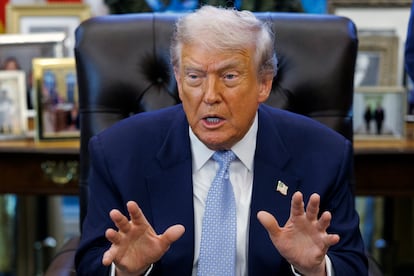

President Donald Trump — who is engaged in psychological warfare against Venezuela with a massive military contingent in the Caribbean that keeps sinking alleged drug-running boats — on Monday also lashed out at Mexico, the source of most of the fentanyl circulating in the United States. Speaking to reporters in the Oval Office, he asserted that he would be “proud” to order strikes in Mexico, but declined to answer whether he would do so without first consulting the Mexican government.
“Would I launch strikes in Mexico to stop drugs? OK with me, whatever we have to do to stop drugs,” he said in reply to a reporter’s question about potential strikes on Mexico. Asked whether such strikes would only take place with prior permission from Mexican authorities, Trump said he “wouldn’t answer that question” and that he has already been speaking with Mexico. “They know how I stand.”
The president stated that Mexican authorities are aware that “we’re losing hundreds of thousands of people to drugs” and that a lot of those drugs come from Mexico. “So let me put it this way: I am not happy with Mexico,” he added.
This is not the first time the U.S. president has publicly protested about drug trafficking from Mexico, the origin of most of the fentanyl entering the United States. Fentanyl has become the deadliest drug in the U.S. and is blamed for most of the tens of thousands of overdose deaths that occur each year in the country.
At the same event — a meeting with FIFA representatives to prepare for next year’s World Cup, which the United States will co-host — Trump also reiterated that his administration must “take care of” the Venezuela issue. His remarks came a day after the USS Gerald Ford aircraft carrier, the world’s largest and most modern, arrived in the Caribbean to join the U.S. fleet carrying out extrajudicial attacks against suspected drug boats under the declared mission of combating drug trafficking.
The arrival of the Ford and its carrier strike group brings the number of U.S. troops in the region to 15,000, making the U.S. military presence in the Caribbean the largest in over 60 years. This has fueled speculation that the true goal of the mission — dubbed “Southern Spear” and which also includes attacks on vessels in the eastern Pacific — is to force regime change in Venezuela. Venezuelan President Nicolás Maduro himself claims that the real purpose is his downfall.
The Republican president is keeping his cards close to his chest and sending out mixed signals about his plans. Last week, after a series of meetings with his advisors to discuss the next steps in the Caribbean, he indicated that he had already “more or less” made a decision.
On Sunday, the U.S. State Department announced it would designate the Venezuelan Cartel of the Suns as a foreign terrorist organization, accusing Maduro of leading it. This move opens the door to an attack on Venezuelan soil, as the White House’s legal argument for the military campaign is that the U.S. is at war with the drug trafficking gangs included on that list.
Yet just a few hours later, Trump hinted in other statements at the possibility of holding direct talks with Caracas, and assured that the Maduro regime was willing to do so. On Monday, he asserted that he was not ruling out any option regarding a possible military intervention in Venezuela, although he also reiterated his willingness to speak with the Venezuelan leader. “I don’t rule out anything. We just have to take care of Venezuela,” Trump maintained.
The president also reiterated his opinion, expressed on several occasions throughout his term, that Venezuela has been “emptying its prisons” and sending its inmates to the U.S.
Sign up for our weekly newsletter to get more English-language news coverage from EL PAÍS USA Edition









































