
Commander Teto, ‘El Abuelo’ and the war against ‘El Mencho’: A decade since the powder keg of Coahuayana
The confrontation between the Jalisco New Generation Cartel and self-defense groups for control of the territory has intensified and shows the difficulties in rebuilding the social fabric in Michoacán
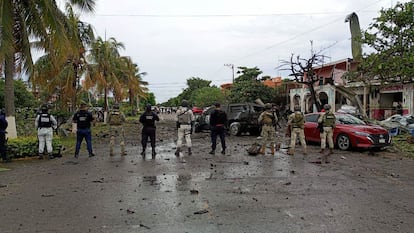

Héctor Zepeda is a tired man. He said so himself a year and a half ago in an interview at his office in the community police headquarters in Coahuayana, Michoacán, which was blown up on Saturday by a car bomb. Nothing suggests his mood has changed, much less for the better. In a phone call that same Saturday, minutes after the attack, which has so far left four police officers dead, Zepeda became angry at the comment about how many years he has been “fighting” against the Jalisco New Generation Cartel (CJNG). “We’re not fighting, we’re resisting!” he protested before hanging up.
Known as Commander Teto, Zepeda leads the community police force of Coahuayana, which rose up in arms in 2014, in line with the other self-defense groups that, at that time, said “enough” to organized crime. It was a powerful movement, inspiring for many in Michoacán and throughout Mexico. But over the years, corroded by the very crime it sought to defeat, it fizzled out. Some of its leaders died in shootouts, like Hipólito Mora, or from illness, like José Manuel Mireles; others took advantage of the movement’s positive image to solidify their ambitions for power, as was the case with Juan José Farías, alias “El Abuelo” (The Grandfather). And still others remained isolated in their own towns, like Zepeda, alone, no longer of public interest, always under the watchful eye of the government, which regards them with suspicion.
On Tuesday, federal Security Secretary Omar García Harfuch pointed to the alleged close ties between the community police of Coahuayana and one of the rival criminal groups in the region, Cárteles Unidos. For years, the CJNG and Cárteles Unidos — or “the Tepalcatepec Cartel, which is the same thing,” a source close to the Security Cabinet told EL PAÍS — have been fighting for control of the Sierra-Costa corridor in Michoacán and the mountainous areas that connect to the neighboring Tierra Caliente region. El Abuelo is the leader of the Tepalcatepec Cartel. “He and El Mencho are sworn enemies,” the source added, referring to Nemesio Oseguera, leader of the CJNG, the group that allegedly carried out the weekend attack.
The federal Security Cabinet, coordinated by García Harfuch, considers Zepeda, although “independent and autonomous,” to be an “operative” for El Abuelo. “A lot of cocaine comes in through there, by sea,” sources point out, referring to the beaches near Coahuayana. “That’s why [the CJNG] wants to take down Teto,” they add. Regarding this, Zepeda has always maintained that his mission is to protect the local population, previously from the Knights Templar criminal group, and now from the CJNG. “The government argues that we’ve made a pact with these bastards or those guys, like Cárteles Unidos or whatever,” Zepeda said last year, “but there’s nothing to it, because we’ve always had the same support, the banana growers’ association.”
It is true that the powerful local agricultural industry supports the community police in Coahuayana. In fact, a government document — a file on Zepeda, updated this year and obtained by this newspaper — indicates that the community police and the Coahuayana banana growers’ association reached an agreement last April whereby the association pays 70,000 pesos ($3,850) a week to the police force. But the issue is actually much broader. This exchange of suspicions and accusations masks a situation as complex as it is serious, in which criminal groups — primarily the CJNG and heavily armed local leaders, whether allied with El Mencho or not — have distorted the dynamics of the region, leaving the social fabric in tatters.
Zepeda took up arms after his brother’s murder, at a time when the Sierra-Costa and Tierra Caliente regions were fed up with extortion by criminal groups. More than a decade later, the situation is practically the same. Only the names of the groups, the alliances, the advance or retreat of one faction or another, and the decline of the self-defense forces — now reduced to those in Coahuayana and the neighboring town of Aquila, mired in its own problems rooted in its mineral wealth — have changed. The issue thus transcends Coahuayana, even Tierra Caliente, and in reality affects practically the entire state, as demonstrated by the assassination of Carlos Manzo, mayor of Uruapan, a little further north, a month and a half ago.
Depending on who’s looking, the diagnosis varies. Someone who lives in Coahuayana and is familiar with the region’s criminal dynamics dismisses the notion of a balance in the struggle between groups, as explained by the federal government, and says that “the CJNG is trying to encircle the self-defense groups to gain control of the entire Tierra Caliente corridor, from Tepalcatepec to the coast.” In this context, two local leaders play a key role. They are Fernando Cruz Mendoza, alias “Tena,” and Miguel Ángel Gallegos, alias “Migueladas,” both veterans of the Knights Templar who later became independent and now, according to this source, operate under the CJNG banner.
“El Tena is on the Caleta side,” he says, referring to a point on the coast around 110 miles south of Coahuayana. “He plants explosives,” he adds. In recent years, especially since the CJNG’s offensive in the Aguililla area, between Tierra Caliente and the coast, the use of antipersonnel mines and drones carrying explosives by organized crime has increased relentlessly. And not only in fights between groups, or with community police, but also against the authorities. This source places Migueladas in Apatzingán, the capital of the Tierra Caliente region, where another Templar splinter group, Los Viagras, also operates, led by the Sierra Santana brothers. Los Viagras are accused of murdering Bernardo Bravo, the leader of the Apatzingán lemon growers, a month and a half ago, and Hipólito Mora himself, two and a half years ago.
The criminal network is completed by the CJNG’s structure in the state of Colima, which is only a few miles from Coahuayana. In fact, Michoacán Attorney General Carlos Torres revealed over the weekend that the criminals who brought the truck loaded with explosives to the municipality came from the neighboring state. For years, authorities have been aware of the CJNG’s structure in Colima, thanks in part to the investigation into the disappearances of Antonio Díaz and Ricardo Lagunes, allegedly in Cerro de Ortega, the first town in Colima when crossing from Michoacán. Díaz was part of the ejido council of Aquila, and Lagunes was his lawyer. Díaz was vying for leadership of the council and seeking to increase contributions from Ternium, the company that operates the local iron mine, a situation that generated tensions within the community and with the mining company itself.
The investigation into the disappearances, which occurred in January 2023, points to Óscar Arreguín, alias “El Anzuelo,” a criminal leader in Cerro de Ortega; Carlos Macías, alias “Sky,” a leader in the municipal seat of Tecomán; and their alleged boss, Luis Gabriel Cabrera, alias “El Humilde.” A source familiar with regional dynamics indicates that El Anzuelo is one of those who have “turned the gun.” Originally from Coahuayana, he, like others, reportedly deserted the municipal community police force in favor of the CJNG. “There were several infiltrators, but they were killed, and they lost their sources of information about Commander Teto,” the source says. This, the source adds, could also be one of the possible explanations for the attack.
For at least five years, the Mexican state has known all these names. Military intelligence documents from 2020 onward, released by the hacker collective Guacamaya, place the CJNG’s structure in the southern part of Colima, specifically in Tecomán and Cerro de Ortega. The army also places local CJNG leaders in the Sierra-Costa region of Michoacán and in Tierra Caliente. But the years go by, and they all remain at large. The rugged geography of these regions certainly hinders law enforcement operations. As before in Sinaloa, capturing the leaders and breaking the chains of criminality and impunity appear to be a major challenge for the Sheinbaum administration.
Sign up for our weekly newsletter to get more English-language news coverage from EL PAÍS USA Edition









































