
Michoacán, untamed territory: One of the symbols of Mexico’s security crisis
The ‘war on drugs’ was declared in the state, where cartels have been entrenched in politics and the economy for decades
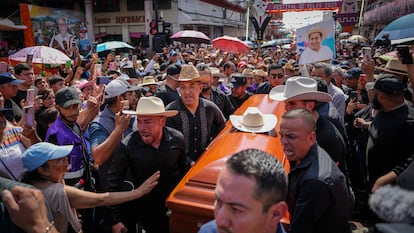

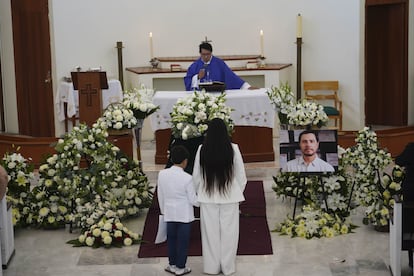
Some deaths become symbols, and sometimes even turning points. The assassination of Uruapan’s mayor, Carlos Manzo, has sparked a social protest rarely seen in Michoacán, a state sadly accustomed to pain and powerlessness. The outburst has even prompted a reaction from Claudia Sheinbaum’s federal government. But almost 20 years ago, just a few blocks from the town square where the mayor was gunned down at point-blank range, another event occurred that marked the country’s recent memory. In the early morning of September 6, 2006, about 20 hooded men with assault rifles, dressed in police uniforms, stormed into a nightclub, firing shots. Before leaving, they took five human heads out of a bag and left them on the dance floor. Three months later, in one of the first displays against narco-terrorism in Mexico, Felipe Calderón, upon taking office as president, announced the deployment of the military to the streets. The ill-fated war on drugs, and its tens of thousands of dead and missing persons, was beginning.
It was in Michoacán where the military barracks were first opened. There, Calderón, wearing an olive-green cap and a military jacket with an eagle and five stars on the lapel, arrived at the Uruapan airport to tell the troops in the heart of the state, in Apatzingán, the epicenter of the violence in Tierra Caliente: “In this great national effort, in which you are on the front lines, what we seek is to halt the advance of organized crime.” That year, the police collected 17 severed heads from the streets, and homicides doubled. Six thousand soldiers arrived in Michoacán to confront the cartels. During the following six-year term, Enrique Peña Nieto extended the strategy. And then Andrés Manuel López Obrador distanced himself further, but without returning the military to their barracks.
The historical figures for violence in Michoacán over these years speak volumes. In 2006, the number of murders approached 700. There was some reduction in the intervening years, but last year closed with more than 1,000 deaths. Michoacán is the symbol of Mexico’s endless security crisis, of failed strategies, of the corrosion of politics and the economy by organized crime, and of the evolution of the cartels: from the drug trade to extortion, to parasitizing lucrative state-run businesses. From the avocados of Uruapan to the lemons of Tierra Caliente, or the trade routes to Asia through the port of Lázaro Cárdenas, one of the largest on the Latin American Pacific coast.
In Uruapan, they are still mourning their mayor, a widely popular figure for his outspoken stance against crime. But they also remember the severed heads of 2006, the bombs in the capital’s Zócalo in 2008, the bodies hanging from bridges, the disappearances, the landmines, the drones carrying explosives. There are candles, flowers, and messages at the exact spot where Manzo was shot. People cross the plaza and stop to read the messages under the shade of giant tropical trees. Keeping an eye on his grandson, who is running around the plaza, a grandfather recalls: “The violence used to be worse. Then it decreased somewhat. But it’s like wasps: when you throw stones at them, they respond by attacking. That’s how the people behind all this are. They want to make money, and we, the poor people, are caught in the middle, not knowing what to say anymore. It feels like a curse,” says Benjamin García, a 71-year-old plumber who hasn’t worked in a long time due to a hand injury.
That curse may be related to the fact that Michoacán is one of the poorest states in the country — more than 40% of the population lives below the poverty line — while simultaneously boasting powerful economic engines such as being the world’s leading producer of avocados, lemons, and berries; hosting a steel plant belonging to ArcelorMittal, the world’s largest steelmaker; and having Chinese and European giants operating its port. Economist Carlos Heredia, an advisor to the state government from 2002 to 2008, explains it this way: “It’s not that violence is ingrained in the DNA of Michoacán residents, it’s that there’s a lot of money here. And that’s a magnet for crime. It’s a rich state with a poor population.”
The turbulent history of Michoacán dates back to the developmental policies inherited from the Revolution. President Lázaro Cárdenas, one of the fathers of modern Mexico, promoted an agrarian reform in the 1950s that boosted rural development. But this momentum slowed, and Michoacán farmers swelled the ranks of the braceros, the mass exodus of farmworkers to the United States. “This decline fostered the formation of armed groups, common criminals dedicated to land grabbing and theft. Furthermore, the departure of so many people to the U.S. created a natural channel for the trafficking of small quantities of drugs. The result is a current scenario where cartels have diversified their criminal activities and increased their firepower in response to militarization,” explains Lorena Cortés, a political analyst specializing in Michoacán.
The evolution of crime in Michoacán, especially in the Tierra Caliente valley, is a moving snapshot of the various changes in the drug trade and the milestones of the security crisis. Since the 1960s, the area’s hot, dry climate fostered marijuana cultivation. During that early period, there was even a certain degree of permissiveness on the part of the authorities. But this policy of turning a blind eye ended in 1985 with the kidnapping and brutal murder of DEA agent Kiki Camarena. His body was found on a ranch in Michoacán, near the border with Jalisco. Pressure from the United States and new drug trafficking activities changed the landscape. Asian precursors for synthetic drugs began to enter the country through the port of Lázaro Cárdenas. With the turn of the century, Michoacán became Los Zetas territory, a mafia formed by deserters from an elite unit of the Mexican Army.
Los Zetas, pioneers of the extreme violence that continues to this day, entered the scene hand in hand with a local and eccentric mafia, La Familia Michoacana, with a pseudo-mystical and regionalist spirit. They were responsible for the severed heads found at the nightclub, along with this message: “This is divine justice. La Familia does not kill innocents.” The alliance broke down in 2006, and the violence spiraled out of control to unimaginable levels. With the military already deployed in the streets, poor farmers took up arms, forming self-defense groups. The Peña Nieto administration focused on capturing the main drug lords. With the major criminal organizations decapitated, a new mutation occurred: a galaxy of new, fragmented groups, eager to profit from every corner. Extortion arrived, along with landmines, drones carrying explosives, and even the appearance of Colombian mercenaries hired by the cartels.
This brings us to the current scenario, where the main player on the criminal map in Michoacán, and in much of Mexico, is the Jalisco New Generation Cartel (CJNG). A modern mafia born in the wake of the decline of the classic cartels, it operates more like a franchise, a brand far removed from the old underworld codes, which focused on drugs and excluded extortion and kidnapping. The fight in Michoacán is the CJNG against everyone: against Cárteles Unidos, which controls much of Apatzingán and is waging a battle for the border with Jalisco that is devastating entire towns; against Los Viagras, which dominates the lemon-growing region; and against the last remnants of La Familia Michoacana, located in the border areas with Guerrero and the State of Mexico.
In fact, Michoacán is home to one of the CJNG’s strongholds. This is Aguililla, the hometown of its leader, “El Mencho,” one of the DEA’s most-wanted criminals. For months, it functioned practically as a lawless zone, where criminals did as they pleased under the watchful eye of the army, deployed on the outskirts of the town. This exemplifies the containment policy implemented by the López Obrador administration.
Heredia summarizes how the relationship between crime and politics has changed. “We’ve gone from tolerance to complicity. It became natural for drug traffickers to finance campaigns to exert influence, especially at the municipal level. From there, it moved to joint partnerships, and now we’re in a state of subordination. Crime decides what gets done, and they kill anyone who opposes them.” This is what happened to Mayor Manzo, who had the CJNG in his sights. Or to citrus grower Bernardo Bravo, who spoke out against the extortion of farmers in Tierra Caliente.
The infiltration of organized crime into politics has also produced high-profile cases. In 2009, the Attorney General’s Office accused Julio César Godoy, half-brother of Governor Leonel Godoy, of having ties to La Familia Michoacana, shortly after he won the election for federal deputy. In 2014, a son of then-governor Fausto Vallejo appeared in a video chatting casually with a leader of Los Caballeros Templarios, a splinter group of La Familia Michoacana. The footage showed the governor’s son drinking beer with kingpin “La Tuta” while they discussed the state’s situation. Five days later, the governor resigned.
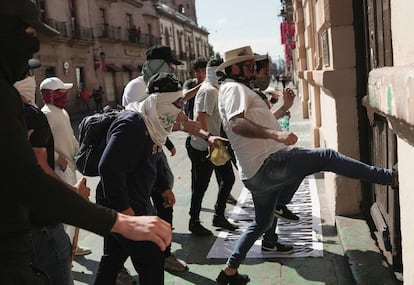
President Sheinbaum has responded to the recent social unrest in the state. From Apatzingán to the capital itself, protests demanding justice and security have erupted. The president has presented a specific plan that involves deploying federal forces and establishing presidential offices in various municipalities, beginning with Uruapan. This presidential initiative incorporates some measures implemented in previous administrations, such as the appointment by Peña Nieto in 2014 of a special commissioner for security and development in Michoacán. Sheinbaum has insisted that her plan does not involve militarizing the state or applying past strategies. Analysts consulted for this report urge patience to see if this new approach can bring some peace to this volatile state.
Sign up for our weekly newsletter to get more English-language news coverage from EL PAÍS USA Edition









































