
Colombian mercenaries training Mexican drug traffickers: ‘They’re bloodthirsty. We don’t want to end up floating in a canal’
EL PAÍS reconstructs, on the ground and using exclusive documents, the presence of former military personnel hired by the cartels, a lethal alliance of organized crime
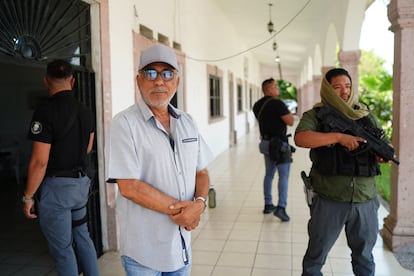
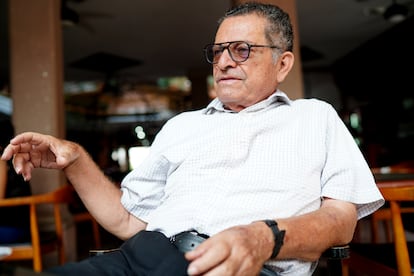
“Los Viagras have several Colombians,” says Lupe Mora, 72, sitting in a dilapidated office in the town hall of La Ruana, a small, hot, lemon-growing town in the state of Michoacán. Three bodyguards armed with Mexican army rifles are stationed outside the office. Two years ago, Lupe’s brother, Hipólito Mora, was murdered at the age of 68 a couple of blocks from here as he was leaving his house one morning. More than 1,000 bullets were fired by 25 Los Viagras hitmen, the same ones who have been sowing terror in this area, known as Tierra Caliente, for years and who now, like the rest of the groups in the region, also have reinforcements in the shape of former Colombian soldiers hired as mercenaries. EL PAÍS has reconstructed how these criminals operate through nearly a dozen sources in Mexico and Colombia and with exclusive information from investigations that prove the operation of this lethal alliance and the limited cooperation from Bogotá to try to stop it.
In his La Ruana office, Mora continues to provide details about the Colombian mercenaries roaming the area. “They run around here hurting the people with drones, explosives, and hitmen,” he explains as the breeze from a fan stirs his gray hair. Since Hipólito’s murder, he has carried on the social activism of his brother, who took up arms against criminal organizations along with other farmers a decade ago. It was at the beginning of the so-called war on drugs, the strategy of sending the military from their barracks to engage in hand-to-hand combat with the cartels. Violence spiraled out of control, and the world looked at Mexico in amazement. “We’re worse off than before, with more shootouts, extortion, kidnappings. And now with the Colombians’ explosives,” Lupe continues. He himself suffered these attacks shortly after his brother’s death. One afternoon, while holding a rally in a town square, he first heard the sound of a drone. Then, the explosion of an object on the roof, leaving a hole above his head. “It left us quite stunned, thank goodness there was a roof,” he says, looking up.
The residents of La Ruana are also aware of the explosives and the Colombian mercenaries. They remember, for example, the case of a father and son who died when a mine exploded while they were picking lemons in a town, Santa Ana Amatlán, less than half an hour away. “It’s those damn Colombians. They’re bloodthirsty, they’re here for what they’re here for,” says another farmer on the side of the town’s dusty main road. A little further ahead, there are blockades with sandbags. They serve as checkpoints for both the army and criminal groups. The farmer says it’s common to see soldiers withdraw from their posts when things get ugly and prefers not to give his name: “We don’t want to end up floating in a canal,” he says. Another woman, who also doesn’t want to give her name, claims she has seen the Colombians, and that they can be distinguished by their manner of speech and because they are always armed. “They come out at night, always in groups, and they go out to kill and extort.”
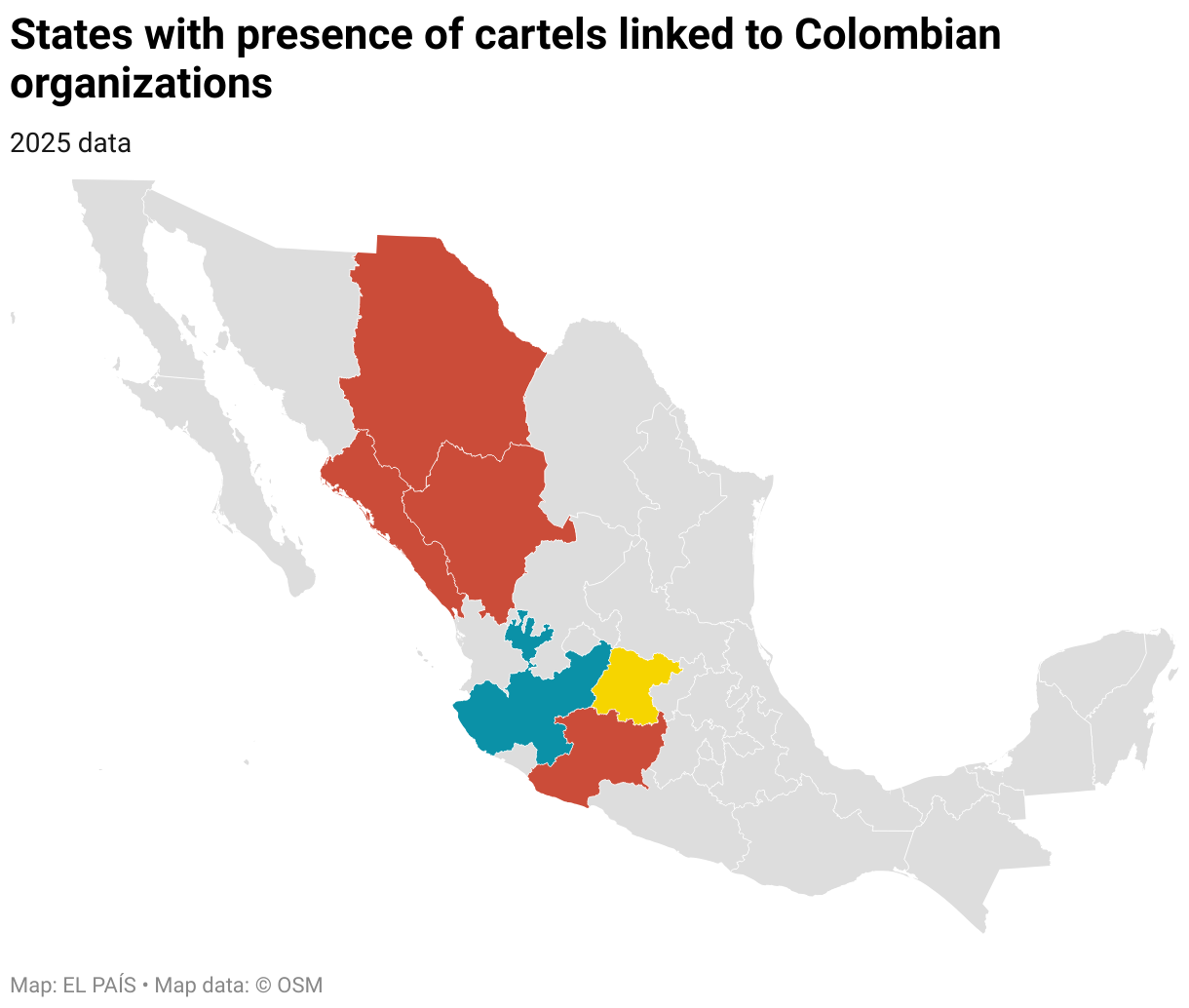
Mexican authorities have been aware of the presence of former Colombian military personnel for at least 15 years, but it has accelerated recently. They are prevalent in the “triangle of death” formed by three central-western border states: Guanajuato, Jalisco, and Michoacán. But also to the north, in Chihuahua, Durango, and Sinaloa: the prized routes of the Mexican Pacific to the United States. They are recruited by Los Viagras, yes, but also by the Cárteles Unidos, Santa Rosa, La Familia Michoacana, and, of course, the Jalisco New Generation Cartel (CJNG), the largest and most bloodthirsty criminal organization in Latin America, if not the world: an army of hitmen that, according to authorities’ estimates, exceeds 20,000 members. Many of the 2,000 or 3,000 Colombian mercenaries recruited in Mexico, according to the same estimates, are part of this cartel.
Michoacán is one of the epicenters of this informal war, especially the towns bordering Jalisco, such as La Ruana and Los Reyes, the areas this newspaper visited during the second week of July. On this frontier, the CJNG has been waging a fierce battle with other criminal groups for years for territorial control.
The clandestine recruitment of retired Colombian soldiers, highly valued for their skilled training, goes back a long way: from fighting with paramilitaries in Sudan to the assassination of Jovenel Moïse in Haiti, to the war in Ukraine. Their most recent assignment is to work for Mexican cartels, with the mission of training hitmen or manufacturing explosives. From the reconstruction this newspaper has been able to make based on a dozen sources in Mexico and Colombia — all of whom request anonymity for security reasons — and exclusive documents, the organizational and economic strength required to bring them in, the limited support Mexico receives from Colombia to curb this scourge, and the inefficiency of the previous administration of Andrés Manuel López Obrador, who opted for a clearly failed strategy to curb the violence that his successor, Claudia Sheinbaum, is now trying to reverse at full speed, are evident
Recruitment through social networks and travel agencies
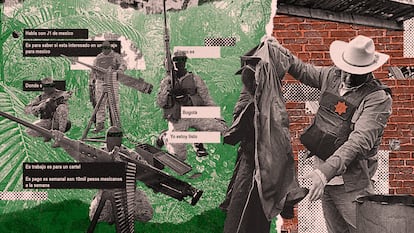
“The job is for a cartel, at least 40,000 Mexican pesos; in Colombian pesos, that’s 10 million a month. The minimum commitment is four months. The job is guarding the plaza (the local crime cell), ensuring no one interferes, and cleaning up those who do. Doing what the area command tells you to. Any questions?” This is how the job postings are advertised in a chain of messages to which this newspaper has had access. The recruitment of Colombian mercenaries — the vast majority of whom are aged between 22 and 42 — is done openly and through social media and messaging services like WhatsApp. “Oh, well, we’ll do it. I was in Ukraine, I haven’t been to Mexico before,” one person in the same group responds. “My friend, the company is providing the fares. The only thing you need to bring is the taxi fare, the bus fare, and the food. The company is providing everything, okay? It’s 48,000 pesos a month, with no food or sleeping allowance. It’s a cartel,” reads another conversation.
Recruitment, in any case, is far from spontaneous and goes beyond word of mouth. Mercenaries also rely on advice from some Colombian travel agencies. They explain to them what they should wear, tell them to take a carry-on bag, and what to say if they are detained by immigration authorities. Colombians do not need a visa to enter Mexico if they are traveling for tourism — the reason given by most, according to the sources consulted — although quite a few, when they run into trouble, admit they have come to “work” with the cartels.
Nearly 2,000 Colombians arrive in Mexico every day. The vast majority enter through an airport. More than 1,700 have been turned away since October 1, 2024 when Sheinbaum took office and Secretary of Security Omar García Harfuch took charge of a new strategy to combat crime, the new president’s primary hallmark. Some of those rejected have criminal records, and authorities have “convincing” evidence that many will join a cartel if allowed to enter Mexico. The most frequently used routes are those from Bogotá to Mexico City, both to the international airport (AICM) and the new Felipe Ángeles Airport (AIFA), and to Cancún. There is also another route, both inbound and outbound, from Europe: through Madrid, many coming from Poland after having fought in Ukraine.
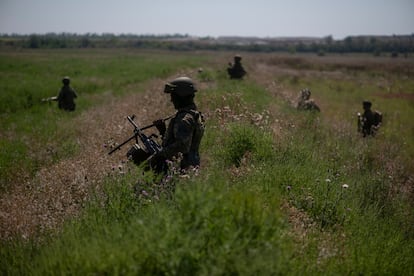
Several of the sources consulted agree that Mexican cartels, especially the CJNG, recruit Colombian mercenaries for their combat experience, that is, to train their hitmen in the use of military weapons, such as AK-47s, AR-15 rifles, and grenade launchers; in the manufacture of explosives; and in the placement of anti-personnel mines. “They actively operate in defense of the [criminal] groups, in the protection and maintenance of the towns,” says one of the sources. Another is more forceful: “The Colombians introduced a more warlike approach, with greater organization. Mexican drug traffickers are more of an ‘I’m a tough guy’ culture; Colombians are more strategic.” “These people don’t come to live here; most of them are ghosts. The problem is that they get paid better than in Europe, they stay for four months, and then they come back,” the same source asserts.
This phenomenon is exacerbating the lethality of organized crime in Mexico, already high due to the supply of military weapons to the cartels, 74% of which comes from illegal arms trafficking from the U.S. Official figures from recent years reflect the epidemic of violence. The highest peak was in 2019, when an average of more than 94 murders were recorded daily. Since then, the numbers have stabilized, with some undulations, at a very high level. Last year closed with more than 80 murders per day. The mercenary phenomenon, which is importing war practices such as explosive drones or anti-personnel mines, only qualitatively increases the threat of horror.
Through WhatsApp, former Colombian soldiers share photos and communicate constantly in groups with dozens of members. “Gentlemen, good evening, blessings, please stay home, no one on the streets, the government is raging all over town,” reads one of the messages this newspaper has had access to. “A mine went off, the cows set it off, but there are children nearby. Talk to the rancher and tell him not to send them there so there’s no accident,” states another.
Colombia has one of the best-trained armies in the world, with extensive experience in counterinsurgency, a result of the endless war against guerrillas and illegal armed groups in the country. “The level of training of the Colombian Armed Forces is very high and almost comparable to that of the United States,” explains Andrés Macías, a member of the UN Working Group on mercenaries.
Even with all this experience, thousands of soldiers retire after 20 years of service to face an uncertain future. Their retirement benefits are only about $650 a month, quite low compared to the salaries offered by mercenary networks and companies abroad or, in this case, by Mexican cartels, which can exceed $2,500, according to authorities’ investigations.
“El Güicho wants you dead”
On May 27, eight members of the Mexican army were killed in the municipality of Los Reyes, Michoacán, by a landmine planted by organized crime. Two days later, a military operation arrested 17 people, 12 of whom were Colombians: 10 of them were retired military personnel, most of whom had served for 20 years. The following were also seized: 15 AK-47 magazines; three AR-15 magazines; two Barrett magazines; and 941 rounds of ammunition of various calibers.
Los Reyes is a forested town that relies on avocados, which grow almost autonomously due to the ideal altitude and humidity. On the other side of the hill, the slope descends to reach the first town in Jalisco: La Loma. With barely a few hundred inhabitants, it is another of the war zones. The day everything went wrong in La Loma, a group of about 10 Colombian hitmen entered the afternoon Mass armed, and Father José Luis Segura threw them out of the church. They didn’t take it well and, upon leaving, told him to be careful, that from now on they would be watching what he preached. The next day, a shootout broke out over several hours at the door of the same church.
After that, they delivered a message: “El Güicho wants you dead.” Father Segura left after the threat from the “town boss.” During the three years he spent there, he saw how the situation was increasingly festering. The open war between the CJNG and a galaxy of small local gangs, associated under the Cárteles Unidos umbrella, is causing a rift in social ties, to the point where some parishioners interrupt him during his homily to scold him for speaking ill of this or that group. “Criminal customs are stronger than Catholic ones,” the priest says in a cafe in Apatzingán, about four hours by car from the town he had to flee.
The capital of Tierra Caliente is, for now, a refuge for this 64-year-old veteran priest, who has had to take a few months off due to the horror and panic it all caused. He says it was common to see corpses floating in the town’s stream, or bodies hanging from bridges. And the tip of the iceberg, for him, are the Colombian mercenaries. “They use force differently; they’re more brutal. Since they come without family or any ties, they can do whatever they want.”
Mexican authorities have sought support from their Colombian counterparts in the intelligence and security services, seeking assistance and a commitment that goes beyond good intentions, knowing that halting the flow of Colombians into Mexico is more than a migration issue, it’s a political one. However, according to information this newspaper has had access to, assistance has been virtually nonexistent. The prevailing feeling is that this is not a priority for Colombia. Gustavo Petro’s government is facing its final year with a rampant security crisis, where its commitment to total peace with the various guerrilla groups and organized crime has been shattered, giving way to a proliferation of violence. Only after the arrest of the 12 Colombians in Los Reyes, accused of murdering eight Mexican soldiers, did Petro declare that “mercenary activity must be prohibited and punishable by severe prison terms.”
Paramilitary training in an avocado orchard
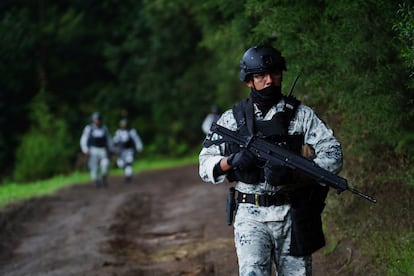
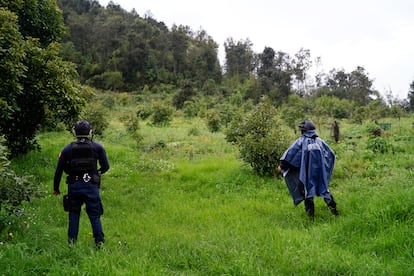
As he turns left, the mayor’s bodyguard adjusts his rifle between his legs and places his hand a little closer to the trigger. The patrol car has just left the highway and is moving along a narrow dirt road. The first drops of a light mid-afternoon rain are falling. The sun has begun to set, and the avocado forest is turning with each step into a dense, menacing, green labyrinth. Behind them are two more National Guard pickup trucks, each carrying three armed soldiers. From the passenger seat of the patrol car leading the way, the mayor gives an order over the internal radio:
— Everyone be alert because they may be here again.
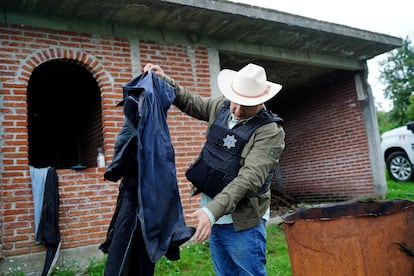
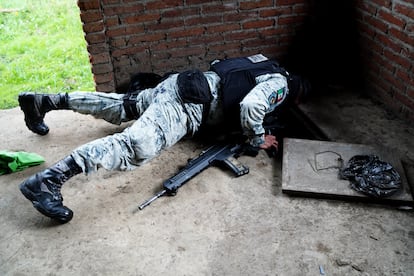
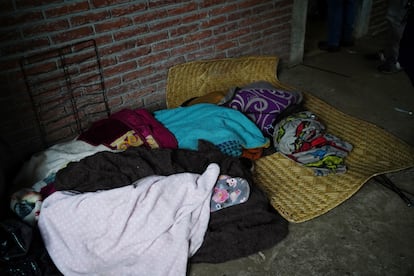
A month ago, a similar operation found an avocado orchard stuffed with high-caliber ammunition, AK-47 and AK-50 assault rifles, and military clothing bearing the CJNG logo. A farmers’ property had been converted into an organized crime training camp. When the police arrived, no one was there; they managed to escape through the green maze. “We couldn’t catch them because they’re organized; they see you with drones,” recalled Carlos Manzo, the mayor of Uruapan, the avocado capital of Michoacán, upon arriving at the exact location. Avocados are a business that generates some $3 billion a year and is another of the juicy profits organized crime is fighting over.
Although no arrests were made, videos of the camp were found on the cell phone of a suspect detained a day earlier. While the National Guard soldiers verified that everything was deserted, Manzo himself showed the videos to the EL PAÍS journalists accompanying him to demonstrate that the locations match. A recruit doing push-ups in front of the shack used as a kitchen. Another group practicing target practice next to some fertilizer sacks. The mayor also asserts that this camp, where remnants of military balaclavas and magazine holsters still remain, housed Colombian mercenaries.
The state government denies that such training camps exist in its territory. But the mayor insists: “We have evidence and complaints from citizens warning us of more places like this in the area. These are armed groups with war material. We have to be very brave to restore order.” This is very precarious in the hottest areas of Mexico, where the mercenary phenomenon is turning a seemingly endless spiral of violence into an increasingly lethal one.
With reporting from Diego Stacey in Bogotá
Sign up for our weekly newsletter to get more English-language news coverage from EL PAÍS USA Edition