
Ryan Wedding, the precocious Olympic snowboarder turned ‘king’ of cocaine in Mexico
The former Canadian athlete, accused of drug trafficking and murder north of the Rio Grande, has surrendered to US authorities
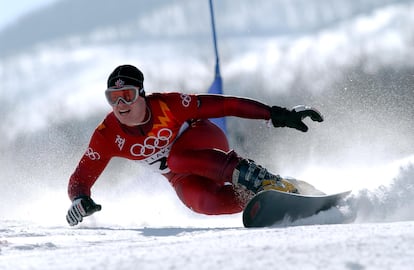

Few life stories today rival the fascinating and tragic tale of Ryan Wedding, a former Canadian Olympic athlete turned one of the Americas’ biggest cocaine traffickers. Tracked for years by U.S. authorities and on the FBI’s Most Wanted list, he was finally transferred to the United States by the FBI this Friday.
“The FBI Director left today for the United States, taking with him two priority targets: a non-U.S. citizen who was arrested by Mexican authorities and is one of the FBI’s 10 most wanted fugitives, and a Canadian citizen who voluntarily surrendered yesterday at the U.S. Embassy,” reported Mexico’s Secretary of Security and Citizen Protection, Omar García Harfuch, on his X account. In addition to Wedding, Harfuch referred to Alejandro Rosales Castillo, a U.S. citizen who, like Wedding, was one of the agency’s most wanted criminals.
Wedding is an enigma to sociology departments worldwide. A precocious snowboarder, he joined the Canadian national team at 15 and, at 21, competed in the parallel giant slalom at the 2002 Winter Olympics in Salt Lake City, Utah. Known by the aliases “King” and “James Conrad,” after a character in the 2017 film Kong: Skull Island, Wedding comes from a well-to-do middle-class family in British Columbia. After the Olympics, he began studying at a university in the Vancouver metropolitan area, a degree financed by his parents.
But his academic adventure lasted only two years, as Rolling Stone reporter Jesse Hyde, who has been tracking him since 2009, recalls. Drawn to the nightlife and the violent local crime scene of those years, and to the control of the marijuana market, Wedding began a career as a security guard at the city’s clubs and bars, while simultaneously setting up a massive marijuana-growing operation. In 2006, authorities seized his warehouses, plants, and equipment, and Wedding had to start all over again. After some ventures in the local real estate market, the Canadian moved into the big leagues of the drug trade and tried to break into the cocaine market.
In October, the Treasury Department announced sanctions against him and his support network. This network of individuals and companies includes a Canadian lawyer and jeweler, a former member of the Italian special forces, and a Colombian pimp who runs a prostitution ring in Mexico.
“Wedding, a former Olympic snowboarder for Team Canada [...] is an extremely violent criminal believed to be responsible for the murder of numerous people abroad, including U.S. citizens. Wedding remains a fugitive from justice, currently hiding in Mexico, where he continues to direct drug trafficking, murder, and other serious criminal activities,” the Treasury Department said in a statement. The reward offered for Wedding was between $10 million and $15 million.
The statement continues: “[Wedding] is responsible for trafficking multi-ton quantities of cocaine through Colombia and Mexico for distribution in the United States and Canada. His criminal organization uses cryptocurrency to move and launder the proceeds of drug trafficking, concealing vast sums of illicit wealth. According to the FBI,” the statement adds, “Wedding has ordered dozens of murders across the globe, including in the United States, Canada, and Latin America. He employs highly sophisticated methods in both the planning and execution of these killings, demonstrating a level of coordination and ruthlessness that has made him one of the world’s most dangerous fugitives.” U.S. authorities have charged Wedding with cocaine trafficking, murder, attempted murder, and racketeering, among other offenses.
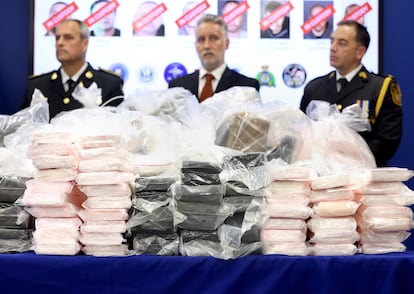
The Treasury sanctions involve freezing the assets of Wedding and nine other individuals and companies that form part of his alleged criminal operation. OFAC has listed a purported former Mexican security agent, Edgar Vazquez Alvarado, identified as the head of his security team. “Vazquez, also known as “the General,” provides protection for Wedding within Mexico and uses law enforcement sources to locate targets for Wedding. Vazquez is believed to be a former Mexican law enforcement officer with ties to senior Mexican law enforcement officials,” the statement said.
In addition to Vazquez, the list includes Wedding’s wife, Miryam Andrea Castillo Moreno, 34, originally from Nuevo León in northern Mexico; his “Colombian girlfriend,” Daniela Alejandra Acuña Macías, a 23-year-old whom authorities place near Morelia, Michoacán; an alleged Colombian associate of the Canadian, Carmen Yelinet Valoyes, who, according to OFAC, runs a high-end prostitution ring in Mexico City; Canadian lawyer Deepak Balwant Paradkar, who “introduced Wedding to the drug traffickers that have been moving Wedding’s cocaine and has also helped Wedding with bribery and murder”; Canadian jeweler Rolan Sokolovski; and former Italian special forces member Gianluca Tiepolo, the latter two being part of his money laundering network.

The activities attributed to each of them are varied. Miryam Castillo, his wife, is accused, for example, of “laundering drug proceeds for Wedding and has helped him conduct acts of violence.” Carmen Valoyes is accused of “assisting Wedding with the murder of a federal witness in January 2025” and of introducing the alleged crime boss to his girlfriend, Daniela Acuña. The witness in question was Jonathan Christopher Acevedo, a Colombian-Canadian man killed in Medellín, Colombia. Acevedo had served a sentence years earlier in Canada for drug trafficking.
The list goes on: OFAC also states that Acuña received hundreds of thousands of dollars from Wedding, knowing of his activities, and that she “assisted Wedding in obtaining information on his rivals.” Paradkar, the Treasury says, allowed “Wedding and his associates to eavesdrop on privileged communications between Paradkar and his other clients, several of whom Wedding wished to murder.”
Of his money laundering network, OFAC notes that Sokolovski, the Canadian jeweler, has “overseen bookkeeping for Wedding’s organization and laundered its funds through his jewelry business, which operates under the trade name “Diamond Tsar” and maintains a storefront in Toronto, Ontario. In addition to using his business as a front for laundering, Sokolovski has transferred millions of dollars in drug proceeds using cryptocurrency, concealing the origins of Wedding’s profits.” For his part, Tiepolo “worked closely with Sokolovski to procure and manage Wedding’s physical assets, including high-end vehicles,” such as a 2002 Mercedes CLK-GTR, valued at $13 million, which has been seized by the FBI.

Unfortunately for Wedding, one of his first purchases, monitored by the FBI in Southern California, went wrong. Authorities arrested Wedding and sent him to prison. It was 2008. The Canadian spent three years in detention, between San Diego and Texas, until the United States agreed to transfer him to Canada to finish serving his sentence. It seems that his years in prison in the southern U.S. served as a training ground for the trafficker, who, back in his home country, got back to work.
Sign up for our weekly newsletter to get more English-language news coverage from EL PAÍS USA Edition









































