
Cartels in Mexico take a leap forward with narco-drones: ‘It is criminal groups that are leading the innovation race’
Security experts detect a greater reach in the arms war of organized crime groups with the use of kamikaze-type drones and signal jammers against attacks from rivals
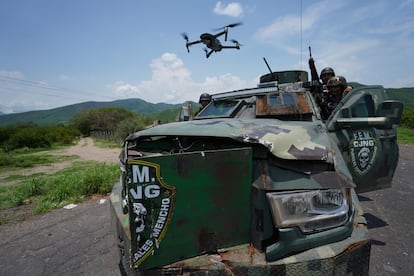

Organized crime is withstanding the onslaught from the Mexican government, which is feeling pressure from the United States to implement stronger measures in the fight against drugs. At the same time, they are fighting amongst themselves for control of their territories and businesses, leaving a trail of death among their ranks and the population caught in the crossfire. This has led to an arms race that transcends borders. Security specialists in Europe, the United States, and Mexico have detected that cartels have infiltrated their members into the Ukrainian frontlines, where they have received training to pilot remotely controlled drones, readily available in any store and capable of being adapted as kamikaze projectiles. In this way, drug cartels are incorporating low-cost combat strategies — which have proven to be a turning point in Kyiv’s resistance against Moscow — into their arsenal.
The use of low-cost, armed, autonomous flying vehicles in the conflict between Russia and Ukraine has leveled the playing field. Kyiv has managed to destroy Russian naval targets with this type of equipment in an attempt to compensate for the disparity in firepower between the two countries, and Ukraine has become a global center for tactical drone warfare training, which centers on everything from the artisanal manufacture and modification of the devices to mastering analog configurations, thermal camouflage, the use of various jamming techniques, low-altitude flight, and first-person view (FPV) piloting.
According to information published by The Intelligence, the FPV drone academies, associated with the Ukrainian Foreign Legion — a unit created by President Volodymyr Zelenskiy — were initially reserved for Ukrainian operators, but gradually opened up to foreign volunteers, predominantly of Mexican and Colombian origin. The report details that many of these recruits, according to data compiled by Interpol and the DEA, are suspected of having criminal records, ties to criminal organizations, or having belonged to narcoparamilitary militias in Latin America.
“There are difficulties in the investigation process on the Ukrainian side, which means it’s hard to track people entering the country, since not all Colombians and Mexicans fighting in Ukraine belong to an organized crime group. There’s a bit of both, and obviously the situation in Ukraine is difficult. But as for how they actually arrive, I’ve seen reports that this is happening through private military contracting companies. Much of this is based on reports and a bit of speculation from some sources,” explains Alexander Marciniak, Latin America intelligence analyst at the firm Sibylline, in a call from London.
According to data from the Center for Strategic and International Studies (CSIS), affiliated with Georgetown University in the U.S., one of the first documented cases of an armed drone in Mexico dates back to October 2017, when a commercial quadcopter equipped with an improvised explosive device was seized during a traffic stop.
Their uses have diversified, from drug and arms trafficking between border territories of Mexico and the United States, to surveillance of rival organizations or personnel in charge of border security. Steven Willoughby, director of the Unmanned Aircraft Systems Program Management Office at the U.S. Department of Homeland Security, has announced that during the last six months of 2024, more than 27,000 drones were detected within 500 meters of the southern border between Mexico and the U.S.
FPV drug drones
Since then, attacks using these types of drones have proliferated at an alarming rate. The Jalisco New Generation Cartel (CJNG), with a purported specialized unit of pilots known as the Mencho Special Forces, began operating drones originally designed for agricultural use. Later, they modified them to carry and launch explosive devices.
Henry Ziemmer, a research associate with the Americas Program at CSIS, explains that for drone attacks, cartels in Mexico typically use quadcopters equipped with explosive payloads that they can release while flying over their targets. These criminal groups, he continues, generally prefer military-grade explosives, such as hand grenades. However, seizures by Mexican authorities have revealed a large quantity of custom-made and homemade drone munitions, including specialized chemical charges.
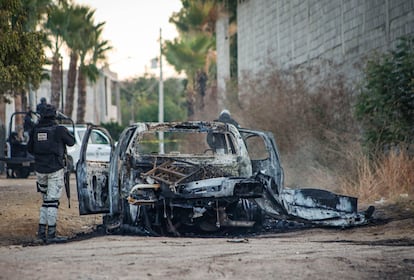
According to official information from Mexico’s National Defense Secretariat, 605 attacks using drones equipped with explosives were recorded between 2020 and mid-2023, with the highest incidence in the states of Guerrero, Michoacán, and Tamaulipas. These types of attacks have been on the rise: from five in 2020 to 260 in the first half of 2023. The CSIS details that of the 77 attacks using this technology that they were able to compile in their database in 2024, 16 targeted another criminal group, 41 targeted the civilian population, six targeted members of the military, and 14 targeted police officers. In May of this year alone, 32 attacks were recorded.
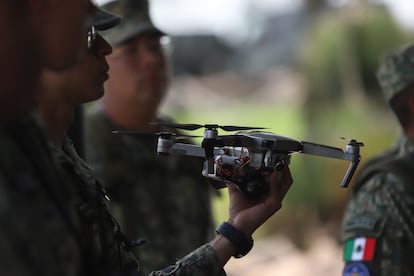
“Previously, if a cartel wanted to eliminate a rival’s leader, it had to invest a large amount of personnel and ammunition, sending them to where the leader was located. The reason this is so effective is because it’s very cheap. We’re seeing drones imported from China at quite low prices, equipped with improvised explosives,” Marciniak explains.
In contrast, armed FPV “narco-drones” typically employ an explosive that detonates upon contact with the target, hence the name “kamikaze.” These devices, which range in price from $400 to $700 — though many now opt for Chinese drones due to their lower cost — are fitted with galvanized steel tubes approximately 10 centimeters long containing gunpowder, pellets, or metal fragments such as nails or screws, which act as shrapnel. More advanced models are even equipped with C4 explosive charges. Autonomous flight allows for greater accuracy in overcoming obstacles and impacting structures.
Chinese technology for Los Mayitos
Just as the cartels have invested in technology for remotely attacking targets, they are also doing so to defend themselves along the border against unofficial reports of CIA drone overflights, as well as against the Mexican army and rival groups. David Saucedo, a security expert in Mexico, reveals that the Los Mayitos faction of the Sinaloa Cartel has invested in anti-drone technology from the Chinese brand Skyfend.
These devices function as signal jammers for portable drones. One of them resembles an assault rifle attached to a backpack that identifies the radio frequencies these aircraft use to communicate with their operators and for navigation. The system can disrupt these links, causing the drone to return to its origin, crash, or fall to the ground.
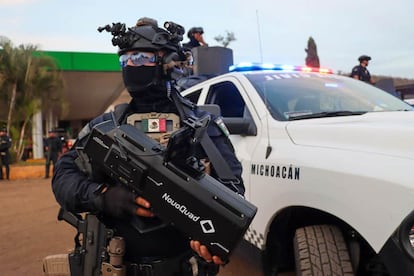
“This type of technology is not regulated in Mexico, and in the United States, where it is acquired, it is also not strictly regulated. Arms traffickers on the U.S. side acquire this equipment and sell it to drug cartels. Although these are military-grade weapons, their sale is permitted. Now, according to intelligence reports, they have begun acquiring not only signal jammers, but also radars for detecting drones and missiles to shoot down armed units,” Saucedo adds by telephone.
With the “Plan Michoacán” underway, following the assassination of former Uruapan mayor Carlos Manzo by organized crime, images have surfaced of the National Guard also using these types of drone signal jammers. However, according to Ziemmer, this has led the cartels to consider counteroffensives such as the use of “narco-drones” equipped with fiber optics. Another tactic straight out of the playbook of Russia’s war in Ukraine.
“In response to signal jammers, we’ve seen drones in Ukraine equipped with a cable, sometimes more than eight kilometers long, running from the controller to the device, meaning they can’t be jammed with electronic weapons. Although it’s still in its early stages, we’ve begun to see reports of this type of strategy in Mexico. Not because the Mexican government has improved its ability to jam these drones, but because the cartels themselves are improving their ability to jam their rivals’ drones,” Ziemmer states.
The CSIS analyst believes that many governments have not yet invested enough in drones and anti-drone equipment, giving criminals an advantage in their ability to challenge the state and carry out their illicit operations. “It is criminal groups that are leading the innovation race among themselves,” he concludes.
Sign up for our weekly newsletter to get more English-language news coverage from EL PAÍS USA Edition









































