
Abortion measures return to the ballot in US midterms
Three initiatives would establish or strengthen abortion rights, while one would impose new restrictions
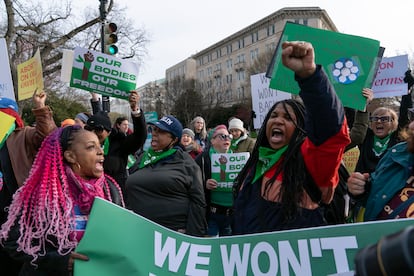

Since the U.S. Supreme Court’s June 2022 decision overturning Roe v. Wade, which had guaranteed a constitutional right to abortion, states have been responsible for regulating access to the procedure, with laws and policies put before voters. Since then, each election cycle has featured ballot measures in different states seeking either to expand or restrict abortion rights. The November 3 midterm elections are no exception. Four states have placed initiatives on the ballot to regulate reproductive rights through constitutional amendments and new legislation.
In Idaho, voters are weighing a measure that would establish a right to “reproductive freedom” and repeal the state’s strict abortion ban. In Missouri, Amendment 3 would impose a near-total abortion ban, with exceptions for rape, incest and medical emergencies. Meanwhile, voters in Nevada and Virginia will decide whether to enshrine abortion access as a constitutional right in their state constitutions.
“Ballot initiatives are a powerful tool for protecting and expanding access to abortion and other reproductive healthcare services, and we are seeing evidence of that in states across the country,” says Kimya Forouzan, senior state policy adviser at the Guttmacher Institute, a nonprofit organization that produces research and data on issues including abortion, contraception, unintended pregnancy and sex education, and advocates for sexual and reproductive health worldwide.
Following the Supreme Court’s 2022 ruling, abortion access has been a central issue in subsequent midterm votes and a recurring theme in candidates’ campaign speeches. In the 2022 and 2023 elections, voters in seven states that put abortion measures on the ballot voted to preserve or expand those rights. In the 2024 elections, 10 states put measures to ratify the right to abortion to a vote, and seven of them were approved.
Since 2025, however, public attention has increasingly shifted toward other concerns, such as the economy. Even so, the measures on the ballot this November 3 could prove consequential not only in Missouri, Idaho, Nevada and Virginia, but also in neighboring states where abortion access and reproductive rights are more heavily restricted.
Idaho: A vote for ‘reproductive freedom’
Proposition 1 on Idaho’s ballot would create a legal avenue to challenge the state’s total abortion ban by enacting a law that establishes a right to reproductive freedom and privacy, and would prevent the state from restricting abortion prior to fetal viability. It would also bar government interference in individual decisions about reproductive health care, including prenatal and obstetric care, labor and delivery services, contraception, fertility treatments and care after pregnancy loss.
The current law, approved in 2020 and triggered by the Supreme Court’s 2022 decision overturning Roe v. Wade, bans abortion except when necessary to save the life of the pregnant person or in cases of rape or incest. The procedure is classified as a felony, carrying prison sentences of between two and five years. Physicians and other healthcare providers who perform abortions can also face temporary or permanent loss of their medical licenses.
Under the existing ban, about 850 Idaho residents obtained abortions via telemedicine in 2025 through providers based in other states and operating under so-called shield laws, according to data from the Guttmacher Institute’s Monthly Abortion Provision Study. Another 1,680 people traveled to Oregon, Washington, Utah and other states to access abortion care.
“Idaho is the only state with a ballot measure to protect abortion rights that at the same time enforces a total ban on the practice; that ban would likely be challenged in court if the measure passes,” says Isabel Guarnieri, U.S. communications manager at the Guttmacher Institute. That means that, if approved, Proposition 1 would not amend the state constitution but would establish a statutory right to abortion in the state.
“While legal protections for abortion rights would represent a major advance for Idaho residents, ordinary laws are easier to repeal than state constitutional amendments,” Guarnieri adds.
Missouri: A vote for an almost-total ban
In Missouri, voters will decide on Amendment 3, a measure that would repeal the constitutional right to reproductive freedom approved by voters in 2024 and replace it with a near-total abortion ban. The proposal would also ban gender-affirming care for minors, which is already prohibited under state law. If approved, abortion would be permitted only in cases of medical emergency, fatal fetal anomaly, rape or incest, and minors seeking the procedure would be required to obtain consent from a parent or legal guardian.
“The measure would block public funding for abortion and allow the legislature to enact various unnecessary restrictions — known as targeted regulation of abortion provider laws — designed to increase oversight of clinics and make providing the service more costly and complex,” explains Guarnieri.
Thanks to voters’ approval of the measure in the 2024 midterm elections, a 2025 court ruling allowed abortion services to resume in the state. Another ruling, issued in June 2026, struck down restrictions that had prevented clinics from providing medication abortions since 2018.
Even so, Missouri’s abortion policies remain restrictive in several respects. For example, abortion services, including medication abortions, are not covered by Medicaid or private insurance plans. In addition, patients are required to be physically present to obtain abortion care.
Nevada: Ratifying the 2024 amendment
Nevada’s Question 6 seeks to ratify a constitutional amendment approved by voters in 2024 that would enshrine abortion rights in the state constitution, while still allowing restrictions after fetal viability.
In Nevada, constitutional amendments originating from citizen-led ballot initiatives must be approved in two consecutive elections before they can take effect.
The amendment would establish that the right to abortion cannot be denied, burdened or infringed unless doing so serves a compelling state interest, defined as “an interest which is limited exclusively to the state’s interest in protecting, maintaining, or improving the health of an individual who is seeking abortion care that is consistent with accepted clinical standards of practice.”
Nevada law already provides broad protections for abortion access. The procedure is covered by the state’s Medicaid program when deemed medically necessary, and the state has enacted shield laws protecting healthcare providers who treat patients from other states from investigations or legal actions initiated in jurisdictions with more restrictive abortion laws.
Virginia: Enshrining reproductive freedom in the constitution
Virginia’s Question 1 is a ballot measure that would enshrine the right to reproductive freedom in the state constitution, guaranteeing Virginians the ability to make decisions about prenatal care, childbirth, postpartum care, contraception, abortion, pregnancy loss and fertility treatment.
As in Nevada, the amendment seeks to protect patients, physicians and nurses from penalties related to those personal healthcare decisions or for helping others exercise those rights. At the same time, it would allow restrictions on abortion during the third trimester, except when the pregnant person’s life is at risk or the pregnancy is not viable, in line with current state law.
Virginia nevertheless retains a number of abortion restrictions. These include the exclusion of abortion coverage from the state’s Medicaid program and laws requiring parental or guardian consent for minors seeking the procedure.
Sign up for our weekly newsletter to get more English-language news coverage from EL PAÍS USA Edition









































