
Checks for voters, Trump’s strategy to turn the midterms around
The president has promised payments ranging from $90 up to $5,000 if Republicans keep control of Congress, but whether it is legal or even feasible remains questionable
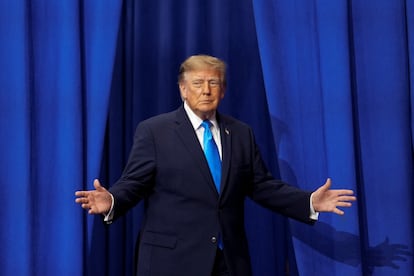

Donald Trump’s latest financial promise, a $90 check for people enrolled in Medicare, will be sent out in October to millions of older adults in the run-up to midterm elections that will decide control of Congress, with Republicans facing voter discontent over the president’s economic record.
The legislative elections have thus become a kind of referendum on the economic management of a president who in 2024 pledged during the campaign that, under him, Americans’ pockets would be fuller.
This is the third check that Trump has announced in recent weeks. First, in a pledge of dubious feasibility, the president said in September he would give $5,000 to every adult American if Republicans keep their slim majorities in the House and Senate after the elections.
The Administration also said in early October it would send a $500 payment to about 1 million people enrolled in coverage under the Affordable Care Act, also known as Obamacare.
These promises and announcements have drawn criticism for their timing during an election period, for the language the government has used to promote them and, in the case of the $5,000 check to every American adult, for doubts about their feasibility, since that is an enormous sum of money that would need congressional approval.
“I am pleased to announce that my Administration will, immediately, begin sending ‘Checks’ of nearly $100 to over 20 MILLION wonderful Seniors to help pay for their Medicare Part B premiums, which we have already reduced by significant amounts,” the president wrote on his Truth Social network. Medicare’s so-called Part B covers medical services to diagnose and treat medical conditions, as well as preventive services.
However, the check would not reach 35 million Medicare beneficiaries enrolled in private plans even though they also pay Part B premiums, KFF, an independent health policy organization, explained in an analysis.
The money would also not go far once you consider how much their premium will rise next year. “The standard Part B premium is $2,435 this year and will rise $79 next year, so that increase will eat up much of the $90 payment,” Juliette Cubanski, vice president and director of the Medicare Policy Program at KFF, said in the analysis.
The rising cost of health insurance
Although the increase in the cost of medical care services has been considerably more moderate than, for example, the jump in gasoline prices, official data do not capture how millions of households this year have had to pay much more each month to cover their health insurance premiums through Obamacare.
That is because, for some people, a pandemic-era tax credit that had helped them cover monthly premiums for several years expired in 2026.
For example, a 40-year-old earning $65,000 a year with insurance through Obamacare now pays a monthly premium of $477, compared with $316 before. Next year, they will have to pay $546 a month out of pocket, an increase of 41% in just two years, according to a KFF analysis.
Dissatisfaction with Trump’s economic management
Trump’s announced checks and promises come as nearly 75% of people described the country’s economic situation as poor in a poll published last week by the AP and the University of Chicago’s NORC Center for Public Affairs Research.
Even respondents who identified as Republicans disapproved — 57% to 42% — of the president’s handling of the economy in that poll.
Trump’s weak ratings — his disapproval stood at 69% — are mainly due to the persistent rise in the cost of living, above all the sharp increases in key areas such as energy prices amid the war with Iran.
Discontent over the financial situation threatens to translate into votes in the congressional contests on November 3. Republicans hold narrow majorities in both chambers that could flip if Democrats pick up a net four seats in the House and the same net number in the Senate.
Republican Senator John Kennedy of Louisiana sounded the alarm on Sunday in an interview with NBC News. “I think the biggest issue is cost of living. I think we have to tell the American people the truth. Telling them not to believe their own lying checkbooks is not going to work,” he warned.
The last presidential elections showed how crucial the economy is for voters. Many chose Trump, fatigued by the rapid rise in consumer prices in 2022 despite a significant slowdown by the end of Joe Biden’s administration, and amid a public perception that the economy was suffering despite strong macroeconomic figures.
The president won by promising to rein in prices. But since then the picture has been complicated by measures he has promoted himself, such as tariffs, and a war with Iran that has disrupted global crude supplies.
Sign up for our weekly newsletter to get more English-language news coverage from EL PAÍS USA Edition









































