Rural America tests the reach of the Democratic wave: ‘I’d like to see some political change’
As tariffs and the war against Iran push up prices, Iowan farmers are growing increasingly disillusioned with Trump. The agricultural state has become a crucial front in the Democrats’ effort to retake the Senate
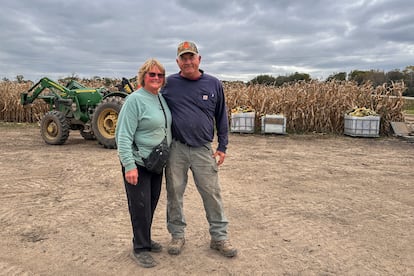

Tractors swarm across Iowa’s cornfields. Farmers are rushing the harvest before rains arrive and ruin their season. Chip Hoffman is among the lucky ones. He has already gathered nearly the entire crop from the family farm, which spans several dozen hectares. It’s Wednesday morning and the 66-year-old farmer is helping his older brother position a hopper to unload grain from the truck into the silo. “These are hard times. Fuel, insurance, even machinery repairs have gone up and they’re extremely expensive,” says Chip. He blames tariffs and the war with Iran for the surge in inflation and the squeeze on profit margins that has hit Iowa’s farmers.
What happens in Washington feels far removed from Chip’s farm. Conversations among farmers in the Corn State seem to pay little attention to Donald Trump’s excesses and outbursts. Nor do they appear particularly energized by the midterm elections, now less than three weeks away, despite Iowa’s status as one of the key battlegrounds in Democrats’ efforts to regain control of the U.S. Senate.
This is rural America: thousands of corn and soybean farms spread across a conservative-leaning region that voted overwhelmingly for Barack Obama nearly two decades ago. Today farmers are more worried about bills. Their lives revolve around costs and commodity prices. Everything else is secondary. And all their expenses have gone up: fuel, fertilizers, insurance, repairs and raw materials. It’s a source of great anxiety.
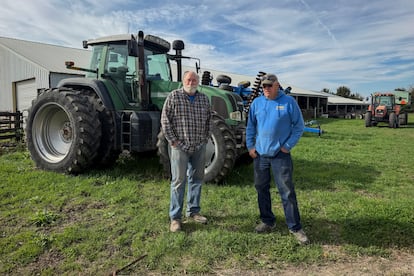
Chip Hoffman is a third-generation farmer. Now that his brother Charlie is retired, his daughter helps out from time to time. While he explains his situation, his wife stands a few meters away arranging orange pumpkins on a cart. Halloween is approaching, and they want to get everything ready. The farm sits on a narrow back road a little more than 18 miles from Cedar Rapids, Iowa’s second-largest city. Next to the freshly painted white farmhouse, there’s a shed full of tools and machinery. Several tractors and combine harvesters are parked on the outskirts.
Chip laments Trump’s tariffs, but he also believes the war with Iran is harming the economy, which is driving voters toward the Democrats in rural areas.
“I don’t think things will change much no matter what happens,” Chip says when asked about the midterms. He explains that running a farm is tough, especially after several years of high inflation. He doesn’t think this is the worst crisis they’ve faced, but admits: “Although past times were also hard, things were cheaper and life was more peaceful. Now everything is much more complicated.”
Ryan Marquart, another farmer, is not optimistic either. “Tariffs are a challenge,” he says from one of his two farms located a few miles from Van Meter, a small town in central Iowa. A large white dog watches the house but is more interested in playing with strangers than in keeping people out.
Marquart, 44, knows what he’s talking about. He’s a fourth-generation farmer. “When you farm, you plan over several years. You market last year’s crop, work with this season’s production and decide what you’ll do next year while starting to sell the following year’s harvest,” says the farmer, wearing rubber boots and a red T-shirt. “Tariffs and all the trade swings make planning harder. You simply don’t know how things will end up,” he complains as his son pokes his head out of one of the rooms in the house.
“Under the Biden administration we saw high input costs, but margins also rose. So there was room to plan. With the Trump administration it’s not like that,” he says.
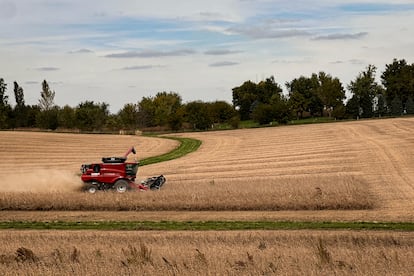
Matt Russell splits his time between his farm and leading Iowa’s farmers’ union. He says agriculture is in one of the worst recessions in decades. “American farming goes through cycles,” he explains. “It isn’t profitable every year. Sometimes you make a lot of money and sometimes you lose a lot. But this is not a normal cycle. It might have been a hard time anyway, but due to political decisions it has turned into a very serious recession,” he adds.
Russell is busy these final days of harvest and in the thick of the campaign season. “It’s a tremendous moment for Americans to decide in these elections whether to continue on the current path or make a change,” he says. But is change possible? “We’re seeing evidence in Iowa that more and more people are interested in achieving it,” he adds.
He is a fifth-generation farmer in Iowa and, although he lived for some years out west, he returned to continue the family tradition. He explains why farmers have so much influence: “When a farmer talks about what he’s doing with his vote or explains his analysis of the policy implications, other Iowans pay attention. So you know it’s not just the farmers’ vote; it’s Iowa’s rural vote.”
Russell acknowledges that farmers are increasingly speaking out and blaming the Trump administration for some of the policies affecting them. He wonders: “Will that affect the rural vote? I don’t think we know yet, but clearly a movement is underway. Polls are showing a shift toward the Democrats; that’s evidence. But will it be enough to change the election outcome? We’ll know in November.”
The vote Russell refers to is particularly important in Iowa, where nearly 37% of the population lives in rural areas, according to data compiled by the National Conference of State Legislatures (NCSL) from Census figures. Moreover, 64% of registered voters in the state live in rural communities, according to Rural Democracy Initiative data cited by the NCSL.
From swing state to Trump territory
Jamie Kuiper, 64, is also a farmer and takes life in his stride. He’s retired and has no mortgage payments hanging over his head at the end of the month. He recently became a grandfather, and that now is his only concern.
“I’d like to see some political change. Change isn’t a bad thing. The problem is that when the same people stay in office a long time, things simply don’t get done as they should. Sometimes when new people come in, change is more likely,” he says from his farm in Atkins, a few miles from Cedar Rapids. “And you don’t know whether the change will be for better or worse until it happens. You know, I’d like to see different people come in.”
Josh Turek is the Democrats’ pick to deliver the kind of change Kuiper is talking about. He is the party’s Senate candidate in Iowa and currently leads in the polls, although his advantage over Republican challenger Ashley Hinson has narrowed in recent weeks.
“This is a dangerous time to be an Iowan farmer,” Turek said during the campaign. “These tariffs are really decimating the commodities markets and you’re looking at Iowa soybean farmers that are upside down. And that’s only going to continue,” added the former Paralympic athlete who won two medals with the U.S. basketball team at separate Olympic Games.
The race is extremely close. That is why U.S. President Donald Trump recently announced that he will spend two days in Iowa in an effort to rally disaffected Republicans, in a last-ditch push to keep control of the Senate.
Another rising star of the Democratic Party in the state is Rob Sand. He is 44, tall and lean, with the kind of face that looks incapable of wrongdoing. He once worked as a model in Europe, but he dresses like a farmer, in plaid shirts and jeans. Some call him the Kennedy of the Midwest. Polls put him ahead in the race to become the next governor of Iowa, a state that has been solid Republican territory for more than a decade.
“The biggest problem we have today for agriculture is tariffs,” Sand told EL PAÍS in an interview. “The solution to that is to have representatives with the backbone to stand up from the start against the administration and the tariffs, and to speak about how harmful they are to the state,” he said at a campaign event with voters.
Iowa used to be a swing state until Donald Trump’s rise in U.S. politics a decade ago. Since then, Republicans have won three consecutive elections. “The western part is definitely different from the eastern part, and the way Iowa has always been is that if you’re close to the state’s large metropolitan areas, they vote differently than the rural area,” Kuiper says. “Although I have my farm, I’ve always worked in town, so I see things differently than a true farmer would.”
Kuiper’s farm has been in his family for 130 years and looks like a movie set. The barn and other red-painted buildings are well maintained. The neatness of the property is striking. “My great-grandfather bought the farm in 1895, then my grandfather bought it from him. My father did the same and so on. So now my daughter and her husband live there with our grandson. So my grandson will be the sixth generation.”
As Kuiper’s family shows, agriculture is the Midwest’s main economic engine. Iowa is known for its corn and soybean crops, as well as its pig farms. Throughout much of the 20th century, the agricultural sector went through repeated cycles of boom and bust, explains Jeff Bremer, a history professor at Iowa State University.
The worst crisis, without question, was the one that preceded the Great Depression at the start of the last century. But in the 1980s, agricultural prices collapsed, triggering a devastating downturn across rural America.
“High debt levels and high interest rates left farmers in crisis. Their incomes collapsed, as did the value of farmland. All this caused the great farm crisis of the 1980s,” Bremer recalls. “Depression, suicide and hunger were common. The farm crisis caused an economic collapse in small towns, which lost 41% of their gas stations and 27% of their grocery stores.” Back then, many people left the countryside. Iowa’s population declined. The situation is not quite as bleak today, Bremer says, “but it is quite challenging.”
The professor explains that “the price of corn and soy is low. Most farmers lost money in 2024 and 2025. High fertilizer consumption and high fuel costs will make it even harder. Debt is rising and export markets are down. Interest rates are also going up.”
However, he adds, unlike past crises, “farmland values haven’t fallen much. Most farmland in Iowa is paid off, and there is greater federal support for producers, with the Trump administration sending direct payments to farmers. But times are hard. Farm bankruptcies have increased.”
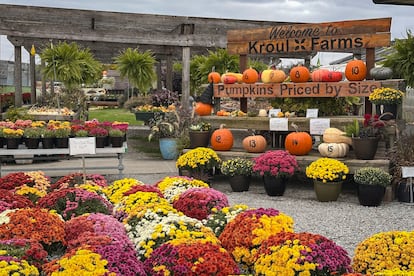
John Kroul’s farm is different. It has had to adapt because the property lies between the highway and the Cedar River. So, in addition to corn, he grows pumpkins, flowers and vegetables.
“The situation is not good. Our costs are too high, between diesel, fertilizers and repairs. Some wonder if there’s a crisis. We’re living in it. The average age of farmers is 65,” he says with a note of resignation. “I’m the third generation of farmers. My children will be the fourth, but it’s getting harder and harder,” he says as he loads a cart with pumpkins. “The season ends in two weeks. So we have to hurry.”
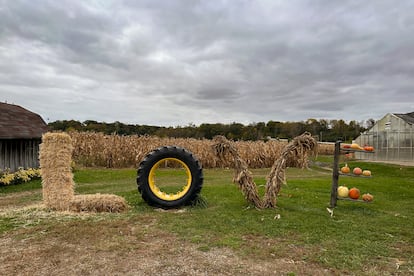
Kroul’s farm is getting by, but only just. He admits market prices for corn and soy aren’t bad; the problem is costs. “When you have to pay a million dollars for a new combine and then add the cost of fertilizer and fuel, you barely break even. That’s not the only problem. Then we have to pay $150 an hour for a mechanic to fix the tractors. We’re a medium-sized farm and those are the ones hardest hit because you can’t afford a larger machine since we don’t have enough acres. So you try to make small equipment work, but of course it needs a lot of repairs.”
Kroul is helped on the farm by his wife Charlene, who runs a stall selling various flowers, honey and other garden products. John is 68 and ready to retire, but he worries about the legacy he’ll leave his son. “Taxes are very high. I’d have to pay 40% of the value and I can’t afford that.”
When asked about the political climate and the Democratic wave that polls suggest is sweeping across the country, Kroul responds with the skepticism of someone who has seen it all. “It’s not going to change anything. I’m independent. But this is capitalism at its fullest. I believe the Democrats when they say money should be shared, but then they can’t give it away, so we go back and forth.”
Sign up for our weekly newsletter to get more English-language news coverage from EL PAÍS USA Edition