Moderate Republicans fear being dragged down by Trump’s unpopularity
Mike Lawler, one of the few Republican lawmakers in overwhelmingly Democratic New York, is trying to distance himself from the president in one of the key battles of the midterms

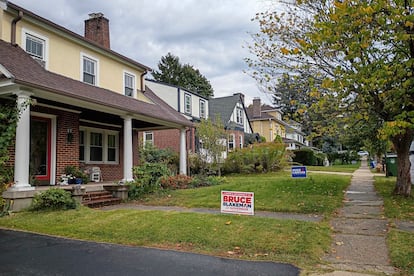
Dan Hanover has planted a sign in the front yard of his home in Tarrytown as if trying to ward off a curse. It bears just three words, “Mike Lawler for Congress,” but that is more than enough for everyone here to understand what it means: the retiree is determined to do whatever he can to help the Republican who represents this charming village north of New York City keep his seat in the House of Representatives after the November 3 election.
Above all, he fears that Democrats will end up controlling everything in a state where they already hold the governorship under Kathy Hochul, the mayoralties of the major cities and 19 of the state’s 26 seats in the House. “This is looking more and more like a one-party state. Someone has to offer an alternative. And that’s the Republicans,” Hanover says from his kitchen.
The 75-year-old retiree believes U.S. President Donald Trump is doing “a pretty good job,” especially compared with the “disaster” of his predecessor, Democrat Joe Biden.
The problem for Republicans is that Hanover’s positive view of Trump is not widely shared among his neighbors. In this part of the Hudson Valley, complaints about the high cost of living are constant, and many residents blame the Republican administration that came to power riding a wave of frustration over inflation during the Biden years.
The rising cost of living is complicating the efforts of Mike Lawler — a relatively popular politician — to hang on to his seat for another two years. Polls suggest a dead heat with his Democratic challenger, Army veteran Cait Conley.
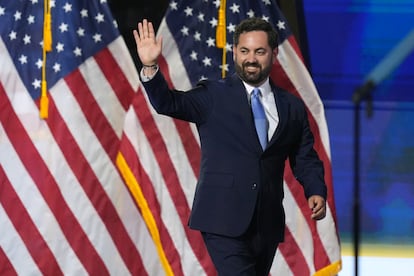
Mike Lawler, like other Republicans desperate to create some distance from the top of the ticket, is running a campaign defined more by what separates him from Donald Trump than by what binds him to his supposed political ally.
His district is a good barometer of the national mood. It was one of only three congressional districts in the entire country that, in 2024, elected a Republican to Congress while simultaneously voting for Democrat Kamala Harris for president.
“Do you pledge your allegiance to Donald Trump?” Lawler was asked during a debate.
“I pledge my allegiance to my constituents, which I always have. It’s why I’ve been rated among the most bipartisan and effective members of Congress. I’ve been praised by presidents of both parties, including Joe Biden and Donald Trump [...] My best friend in Congress is a Democrat,” he replied.
“I’ve clashed with the president on numerous issues,” Lawler said on another occasion, after Democratic candidate Cait Conley blamed him for the economic difficulties facing local families because of his support in Congress for Trump-backed measures. According to an analysis by Congressional Quarterly, the Republican voted in favor of legislation proposed by the president 94% of the time.
On Monday, Lawler did break with Trump over the war in Ukraine. In an interview with CNN, after footage emerged of the U.S. president blaming Ukrainian President Volodymyr Zelenskiy for the failure to reach a peace deal, the congressman responded: “Vladimir Putin, and Vladimir Putin alone, is responsible for this war.”
Perhaps because of what is at stake — it could help determine which party controls the House of Representatives — it has become one of the most expensive races in the country, with the two parties spending more than $40 million between them.
Each side is targeting the other’s vulnerabilities. Democratic ads highlight the ties between Donald Trump and Mike Lawler, while Republicans have closely scrutinized Democratic candidate Cait Conley’s links to artificial intelligence companies and have sought to associate her with the alleged antisemitism of Zohran Mamdani, the mayor of New York City.
Lawler’s difficulties are also affecting other centrist Republicans who fear being dragged down by Trump’s shadow. Among them is Senator Susan Collins, who is fighting to hold on to her seat in Maine by distancing herself from the Republican administration on issues such as the war with Iran, the sweeping tax package known as the One Big Beautiful Bill Act, which increased healthcare costs for many families, and tariffs on Canada.
“The president did not have a good plan,” Collins acknowledged during a debate last Tuesday.
A town split in two
Tarrytown has an unusual characteristic: it is split in two. One side of the town of 12,000 residents belongs to New York’s 16th congressional district, represented in Washington by a Democrat. But all it takes is crossing a street to reach the 17th District, represented by Republican Mike Lawler. Two ideologies sit side by side in this world of perfect lawns filled with professionals who spend their weekends mowing the grass.
Lawler says he has broken with Trump on issues such as lifting caps on tax deductions, extending temporary protections for Haitian migrants and expanding tax credits for health insurance. Taxes, immigration and healthcare are, in fact, among the issues that most concern residents of the Hudson Valley.
Faced with criticism over the excesses of Immigration and Customs Enforcement (ICE), local Republicans highlight crimes committed by immigrants in their campaign ads to underscore the need for tighter border controls.
“During Biden’s presidency, illegal entry got out of hand. Now, with Trump, there may have been some excesses, but the problem has been solved. Illegal immigrants have no place in this country,” says Hanover, the resident with the Republican campaign sign in his yard.
New York’s 17th District is particularly revealing because it shows how voting patterns shift depending on the makeup of local communities. Many residents moved here from New York City to escape increasingly unaffordable housing costs. As these generally more progressive families settled in the area, the district gradually became more Democratic.
The district’s diversity is evident from one town to the next. Home to about 780,000 people, it includes one of the largest Jewish populations in the United States as well as sizeable Haitian and Hispanic communities. Wealthy enclaves such as Chappaqua, home to Bill Clinton and Hillary Clinton, coexist alongside working-class communities.

People here are not fond of extremes. Lawler is a traditional Republican who steers clear of Trump-style bombast, while his opponent, Conley, is a centrist Democrat who highlights her military service, her support for Israel and her call to reform, rather than abolish, ICE — positions far removed from those of New York progressives such as Alexandria Ocasio-Cortez and Mamdani.
Peter Bartolacci is another Republican who lives in this landscape of family homes and manicured lawns. He is far from enthusiastic about the Trump administration’s performance, but says it was still the better option given the alternative.
“The Democrats haven’t presented a good candidate since Obama, whom I wasn’t a big fan of either. That’s when identity politics began, which hasn’t brought us anything good,” he says in his living room.
He is certain he will vote Republican on November 3. When asked if he likes what Trump is doing in Washington, Bartolacci answers with a line often used by former New York City mayor Ed Koch: “If you agree with me on nine out of 12 issues, vote for me. If you agree with me on 12 out of 12 issues, see a psychiatrist.”
Sign up for our weekly newsletter to get more English-language news coverage from EL PAÍS USA Edition