The White House tests its election playbook in California ahead of the midterms
The Trump administration’s latest offensive centers on claims that thousands of non-citizens are registered on the state’s voter rolls
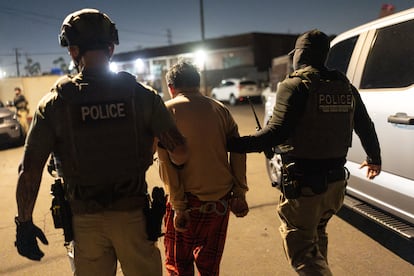

The Donald Trump administration dubbed it Operation Protect the Vote and on Monday focused its efforts on trying to substantiate the conspiracy theories promoted by the president and members of his administration: that large numbers of undocumented immigrants in California vote illegally for Democrats and that the state’s voter rolls still contain deceased individuals and people who have moved to other states. The charges announced, however, do not prove those claims.
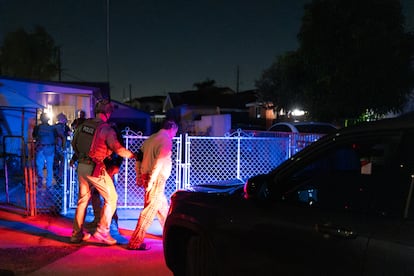
The operation resulted in the arrest of 11 people in cities across California, while another 17 were charged, bringing the total to 28. They are accused of illegally registering to vote and, in some cases, of actually casting ballots. The action forms part of a broader offensive against California election officials, whom the Department of Justice accuses, in a lawsuit filed on Thursday, of refusing to cooperate in verifying whether more than 20,000 non-citizens may be improperly registered on the state’s voter rolls.
The timing of the actions is particularly striking: they come just weeks before the midterm elections, amid concerns about possible interference by the Trump administration in a race that polls suggest will be an uphill battle for Republicans.
With the midterms so close, however, the Justice Department has little time to substantiate its allegations. Even so, state officials argue that the actions reinforce fears that Trump may seek to intervene in the upcoming elections.
“This is a sad, desperate attempt by Trump to use his politicized Justice Department to try to suppress California voters,” California Governor Gavin Newsom said last week in a post on X and in a statement.
In California, the quintessential Democratic stronghold, Republican candidates are swimming against the tide. In the race for governor, Republican Steve Hilton trails in every poll, including those commissioned by his own campaign. And in contests for the House of Representatives, Democrats are hoping to pick up five additional seats in California, a key part of the party’s effort to regain control of Congress following an unprecedented redistricting overhaul.
Beyond the administration’s latest actions, state officials have voiced a range of concerns, from the deployment of troops and federal agents at polling places to the seizure of ballots. Indeed, Newsom, who is widely seen as a potential presidential contender in 2028, has signed 13 new laws in recent months aimed at shielding the midterm elections from possible interference. Among the most significant is AB 282, which makes it a felony to seize ballots, voter registration records or voting machines before election results have been certified.
The Trump administration’s trump card, however, is Operation Protect the Vote. The president has repeatedly claimed, without providing evidence of widespread electoral fraud, that irregularities have favored Democrats and has pushed for stricter voting controls. Among the measures he supports is requiring proof of U.S. citizenship to register and vote in federal elections.
Trump has also questioned California’s electoral system, claiming that anyone can cast a ballot there, though that is not the case. In the days leading up to the state’s most recent primary elections, he described California’s voting process as “rigged” and “corrupt.”
Separating 20,000 ballots
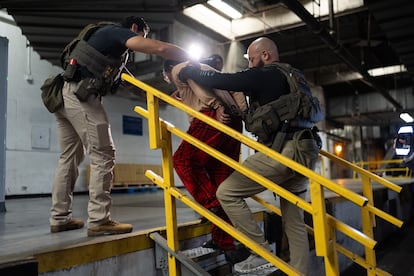
In Monday’s operation, a large contingent of federal agents took 11 people into custody in the early hours of the morning, while 17 others were charged with offenses carrying penalties of up to five years in prison. None, however, fit the profile described by Republicans: all are lawful permanent residents, or green-card holders, an immigration status that allows them to live and work in the United States but not to vote in elections.
To bolster the operation, the four federal judicial districts in California — Southern, Eastern, Central, and Northern — joined forces.
On a separate front, also on Monday, the Department of Justice’s Central District of California filed a motion for a preliminary injunction asking a federal judge in Los Angeles to set aside the ballots of the 20,000 individuals suspected of being on the voter rolls until their citizenship status can be verified.
“This Department of Justice will not look the other way while non-citizens vote in federal elections,” Deputy Assistant Attorney General Trent McCotter said at a news conference.
THIS MORNING IN CA: Acting Deputy Attorney General @PADAGMcCotter announces charges against 28 Foreign Nationals in California for election crimes.
— U.S. Department of Justice (@TheJusticeDept) October 19, 2026
"Today's charges demonstrate why that lawsuit [against CA over its voter rolls] is so important. The lawsuit is about preventing… pic.twitter.com/d0oIJ4sRFb
The 28 people charged on Monday, residents of communities across California from San Diego to San Francisco, are among the 20,000 voters under scrutiny by the Trump administration. “At least eight of these defendants allegedly voted more than once illegally, including some in the 2026 primary,” McCotter said.
However, the officials named in the lawsuit — Shirley Weber, California’s secretary of state, and Dean Logan, head of Los Angeles County’s election office — continue to refuse the Department of Justice’s demands. They argue that sufficient safeguards are already in place to verify voter eligibility and contend that the federal agency is violating a law that bars states from removing voters from the rolls during the 90 days preceding an election.
Fears in a Democratic stronghold
In the view of Bill Essayli, the U.S. attorney for Los Angeles, the arrests and charges announced on Monday are enough to confirm “what we have been warning about.” Following the primary elections, the official told conservative media outlets that California’s voter rolls included deceased individuals and voters who no longer reside in the state. He also argued that existing verification procedures are not enough to prevent undocumented immigrants from registering and voting. None of those claims has yet been substantiated.
“Almost anybody can register to vote in the state of California. You don’t have to have a Social Security number, and you don’t need a driver’s license number,” Essayli said months ago in an interview with conservative commentator Glenn Beck. Without offering evidence, he claimed that the state accepts a wide range of documents for voter registration, citing examples such as gym membership cards, prescription labels, workplace IDs and health insurance cards.
During Monday’s news conference, McCotter did not repeat those conspiracy theories but insisted that “California is mailing ballots to noncitizens, and they are refusing to comply with federal law.”
The cases against the 28 defendants came to light when they applied for U.S. naturalization, according to court records. During that process, prosecutors allege, they falsely claimed to be U.S. citizens or failed to disclose that they had registered to vote or cast ballots despite being ineligible to do so.
Among those charged is Omar Alexander Muñoz, a 72-year-old immigrant from Belize who lives in Commerce. He is accused of voting on four occasions in the 2020, 2022 and 2024 elections. Another case involves Butleng Taing, a 43-year-old Cambodian citizen and resident of Long Beach. Federal prosecutors allege that he illegally took part in the 2022 and 2024 elections.
Sign up for our weekly newsletter to get more English-language news coverage from EL PAÍS USA Edition