
Trump’s trade policies hit by rising cost of living
Affordability was a key issue in Mamdani’s mayoral campaign in New York City. The US president is trying to deflect criticism over rising prices for basic goods
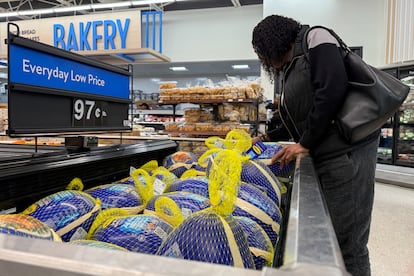

The affordability crisis has become a nightmare for millions of Americans who can’t make ends meet because grocery bills are prohibitive, because they cannot afford a home, because school fees for their children are overwhelming, or simply because they can’t indulge themselves. It is, moreover, a political issue that runs across U.S. politics, from California to New York, and also through Washington.
In an attempt to alleviate rising food prices, the White House signed trade agreements last week to reduce tariffs on certain food items, including coffee, bananas, and beef. But economists don’t believe it will be enough. “We estimate that the reduction in overall inflation would be minimal at best,” explains Bernard Yaros, head of economic analysis at Oxford Economics.
The cost of living is the top concern for nearly half of Americans (47%), according to a CNN poll published a week ago. Socialist candidate Zohran Mamdani championed affordability as the centerpiece of the groundbreaking campaign that led him to win the mayoral race in New York, the largest city in the United States, earlier this month. Mamdani promised to freeze rent in rent-stabilized apartments, make public transportation free, and create a network of public supermarkets. His fellow Democrats Abigail Spanberger and Mikie Sherrill won the governorships of Virginia and New Jersey, respectively, on the same day, appealing to the same issue despite representing different factions within the Democratic Party.
At the opposite end of the spectrum, the politician who became famous for firing workers on a television show was quick to react. Donald Trump initially dismissed the crisis, calling it a “hoax” and something the Democrats had invented. He then refused to comment on the matter when questioned by reporters, saying, “I don’t want to hear about the affordability, because right now we’re much less.”
The president then made his new perspective on the crisis clear on Truth Social, his social media platform: “2025 Thanksgiving dinner under Trump is 25% lower than 2024 Thanksgiving dinner under Biden, according to Walmart. My cost are lower than the Democrats on everything, especially oil and gas! So the Democrats “affordability” issue is DEAD! STOP LYING!!!"
Economists agree that the dinner offered by Walmart may be cheaper than last year, but that’s because it contains fewer items.
The affordability crisis, or the high cost of groceries, is not a new problem in the United States. Trump hammered this issue against his predecessor, Joe Biden, during the last term. It was one of the three pillars of the campaign that brought him back to the White House, along with tariffs and immigration. But now the issue has backfired. It has given momentum to the Democrats and is angering many Americans who are disillusioned with the Republican economic agenda.
Trump’s tough trade policies, with sweeping tariffs on all countries, are fueling the price spiral. The latest official data shows that grocery prices rose 3% in September, the largest increase since January. Although inflation is more controlled than expected, it continues to strain household budgets.
Affordability has suddenly become a central political issue, explains Paul Donovan, chief economist at investment bank UBS. “People are angry about the loss of affordability, and are inclined to blame incumbent governments for this.” This economist, a boxing fan and apple grower, explains that affordability is subtly different from the cost-of-living crisis. It includes rising prices. “The sentiment ‘I cannot afford that’ is central to anger,” he elaborates.
“Affordability is a recurring theme in American politics,” adds Yaros. “Healthcare subsidies were central to the government shutdown, and the possibility of a 50-year mortgage was raised as a way to improve access to housing.”
While inflation is a general increase in prices, affordability typically refers to specific, high-value expenses, such as buying a home or a car. “Affordability also includes a certain aspiration. People want things and get frustrated when they can’t afford them,” Donovan continues. Affordability can be a problem even when the overall inflation rate is kept under control.
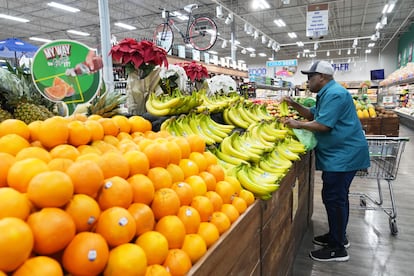
The approach of Thanksgiving and Christmas does little to quell the debate. November and December account for a disproportionate share of retail spending in the United States. The weeks leading up to the end of the year represent a considerable portion of all households’ annual spending. More than 20% of credit card spending on general merchandise, electronics, and clothing is concentrated in those two months, according to Bank of America. “Consumers spend more in stores, but get less, and may opt for lower-quality services,” explain analysts at the institution.
The debate intensified when Trump decided to demolish the East Wing of the White House to build a lavish ballroom, complete with marble and sumptuous furnishings. He has also frequently spoken about renovating the bathroom in the Lincoln Bedroom, in the presidential residence, with gold ornaments and marble. His penchant for ostentation and luxury does nothing to help the broader debate about the cost of living.
So he has decided to go on the offensive. His team of advisers admits that he is devising a strategy to try to regain the initiative on this front, according to various U.S. media outlets. “I have asked the DOJ [Department of Justice] to immediately begin an investigation into the Meat Packing Companies who are driving up the price of Beef through Illicit Collusion, Price Fixing, and Price Manipulation,” Trump wrote last week on Truth Social.
The president has also closed trade agreements last week with Argentina, Ecuador, El Salvador and Guatemala that will allow him to lower the price of coffee, bananas, beef and other foods.
Controlling the situation, however, does not seem straightforward. Housing prices and rents have skyrocketed in the country’s major cities, where it is difficult to find apartments for less than $2,500 a month. The cost of groceries has continued to rise at supermarkets. Even the cheapest, like Costco, are now more expensive than a year ago. A survey by The Washington Post, ABC News, and Ipsos revealed that the majority of Americans say they are spending increasingly more on food and utilities.
Consumer confidence in the United States fell last week to its lowest level in three years. Delinquency rates on auto loans among high-risk borrowers reached their highest level since 1994, according to data from the Fitch ratings agency.
The six-week federal government shutdown — the longest in history — and tariffs have hit Americans’ wallets hard and highlighted the country’s growing inequality. “Large gaps persist between spending and wage growth between higher- and lower-income households,” concludes a Bank of America report published last week. “Higher-income households saw 2.7% YoY [year-on-year] spending growth in October, lower-income groups lagged at just 0.7%.”
In addition, nearly 1.4 million federal workers went 43 days without pay due to the administrative gridlock between Republicans and Democrats over the budget extension.
It’s a precarious situation because one in four Americans admits to living paycheck to paycheck, according to Bank of America. A recent survey from the institution shows that 24% of households spend more than 95% of their income on basic necessities, leaving little or nothing for other expenses such as dining out or going on vacation, let alone buying a house.
Trump is “in real trouble and I think it’s bigger than just cost of living,” Lindsay Owens, executive director of Groundwork Collaborative, a progressive economic analysis group, told the AP.
Sign up for our weekly newsletter to get more English-language news coverage from EL PAÍS USA Edition









































