‘Temu level shit’: Why Trump’s White House makeover has outraged historians and experts
The US president is carrying out the biggest change to the presidential residence since Harry S. Truman, and many see his mammoth project as a symbol of his policies
After Trump’s inauguration in January, the curators of the White House art collection embarked on a peculiar treasure hunt through the residence’s inventory of decorations and furniture. Gold — Trump wanted gold, and among the various candelabras, vermeil figures, and other gleaming objects they showed him, Trump himself later handpicked the pieces he liked most for the Oval Office.
But that was not enough. A month later, in February, images of his tense meeting with Ukrainian President Volodymyr Zelenskiy revealed that he had replaced the famous Swedish ivy, which had adorned the fireplace mantel for decades (one of the White House’s symbols), with nine pieces from the antique collection: five gilded silver ornaments gifted to Eisenhower; two Empire-style baskets from Nixon’s era; and two gilded bronze centerpieces commissioned by James Monroe, the fifth U.S. president, from Parisian goldsmiths.
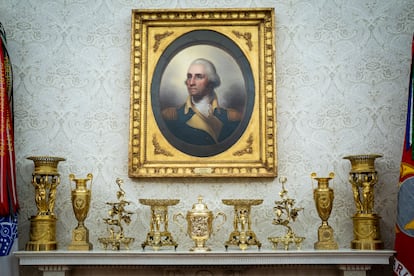
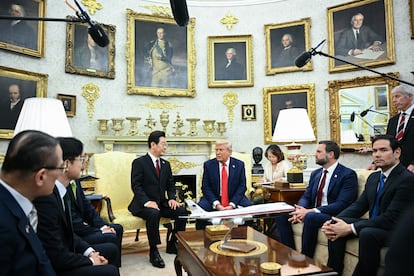
As seen that same day, Trump also ordered golden mirrors to be moved into his office and increased the number of portraits of his predecessors that Biden had displayed — after all, the frames were gilded too.
But when, only two months later, Trump received the Israeli president in the Oval Office, no historian could identify the garlands suddenly adorning the fireplace. As the Wall Street Journal eventually discovered, Trump had commissioned them from John Icart, the same Florida cabinetmaker he had hired to decorate his opulent Mar-a-Lago mansion. Icart was sent from Florida to Washington aboard Air Force One following yet another presidential bout of horror vacui.
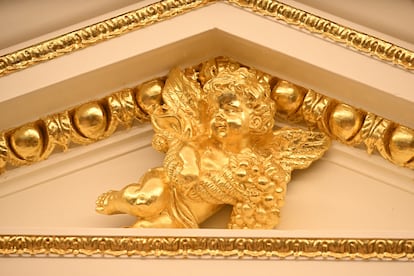
“It needed a little life,” Trump explained shortly afterward on Fox News, showing off some cherubs he had also added to the office.
The gold rush
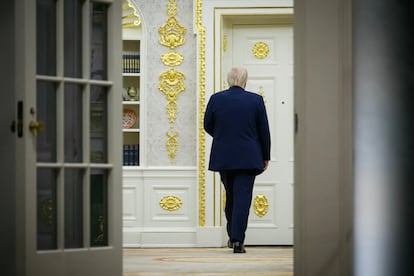
The president’s team of gilders has been very busy ever since. In a meeting Trump held again this summer with his Ukrainian counterpart, the garlands on the fireplace had spread to the walls, while moldings that were previously white had been turned gold. The same transformation has begun in other spaces, such as the Cabinet Room, which was renovated like the Oval Office in what Trump considers a symbol of this “Golden Age” he promised in his inaugural address. “It’s really become quite a beautiful place,” he said about the Cabinet Room during a meeting with Cabinet members.
Later, he asked them what they thought of the new gold ceiling moldings, and although it’s not known what they told him, many of his fellow citizens have been more than happy to answer.
Interior designer David Netto, for example, described the newly gilded Oval Office as “a Ceaușescu hell,” while fashion expert Derek Guy mocked the amorphous look of the cherubs above the doors when viewed up close. “Temu level shit,” he wrote in one of his viral posts on X.
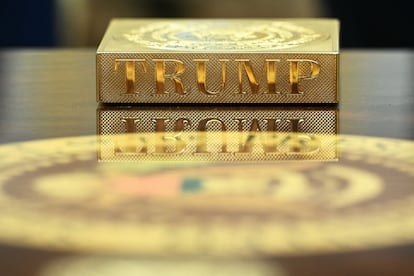
Examining the desk where Trump usually receives his guests, other X users discovered gold coin-shaped coasters engraved with his surname in capital letters (produced by a luxury money holder manufacturer from Las Vegas). And while the opulent moldings are supposedly from Trump’s cabinetmaker’s workshop, their design is almost identical to ones sold for $5 on Alibaba.
The cranes arrive
It’s not as if Trump’s predecessors lacked a taste for whimsical interiors. In the late 19th century, for example, president Chester Arthur filled the building with luxurious Tiffany glass screen, and the costly redecoration carried out by Nancy Reagan — who commissioned a total of 4,370 porcelain pieces for the residence during the 1981 economic crisis — was already criticized in its day.
However, what some call Donald Trump’s “gilt-y” or “deplorablecore” style is about to reach quite unusual proportions. On Monday, demolitions began in the East Wing of the White House, where the grand ballroom promised by the president in August will be constructed — a building of 88,000 square foot with a capacity of over 650 people. Back in 2010, when he wasn’t even a candidate yet, Trump had offered it free of charge to then-president Obama, so there would be a suitable space for state dinners and similar events (currently, the main dining room accommodates fewer than 200 people, which in practice usually means events are held in large tents).
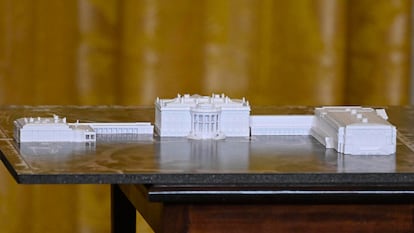
For now, the coffered ceilings, columns, and gilded chandeliers in the space (very similar to the Mar-a-Lago ballroom) exist only in the project renders, but many experts have already expressed concern over what will, whether people like it or not, be the largest architectural change the White House has undergone since president Truman, who demolished most of the interior to renovate it.
“I know our president is fond of superlatives, and this is a superlative. There’s never been anything like this before — absolutely not. This dwarfs everything that has ever been done on that property before,” said Edward Lengel, former chief historian of the White House Historical Association, in August on an NPR program, lamenting the disproportionate size of an annex that will break the harmony of the complex as it “rivals the size of the presidential mansion itself.”
The project will cost $250 million, and since Trump wants to inaugurate it before leaving the White House in 2029, he has skipped the usual consultations normally required for such extravagant projects. The president had promised that no existing structures would be altered, but photos of the construction show that cranes have already torn down part of the East Wing.
“It’s more than putting a little gold leaf on the fireplace of the White House,” historian John A. Lawrence, former chief of staff to Democrat Nancy Pelosi, told The Washington Post. “It’s really sending a message of a monarchical, autocratic concept of what the job is and what his role is.”
Jackie’s garden
It’s not the first time this year that Trump has shown himself to be less nostalgic for the past than might be suggested by his Beaux-Arts-style ballroom — a historic style that, along with other neoclassical designs, he has ordered to be preferred for federal buildings. In August, he signed the executive order called “Making Federal Architecture Beautiful Again” to promote these classical styles and eliminate “brutalist” or modern architecture.
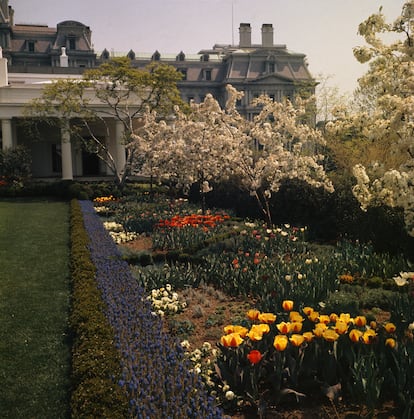
While announcing his ballroom, Trump said he adored the White House design, but in this second term the president has already altered one of the most emblematic spots on the grounds: the former rose garden, created in the 1960s by gardener “Bunny” Mellon, now transformed into what could pass for a cement square.
Opened last April to coincide with the announcement of his tariffs on the world, the courtyard on the paved-over lawn is again modeled after the one at Mar-a-Lago (decorated with the same umbrellas and outdoor chairs), though on social media it has also been compared to the patio of a Panera Bread café on a college campus.
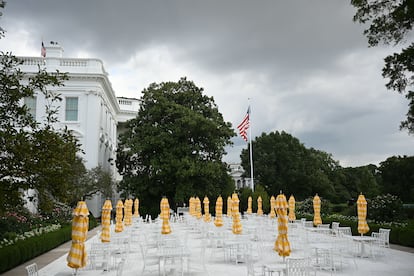
More than a renovation, many Americans consider the decision to pave over the lawn an outright sacrilege — an opinion that makes more sense when one remembers that the rose garden was one of the few remnants of Jackie Kennedy’s era, credited with what is still regarded as one of the finest periods of White House interior design.
In 1961, horrified upon moving in and discovering that the residence looked as if it had been “furnished by discount stores,” the then-first lady created a committee of fine arts experts and began restoring the building’s historical character. She repurchased some of the furniture that had belonged to previous presidents (before Jackie, White House furnishings were not protected and were often sold at auction) and persuaded families who had inherited pieces to donate them back. It was Jackie Kennedy, for example, who recovered the exquisite Bellangé chairs that president Monroe had commissioned in 1817 for the Blue Room, and who ordered the placement of the famous oak Resolute Desk in the Oval Office — a gift from Queen Victoria to president Rutherford B. Hayes — which has since been used by most presidents.
Her ambitious restoration was widely admired. In February 1962, more than 80 million viewers watched the guided tour Jackie recorded for CBS, a program that cemented her reputation as a woman of exquisite taste and earned her an Emmy.
“Everything in the White House must have a reason for being there,” Jackie explained to Life magazine at the time. “It would be sacrilege merely to redecorate it — a word I hate. It must be restored, and that has nothing to do with decoration. That is a question of scholarship.”
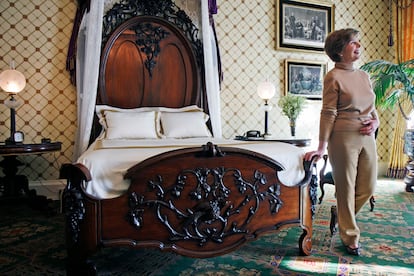
The same philosophy later guided Laura Bush when she oversaw the restoration of the Lincoln Bedroom, refurnishing it with pieces from Lincoln’s era based on historic photos and documents. In 2009, the Obamas updated the White House collection with paintings by American artists from the second half of the 20th century, such as Edward Hopper, Ed Ruscha, and Jacob Lawrence, the first African American artist whose work was acquired by The Museum of Modern Art (MoMA). They also broadened what was considered historic or traditional in the residence by including ceramic pieces of Native American art.
With Trump, however, it’s all about gold.
Sign up for our weekly newsletter to get more English-language news coverage from EL PAÍS USA Edition