
Chicago, the heart of the rebellion of Democratic cities against Trump
The metropolis in the state of Illinois, where Barack Obama was forged, is rebelling against the deployment of National Guard troops ordered by the White House
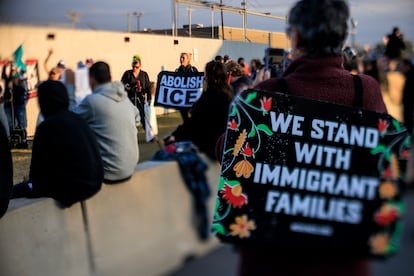

The grim Immigration and Customs Enforcement (ICE) detention center at the entrance to Broadview, a small, predominantly African American town about 15 miles southwest of Chicago, has its entrances blocked by concrete blocks and metal fences. Dozens of police vehicles surround it. This huge dark brick block, where detainees report deplorable conditions and where National Guard soldiers were deployed on Thursday, is the focus of protests in the metropolis against Donald Trump’s policy of mass deportations. These protests have made it a symbol of resistance by Democratic cities against the president’s attempts to control them with troops.
Olegario Gomez, according to his wife, is one of the undocumented immigrants inside, detained on Thursday as he left his home during one of the mass raids that ICE has been carrying out in Chicago and its surroundings in the so-called Operation Midway Blitz since the US president gave the green light a month ago to the deployment of agents from that agency in the self-proclaimed sanctuary city. Gómez, according to his wife, who went to Broadview to see him on Friday, has a broken arm from the struggle, but has not received treatment.
Gómez and other detainees awaiting transfer to other centers complain of poor sanitary conditions, overcrowding, freezing temperatures, and minimal access to medical services. “They have to sleep on the floor because they don’t have beds, and they don’t give them blankets for the cold. My husband is not a criminal, he is a worker who has been here for twelve years, who pays taxes and has never had any problems with the law,” she said.
Since the start of Operation Midway Blitz, in which more than a thousand people have been detained, protests have been held every day in front of the Broadview center. ICE agents have cracked down on them with increasingly drastic methods, including the use of pepper spray and tear gas, even shooting a Protestant pastor in the head who was participating in demonstrations to denounce the agency’s excesses. These excesses include the shooting death of an immigrant and a helicopter raid on a family housing building in the middle of the night.
Chicago is one of the Democratic cities, along with Portland, Washington, Memphis, and Los Angeles, against which Trump has ordered the deployment of the National Guard in a power struggle for control of its streets. The National Guard is a military reserve force, usually under state command, but which the president can mobilize in emergencies—a natural disaster, for example—with the permission of the governor of the affected state. In the five cities—Trump threatens that there may be more in the future and has mentioned Baltimore, New Orleans, and St. Louis—he falsely claims that the violence, whether generated by a wave of common crime or by protests against his immigration policy, is such that the deployment of this force is essential, even if the governors oppose it.
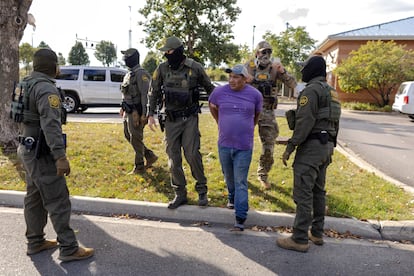
Trump describes Chicago as a war zone, a lawless city in decline, consumed by problems. His animosity is personal: Cook County, where the city is located, voted 70% for Kamala Harris, his Democratic rival, in 2024. It was on its multicultural streets that his great political enemy, his predecessor Barack Obama, trained as a community organizer and then as a politician.
Time and again, Trump has lashed out against Chicago, claiming, going against available evidence, that Chicago has more crime that anywhere else in the world. After threatening to do so since August, he finally ordered the deployment of the National Guard there a week ago. Nearly 500 soldiers from this local force, along with those from Texas and California, were activated on Thursday.
But Chicago and its state, Illinois, have responded strongly. Their authorities, along with those of Portland and Oregon, have taken the deployments to court and obtained a temporary block on the mobilizations. On Thursday, as those soldiers began operating at the ICE center in Broadview, District Judge April Perry imposed a ban on the deployment for a minimum of fourteen days.
Senator Tammy Duckworth, who on Friday unsuccessfully attempted to gain access to the ICE facility in Broadview, denounced the Republican administration for “trying to normalize the presence of troops on our streets, across this great nation.” “They’re trying to normalize an extension of presidential power. That is not appropriate under the constitution,” she insisted.
For Zuli, a 25-year-old telecommunications worker born in the United States but also of Mexican descent, Trump’s order to deploy ICE agents first and then the National Guard is nothing more than “pure racism.” “They stop us and question us simply for speaking Spanish, for the way we look,” denounces this participant in the Broadview demonstrations vehemently. “Donald Trump said they would detain and deport the worst of the worst, the criminals, the sexual predators, but the ones they’re taking away are workers, tamale and corn vendors, people with no criminal record, people like my friend, who came here as a child, without papers, but who has lived here her whole life, and now they’ve taken her away.”
In areas with large Hispanic populations, such as La Villita, a working-class neighborhood that was initially home to Polish and Ukrainian immigrants and where a large Mexican arch now welcomes visitors, that nervousness is palpable. Groups of citizens have organized to report the presence of ICE vehicles on social media and document the detentions. Restaurants promising “fish like in Mexico City” and businesses with signs in Spanish report a decline in customers worried about the possibility of being caught in a raid.
One of the fears in these areas is that, following the court setbacks against Trump’s orders, ICE will intensify its raids. Homeland Security Secretary Kristi Noem said Thursday that her department will purchase more buildings in and around Chicago to use for its operations. “We’re going to not back off. In fact, we’re doubling down, and we’re going to be in more parts of Chicago,” she warned.









































