
Trump’s battle with Democratic cities intensifies as National Guard arrives in Chicago
‘If the governor can’t do the job, we’ll do the job’ said the US president
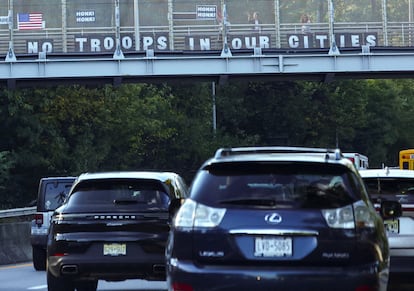

The Texas National Guard has been in Chicago since Tuesday, despite the staunch opposition of local Democratic authorities, led by Illinois Governor J. B. Pritzker. This marks a new escalation in the confrontation between Democratic-run cities and U.S. President Donald Trump, who has ordered troops deployed to the streets and even spoke of the prospect of using the Insurrection Act.
Around 100 Texas soldiers are now stationed in Chicago, and a second contingent of roughly 100 troops is expected to arrive during the day. Their arrival comes after Trump threatened on Monday to resort to the 19th-century Insurrection Act if courts ultimately block his effort to mobilize the National Guard wherever he wants. Speaking from the Oval Office — where he met Tuesday with Canadian Prime Minister Mark Carney — Trump reiterated his determination to deploy the troops to Chicago despite Pritzker’s protests: “If the governor can’t do the job, we’ll do the job,” he said.
In his remarks, the president declined to specify whether he intends to formally invoke the 19th-century law, which would grant him extraordinary wartime powers. “It’s been invoked before,” Trump said. “If you look at Chicago, Chicago is a great city where there’s a lot of crime, and if the governor can’t do the job, we’ll do the job.” The last time the Insurrection Act was used was in 1992, when it was applied to quell the major riots in California after a court acquitted the police officers who had brutally beaten Black motorist Rodney King.
Trump is locked in a political standoff with Democratic cities, where he has deployed or seeks to deploy National Guard troops on the grounds that violence — whether criminal activity or street protests against his hardline deportation policies — is out of control and can only be stopped by radical measures. Democratic states and cities counter that the protests taking place do not substantially disturb public order and that crime in their jurisdictions has fallen after the rise during the COVID-19 pandemic.
The battle, in which neither side shows signs of backing down, will almost certainly end up before the Supreme Court. Lower-court judges already warn that the case could affect the very pillars of the U.S. democratic system: separation of powers, the division of competencies between the federal government and the states, and an entire body of legislation that prevents the country’s armed forces from acting against its own citizens.
Since June, Trump has ordered National Guard deployments in five cities. In the first, Los Angeles, he cited protests against his deportation policy to mobilize as many as 4,800 troops from the Guard and the Marine Corps despite objections from California Governor Gavin Newsom. About 300 of those forces remain there.
In August, he activated up to 2,800 troops in Washington, where they are still deployed. In September, he followed with Memphis, Tennessee. Ten days ago, he sought to mobilize several hundred troops in Portland; this past weekend, he ordered the deployment to Chicago. He has also mentioned cities such as San Francisco, Baltimore, New Orleans and St. Louis as other potential targets.
Institutional showdown
The National Guard is generally under the command of each state. The president can mobilize it in emergencies, such as natural disasters, but requires the governor’s permission — except in cases of the utmost gravity. Invoking the Insurrection Act by declaring the existence of an armed uprising against the government would grant Trump these powers.
This past weekend, a Trump-appointed federal judge in Oregon, Karin Immergut, blocked the deployment of National Guard troops for at least two weeks while a court determines the legality of the presidential order. The judge noted that, by issuing the mobilization directive, Trump had overstepped his authority and violated laws prohibiting federal forces from performing local police duties. She also expressed the view that Trump may have breached the Tenth Amendment of the Constitution, which limits federal power in favor of the states.
In a show of force, representatives of the Trump administration traveled on Tuesday to Oregon and Illinois — the states most resistant to the president’s plan — to signal that the government does not intend to back down despite court rulings against the deployments. Homeland Security Secretary Kristi Noem went to Portland, where a judge has temporarily barred the National Guard deployment, while the FBI director, the federal police, and Deputy Attorney General Todd Blanch flew to Chicago.
Sign up for our weekly newsletter to get more English-language news coverage from EL PAÍS USA Edition









































