
The Insurrection Act: How it has been used before and why Trump wants to invoke it now
The 1807 legislation allows the US president to deploy the Armed Forces on national territory in times of insurrection, rebellion, or widespread civil unrest
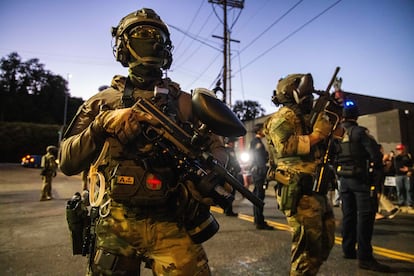

The Insurrection Act of 1807 is one of the most controversial statutes in the United States. For more than two centuries, it has allowed presidents to deploy the Armed Forces on domestic soil to enforce the law in times of insurrection, rebellion, or widespread civil unrest. Now, President Donald Trump has said he could invoke the legislation in response to protests against his immigration policy in several Democratic-governed cities, where he has sought to deploy elements of the National Guard.
The law is codified in Title 10 of the United States Code and gives the president the authority to deploy troops in three situations: when a state requests assistance in suppressing an insurrection (§251), when rebellion or obstruction makes the enforcement of federal law impracticable (§252), and when domestic violence or conspiracy deprives citizens of their constitutional rights and the state fails to act (§253).
History
The Insurrection Act was proclaimed by president Thomas Jefferson on March 3, 1807, and allows the president to use both federal and state troops in “all cases of insurrection or obstruction to the laws.” Originally, it was designed to protect states from internal uprisings or attacks, but it also allowed the president to act independently if local governments were unable or unwilling to enforce federal law.
Over the years, Congress has amended the law several times. One of the most important was the 1871 amendment, known as the Third Enforcement Act. It targeted the Ku Klux Klan, which had formed six years earlier at the end of the Civil War, and granted the president the power to protect the constitutional rights of African Americans when states refused to do so. This marked the beginning of the federal government’s role in enforcing civil rights through military intervention.
Applications
Since its proclamation, the law has been invoked more than 30 times by various presidents, including Abraham Lincoln, who used it at the start of the Civil War to ensure he had the legal authority to wage war in a state without the permission of the governor. Years later, presidents Ulysses S. Grant and Rutherford B. Hayes used it during the Reconstruction era — as the two decades after the war are known — to dismantle white supremacist violence in the South.
In the 20th century, the law played a key role in the enforcement of civil rights. Presidents Dwight D. Eisenhower and John F. Kennedy deployed federal troops to enforce school desegregation in Little Rock, Arkansas (1957) and at the University of Mississippi (1962), as the governors of those states resisted federal authority. Later, president Lyndon B. Johnson used it to protect civil rights protesters in Selma, Alabama.
The most recent case took place in 1992, when the governor of California asked president George H. W. Bush for military assistance to quell the Los Angeles riots that followed the verdict in the case of Rodney King, a victim of police brutality.
The Posse Comitatus Act and presidential discretion
The Insurrection Act is an exception to the Posse Comitatus Act of 1878, which prevents the military from acting as a police force in the states. When the Insurrection Act is invoked, those restrictions are suspended and the military can assist in enforcing the law.
However, the law does not clarify exactly what “insurrection,” “rebellion,” or “domestic violence” means. In 1827, the Supreme Court ruled in Martin v. Mott that the president has the exclusive authority to determine when such situations exist, giving the executive branch almost complete discretion to decide when to deploy troops.
Trump and the Insurrection Act
In 2020, Trump threatened to invoke the Insurrection Act amid nationwide protests following the killing of George Floyd, an African American man killed by a police officer. Although he ultimately refrained from doing so, the episode reignited questions about the scope of presidential power under the law.
During his second term, the issue resurfaced during protests against Trump’s immigration policy in Los Angeles, which took place in the summer. It is once again being considered as a response to the unrest in cities such as Portland and Chicago, following Immigration and Customs Enforcement’s (ICE) migrant detention operations.
Trump publicly stated that he would consider invoking the law “if necessary” to restore order, calling the protests a “criminal insurrection.” His allies, including former strategist and political commentator Steve Bannon, called for troops to be immediately deployed, while governors such as Gavin Newsom of California and J.B. Pritzker of Illinois, both Democrats, accused the Trump administration of manufacturing chaos to justify federal intervention.
Experts and civil rights organizations have long argued that the law is outdated and dangerously vague. The Brennan Center for Justice and lawmakers such as Democratic Senator Richard Blumenthal have proposed reforms to clarify its wording, limit presidential discretion, and require consultation with Congress before it is invoked. Proposals such as the Curtailing Insurrection Act Violations of Individuals’ Liberties (CIVIL) Act would require congressional approval after 14 days and restrict the deployment of active-duty troops.
Sign up for our weekly newsletter to get more English-language news coverage from EL PAÍS USA Edition









































