
Chicago, turned into a ‘war zone’ by Trump’s immigration terror
Federal forces have used tear gas and pepper spray and fired at protesters, following days of protests over migrant detentions, while Trump authorized the deployment of the National Guard
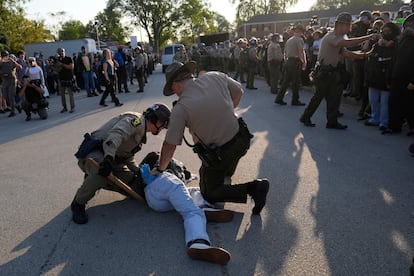

U.S. President Donald Trump has declared war on Democratic-led cities, and judging by the violent scenes of recent days, Chicago has become a battleground. Numerous people have been injured and several were arrested in clashes between federal forces and protesters in weekend demonstrations against the government’s migrant detention operation launched in the city last month. Immigration agents used tear gas and excessive force against citizens who denounced abuses committed against migrants and the deplorable conditions in which they are held in detention centers.
The so-called Operation Midway Blitz, launched in early September, has already resulted in more than 500 migrant arrests, according to government data. Protests against the operation have multiplied in recent weeks, leading President Trump to authorize the deployment of 300 National Guard troops to contain the demonstrations and protect federal agents. Texas Governor Greg Abbott, a Republican, has also made Texas troops available.
Authorities in Chicago and the state of Illinois responded this Monday with a lawsuit against the administration to block the deployment of troops on their streets, but a federal judge has so far refused to block it. The soldiers are expected to arrive in Chicago, the nation’s third most populous city, on Tuesday.
Illinois Governor J.B. Pritzker has accused the government of wanting to create a war zone to justify the deployment of troops. “Their plan all along has been to cause chaos, and then they can use that chaos to consolidate Donald Trump’s power,” he said.
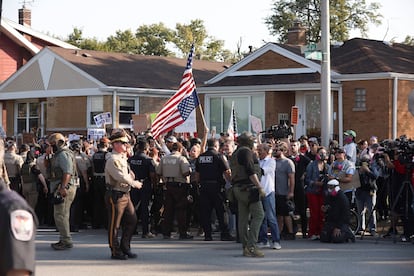
Violence escalated last weekend when protesters and law enforcement officers clashed outside the detention center in Broadview, a Chicago suburb west of Chicago where the majority population is Black and Latino. Videos quickly spread on social media showed the aggressive behavior of Immigration and Customs Enforcement (ICE) officers.
The Department of Homeland Security (DHS) acknowledged that federal agents shot a woman Saturday morning in southwest Chicago. DHS said the woman was a U.S. citizen and had a semi-automatic weapon. Tricia McLaughlin, deputy secretary of the department, said the woman drove herself to a hospital for treatment. DHS said the shooting occurred when a group of people rammed their cars into the vehicles of immigration officials.
Jessie Fuentes, an alderwoman from Chicago’s District 26, was assaulted by federal agents at her neighborhood hospital, where she went after receiving a tip that ICE agents were scaring staff and patients. “There was someone in the ER with a completely shattered leg. I asked them if they had a warrant. They refused to show me anything and were very aggressive toward me. They pushed me twice before handcuffing me for doing nothing except asking them if they had a warrant to detain the individual in the ER,” she told reporters. They took her out and put her in a Border Patrol vehicle, only to release her later.
ICE-free zones
In response to the chaos in the city, Chicago Mayor Brandon Johnson, a Democrat, announced Monday that he would establish “ICE-free zones,” preventing federal agents from entering without a warrant. In addition, several citizens, media outlets, and clergy representatives filed a lawsuit Monday denouncing police violence during recent protests.
“Never in modern times has the federal government undermined bedrock constitutional protections on this scale or usurped states’ police power by directing federal agents to carry out an illegal mission against the people for the government’s own benefit,” states the lawsuit, which will be defended by, among others, the American Civil Liberties Union (ACLU).
The organization denounces that “this rampant violence by the federal government is a blatant attempt to interfere with the most cherished and fundamental rights enshrined in the First Amendment to the United States Constitution: freedom of speech, freedom of the press, freedom of religious belief, and the right to peaceably assemble and express disagreement with the government.”
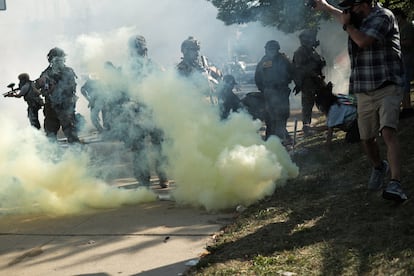
Pastor David Black of the First Presbyterian Church of Chicago in the Woodlawn neighborhood of Chicago, one of the most marginalized areas of Chicago, claims to have been shot in the head with near-lethal projectiles and tear gas in the face. He extended his arms, palms outstretched, toward the ICE agents, in a traditional Christian posture of prayer and blessing, the pastor states in the lawsuit. Without warning, and without any order or request that he and the others disperse, the ICE agents suddenly shot at him, hitting him seven times in the arms, face, and torso with explosive pellets containing some type of chemical agent. “It was clear to me that the agents were aiming for my head, where they struck me twice.”
William Paulson, a 67-year-old retired union painter, recounts in the same lawsuit that on September 27, ICE agents launched an indiscriminate attack on protesters without warning. They fired gas canisters in front of and behind him, he says, and he started inhaling the gas and couldn’t see or breathe. “My eyes and nose were burning… I fell to my hands and knees and vomited. There was extreme pain in my eyes and nose. My skin was burning. I have emphysema and COPD [chronic lung disease], so the gas affected me greatly.”
Trump has been threatening to send the National Guard to Chicago for weeks, justifying it as an emergency due to alleged high crime rates in the city and to protect federal officers, as he has done in Los Angeles, Washington, D.C., Memphis, and Portland. On Sunday, a federal judge in Oregon temporarily blocked the deployment of troops to Portland. Now, Trump says he’s considering invoking the Insurrection Act to circumvent the court’s injunctions.
The lawsuit filed Monday by the State of Illinois and the City of Chicago joins three other lawsuits against Trump’s unprecedented use of troops to patrol U.S. cities, suppress protests, and enforce immigration laws nationwide, alleging, without evidence, increased crime in cities governed by Democrats.
Sign up for our weekly newsletter to get more English-language news coverage from EL PAÍS USA Edition









































