
Wounded and handcuffed in hospital beds: The double punishment for the migrants shot at ICE office in Dallas
The families of the two hospitalized victims and the deceased face silence from the Trump administration, which is using the attack to justify its domestic military deployment
Just before 7:00 a.m. last Wednesday, Joshua Jahn, a 29-year-old American, opened fire on the Immigration and Customs Enforcement (ICE) offices in Dallas, Texas. Shortly afterward, Norlan Guzmán Fuentes, a 37-year-old Salvadoran detained at the facility, died. Miguel Ángel García Hernández, a 31-year-old Mexican, was taken to Parkland Hospital with multiple gunshot wounds that tore through his body and left him in critical condition. José Andrés Bordones Molina, a Venezuelan, was also wounded and is in hospital. From a statement from Jahn, authorities learned that the gunman intended to “cause real terror” among immigration agents, although none of them were shot that morning.
Nearly a week later, the information provided by the Donald Trump administration about the deceased migrant or the two injured men has been minimal and has come in dribs and drabs. The Republican administration has instead focused on portraying immigration agents as victims and framing the incident as part of a campaign of attacks against the agency charged with carrying out the “largest deportation in history,” as promised by the president. Little has been said about the affected migrants and their families, who in recent days have recounted the pain and uncertainty they are experiencing following the attack.
On Saturday, Trump announced his order to send troops and use “full force” to protect the city of Portland, Oregon, and in particular the ICE facility, allegedly under siege by “Antifa and other domestic terrorists.” In the absence of evidence of attacks or riots in the northwestern U.S. city, widely known as a progressive bastion, the deadly attack in Dallas served as proof of the need to deploy the military. It is the fourth city to which U.S. troops have been deployed during the Republican’s second term, following Los Angeles, Washington, and Memphis.
The Department of Homeland Security has yet to publicly confirm the identities of the two detainees who were wounded. On Monday, it did release a statement confirming the death of the Salvadoran, so far the only fatality from the attack: “Norlan Guzman-Fuentes, 37, while in the custody of ICE suffered a senseless and tragic fatal gunshot wound during a senseless sniper assault on the ICE Dallas Field Office. Guzman was an illegal alien from El Salvador who was picked up by ICE from local law enforcement.” The government has not commented on the plight of the victims’ families, including a U.S. citizen.
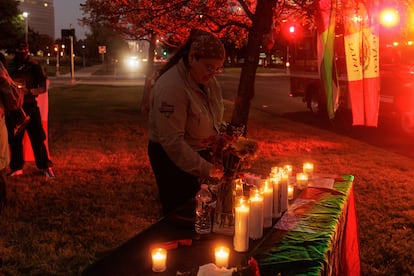
The nearly one-week delay in releasing the names and conditions of the detainees wounded in the attack has sparked outrage among family members and the general public. Authorities have also not responded to press inquiries. Vigils for García Hernández were held on both sides of the border over the weekend, as well as in support of the other victims and their families.
Guzmán’s relatives in El Salvador have filled in some of the gaps left by the authorities. According to their testimonies, before his arrest by immigration authorities, he worked as a gardener, had lived in Florida, and moved to Dallas after being involved in minor crimes, such as a bar fight. He faced imminent deportation and had already decided to voluntarily return to Jiquilisco, his hometown. Speaking to Univisión, his sisters said they planned to welcome him with chicken soup, as he wanted, but now they must prepare his burial.
Details about the two wounded men have also begun to emerge from their loved ones. García Hernández, the Mexican citizen now in hospital, arrived in the United States aged 13. As an adult, he married Stephany Gauffeny, had children, and worked as a painter. He was also in the process of obtaining citizenship through his wife. However, on August 8, he was arrested for driving under the influence of alcohol and was taken into custody by immigration authorities the following day. He was in the country illegally and had been convicted of providing false information, evading arrest, drunk driving, and fleeing from police.
When Gauffeny last saw her husband, he was smiling at her from an immigration courtroom. The next time was at Parkland Hospital in Dallas, unconscious. “He’s all swollen, with staples in his head, a bunch of tubes going down his throat,” she told CNN.
García Hernández was shot several times. The bullets pierced his urethra, tailbone, and shoulder. The most dangerous hit an artery in his neck that connects to the brain. His condition was so serious that doctors weren’t sure he would survive the first night. When she finally saw him, Gauffeny found her husband with his arms tied to the hospital bed and his feet handcuffed. She protested. An ICE official said they could temporarily remove the handcuffs, but only to replace them with plastic ties.
According to Gauffeny, ICE allows her four hours of visitation per day: two in the morning and two in the afternoon. Agents remain in the room during each encounter. “It’s a situation where I think I should, as his wife, be able to spend more time with him,” said Gauffeny, who is days away from giving birth and has already chosen a name for the baby with her husband. “I just want everyone to know that he’s a good man, a good father, a good husband, a good friend, a good person, a hard worker,” Gauffeny added. “He’s not just a victim; he’s a person with a life, with children and a family.”
Gabriela Gauffeny, Stephany’s sister, has organized a GoFundMe campaign to cover medical and family expenses. “He is the sole support for his family, including his children, his wife, and his unborn child,” she wrote about the hospitalized man.
Meanwhile, in San Luis Potosí, Mexico, María Hilaria García, who was deported from the United States two months before the shooting, recounts the plight of her wounded son. “A bullet entered here through his neck and exited through his head, hitting parts of his brain,” she explained to Mexican media. “There were four bullets: in the neck, in the stomach, another in the leg, and another in the back.” Hilaria is now requesting a humanitarian visa to return to Texas and be with her son.
Few details are available regarding the third victim, José Andrés Bordones Molina. He has a history of property theft and a traffic violation. Authorities confirmed that the Venezuelan was wounded in the attack and remains hospitalized, but his family has not made any public statements.
Sign up for our weekly newsletter to get more English-language news coverage from EL PAÍS USA Edition









































