The Democrats’ endless drift on immigration
The Democratic Party is avoiding the immigration debate. Although polls show a majority rejects Trump’s policies, Americans still trust Republicans more when it comes to securing the border
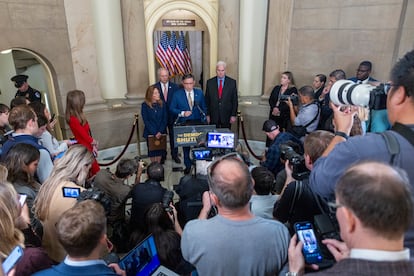

In the duel of cross-accusations at the heart of the government shutdown that has paralyzed the United States since October 1 and shows no clear end in sight, each side of the political debate fires from the position they find most comfortable. Democrats present themselves as defenders of affordable health care, while Republicans portray them as protectors of undocumented immigrants when they falsely claim that the federal gridlock is due to the Democrats’ insistence on spending $20 billion on healthcare for migrants. Beyond the facts, the trenches drawn in this dynamic reflect a reality so deeply rooted that Democrats accept it as an immutable truth and cede ground in the public debate on immigration, dismissing it as lost from the outset.
At first glance, this may seem paradoxical. President Donald Trump’s immigration agenda, especially his methods, has already been losing popularity in the nine months he has been back in the White House. Polls in recent months show that the majority of Americans disapprove of his policies, from family separations to mass raids by Immigration and Customs Enforcement (ICE). This week, The New York Times published a comprehensive survey of the Trump presidency conducted in late September. Among various points ranging from the economy and tariffs to the wars in Gaza and Ukraine, 51% of respondents say the immigration actions have gone too far, 35% that they have been adequate, and 12% that they have not been enough.
The Democratic Party, however, in search of a message that could help it recapture the House in the 2026 midterm elections, has remained relatively silent on the issue and has shown no signs of trying to capitalize on one of the current administration’s most unpopular policies. According to another poll by The Wall Street Journal, only a third of voters believe Democrats handle immigration better, while nearly half of Americans trust Republicans more on this issue.
This credibility gap has deep roots, notes Muzzafar Chishti, director of the New York-based Migration Policy Institute, an independent think tank focused on migration. “For two decades, [Republicans] have completely linked the immigration narrative with border security, basically arguing that as long as the border isn’t secured, nothing more can be done on immigration. Whether they truly believed that, or whether it became an excuse for doing nothing, it was accepted as a political reality.”
Trump has been repeating it for 10 years as one of his slogans: “Without borders, we don’t have a country,” he often says. Thus, Republicans turned the idea into dogma, while Democrats, even when they held majorities in Congress, were unable to reverse that framework.
Center-left analysts, such as Matthew Yglesias, founder of the digital media outlet Vox, and Jerusalem Demsas, of The Atlantic’s Good on Paper podcast, point out that the Democrats have failed to articulate a coherent message that combines border control with a positive vision of immigration as an economic and social driver. They have also failed to connect the issue with the concerns of the average voter: jobs, wages, access to basic services. Meanwhile, Trump and the Republicans have fused both into a single, central message: immigration threatens security and people’s pockets.
In the middle, immigration has been caught in a legislative impasse due to the 60-40 Senate majority needed to advance any new, substantive immigration law. The math always favors the Republican position. “Democrats can’t do anything alone that doesn’t also include significant border measures [to enlist some Republicans], but that’s where they come into conflict with the party’s base, which doesn’t like punitive border control. They’re caught between those two political realities,” Chishti explains.
This has translated into a narrative of weakness on migration around the Democrats. Even when former president Joe Biden, in mid-2024, managed to drastically reduce migrant inflows across the southern border with executive actions, the dominant narrative was not one of effectiveness, but of delay. After years of historic migratory flows following the pandemic, and despite the fact that bipartisan immigration legislation was struck down in Congress by Trump’s order a few months earlier, Biden’s executive orders that rapidly reduced border crossings only cemented the idea that the tools to control the border had always been there, they just hadn’t been used.
Against this backdrop, last year’s presidential election was largely decided by immigration. And now, as masked ICE agents patrol some of the country’s major cities, the Democrats haven’t forgotten this and have dug into their trenches. In the budget dispute, they have taken up the issue of healthcare, but they haven’t attacked the unprecedented increase in funding for immigration enforcement, which now far exceeds the funds to combat crime and drug trafficking.
In other settings, such as the surprisingly successful progressive Democratic Socialist Zohran Mamdani’s campaign for mayor of New York City, one of the most expensive cities in the world, the cost of living has been at the center of the debate. While Mamdani has been forceful in his rejection of Trump’s immigration policies and has proposed providing free legal representation to migrants in the city—laying the groundwork for a future confrontation that the president is also fueling with his repeated attacks on the mayoral candidate—what he can offer in terms of substance regarding migration is limited. Consequently, at the national level, there is a narrative vacuum in this area.
Any shift in the debate will be determined, then, by Trump, Chishti argues. “If President Trump decides at some point—and he’s right to do so—that the border is now completely under control, which it basically is, with the lowest numbers since the 1960s—if he can declare victory and say, ‘Let’s shift gears and move on to other things,’ he has the legitimacy to do so. Unlike many presidents, he has the extraordinary ability to mobilize his party in Congress.”
Chishti believes this is likely to happen at some point during Trump’s second presidency, as the pressure to find a lasting solution, even if not ideal, is very strong. “Trump’s base is essentially a MAGA populist base and enormous corporate interests. The MAGA base may not want any entry for immigrants, but the corporate base is enormously dependent on them—from low-skilled sectors to high-skilled ones, from agriculture to finance. So there are inherent reasons to believe there will be movements toward reform.”
In fact, during his first term, Trump proposed a comprehensive reform based on four pillars: a path to citizenship for 1.8 million Dreamers—undocumented immigrants who came to the United States as children, have lived in the country most of their lives, and were granted temporary protection from deportation and work authorization under the Deferred Action for Childhood Arrivals (DACA) program, established in 2012; $25 billion to secure the border; reductions in family-based immigration; and the elimination of the diversity visa lottery. However, the proposal never reached a vote in the Senate.
So now, unless Trump gives the signal, even bipartisan legislation like the one proposed by Florida Republican Representative Maria Elvira Salazar, which also opens paths to citizenship for Dreamers, is destined to fail. And Democrats, long adrift in the debate, will have to continue trying to focus the discussion on other issues.
Sign up for our weekly newsletter to get more English-language news coverage from EL PAÍS USA Edition