
Migrant caravans no longer want to go to the United States
A group of about 1,000 people are walking north from Tapachula with the goal of staying in Mexico City instead of crossing the border into American territory
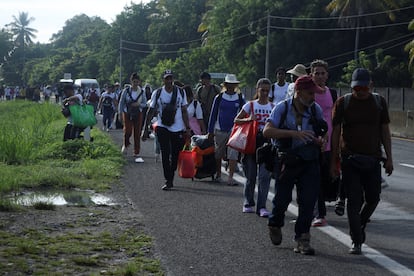
“And why would I want to go to the United States? They hate us there! All I want is to get to Mexico City where my friend is waiting for me and make a life for myself there.” Esther López Hernández, a 37-year-old Cuban woman, has walked more than nine miles (15 km) in the last four hours and she looks tired. She is pushing a blue stroller carrying her two-year-old daughter, while her other son, Ernesto, 18, walks next to her. The three are traveling in a caravan of about 1,000 migrants that left this morning from Tapachula, on Mexico’s southern border, and which is not seeking to reach the United States, but rather to remain in the Mexican capital.
It’s an odd sight because, for at least the last eight years, dozens of caravans have set out from this very place with one goal: to cross the northern border and reach American territory. But the so-called “Trump Effect”—that is, the fear of the U.S. president’s anti-immigration policies—has had an effect that was unthinkable until recently: migrants no longer seek a new future there.
The caravan that left this Wednesday was made up mostly of Cubans. This makes it even more unusual. Cuban migrants usually try to settle in U.S. states like Florida or New York, where they have long-standing community and family roots.
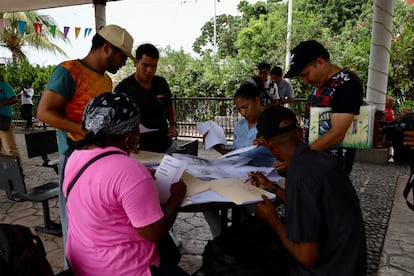
Before leaving, a group of leaders leading the caravan held a brief press conference to send a joint message: “We’re leaving Tapachula because we’re trapped here. They won’t give us papers to live here formally, and to obtain them we have to pay up to 20,000 pesos (about $1,000). We’re not trying to get to the United States,” said Diana, one of the caravan’s spokespersons.
Since Trump took office, the migratory flow to the United States has plummeted. Activists on the southern border report a drop of up to 80%. This is evident along the Suchiate River, which separates Mexico from Guatemala: where there used to be camps with hundreds or thousands of migrants waiting to cross, now there is almost no one. And the few who do cross do so in secret.
This is also reflected in the caravans: between October and January, the four months before Trump took office, 15 caravans departed from Tapachula. Since the inauguration, only two have departed. In these latter cases, the spokespersons leading the groups said they did not want to reach the United States, but rather to stay in Mexico.
López, the woman traveling with her two children, worked in Tapachula for the past nine months in a restaurant where she earned 150 Mexican pesos a day (about eight dollars at the current exchange rate). She says that wasn’t even enough for food, so in recent weeks she had to give up her rent and move to a shelter. “You can’t make a living here,” she said.
EL PAÍS spoke with about 20 migrants traveling in Wednesday’s caravan, and all of them said they wanted to stay in Mexico, but couldn’t bear to live in Tapachula anymore. They also reported that in recent months, applying for humanitarian residency at the southern border has become impossible. Some reported waiting from three to 10 months without any results. “My last appointment was over a month ago, and I’m only getting my third signature. Can you imagine how much longer I have to spend waiting here?” said a Cuban woman named Yoalmi, traveling with her husband and two children.
According to migrants, the slowness of the Mexican Commission for Refugee Assistance is due to a corruption network: outside the facilities, there are always one or two lawyers offering to expedite the process in exchange for a fee that can vary from 3,000 to 20,000 Mexican pesos ($150 to $1,000).
“They don’t want us in the United States. I’ve seen videos where they grab and beat migrants as if they were criminals. I don’t want to go there. I want to stay here,” López insisted. “I don’t know why, if Tapachula is part of Mexico, they won’t let us in. They already let us in. Now we just want a better life than the one we have here,” López says.
Other migrants said they’re afraid of Donald Trump. Like Ashley and Claudia, two Cubans who have been traveling together for three months. They left Havana in early July and received help from their relatives in the United States to finance their trip. But they don’t want to join their family there. Their goal is to stay in Mexico City and open a grocery store. “My family tells us it’s dangerous there [in the U.S.]. You can’t even go out to work. It’s better for us to stay,” Ashley said.
The decline in the flow of migrants to the United States that Trump hoped for is a double-edged sword for those on the route: it forces them to travel in small groups, which means greater exposure to organized crime. “We travel in a caravan because that’s the only way we won’t get kidnapped. Because they say that on the way up, the drug traffickers will take you,” Claudia says. Meanwhile, she keeps walking.
Sign up for our weekly newsletter to get more English-language news coverage from EL PAÍS USA Edition









































