
Anatomy of a mass disappearance in Mexico: ‘Mom, I fell into the hands of the mafia’
EL PAÍS reconstructs the last movements of a group of 40 migrants from Cuba, Honduras and Ecuador who disappeared on December 21, 2024, in San José El Hueyate, on the coast of Chiapas. Six months later, no authorities have begun to search for them.

They were humble. They came from neighborhoods with low-rise houses, and survived on remittances. They were drivers and bricklayers, housewives and students. They came from Cuba, Honduras, and Ecuador. They wanted to reach the United States, where some had a mother, a husband, or a sister waiting for them; others were fine with staying in Mexico. They called their families daily, sent their real-time locations, and shared smiling selfies of each stretch of the journey. They answered questions about whether they’d eaten, if they were hot and how they’d slept. They were flesh and blood and hard work.
The list includes 40 people, eight of whom their families are desperately searching for. Where is 18-year-old Elianis Morejón? And 21-year-old Jefferson Quindil? Missing too are Meiling Bravo, 40, and her son Samei Reyes, 14; Jorge Lozada, 24; Lorena, 28; Dayranis Tan and Ricardo Hernández, both 33.
They all disappeared on the morning of December 21, 2024, in southern Mexico, just after boarding boats that were supposed to take them from San José El Hueyate, on the coast of Chiapas, to Juchitán de Zaragoza, in Oaxaca. At 8:25 a.m., the last signal went dark. The smugglers say they were detained, that they drowned, that they were killed, that the cartel is holding them in a forced labor camp. Despite constant complaints, the Mexican authorities have not taken a single action to find them. For six months, the families have faced deception, extortion and threats, but there is still no trace of the missing. It’s as if Mexico — with its 129,000 missing persons — had swallowed them up.
Migrants say there’s something even worse than crossing the dark Darién jungle in Panama to reach the United States. They say nothing compares to Mexico. In the last five years, 237 migrants have disappeared in the country, according to figures from Mexico’s Ministry of the Interior. Hundreds more have been murdered: suffocated in immigration cells in Ciudad Juárez, shot by mistake by the military, massacred like the 72 in San Fernando, burned alive between Tamaulipas and Nuevo León. These episodes became the horrific images of the north, but now, the terror at the border has moved south.
Chiapas has always been the gateway for criminal business. Weapons, drugs and migrants cross the Suchiate River. They enter from Guatemala, and once in Mexico, they are distributed everywhere. For more than a year, Chiapas — the poorest state in Mexico — has been under siege. The fight between the country’s main criminal groups — the Sinaloa Cartel and the Jalisco New Generation Cartel — has left a trail of voids and corpses.
In this battle for territory, migrants have been easy prey. Most do not report the crime, so their cases do not show up in official statistics. But in 2024, the organization Alto al Secuestro recorded that in just one month, 101 migrants were kidnapped in Chiapas. The persecution and abuse happen under the watchful yet indifferent eyes of Mexico’s National Guard checkpoints and the National Institute of Migration (INM).


Over the past two years, during which nearly two million people have entered Mexico illegally, criminal groups in the south have built a vast human trafficking industry. Many of those who cross into Mexico arrive with the entire journey already paid for. This was the case for Meiling and Samei, Lorena and Jorge, Elianis and Dayranis, all from Cuba. They had paid between $8,000 and $10,000 for the route between Managua in Nicaragua and Mexico City. Like a relay race, they were picked up in private vehicles by different drivers, who recorded videos when dropping them off at each new stop. “We’re here dropping off the service of these two people, safe and sound. Everything good, gentlemen?” says one of the last videos taken of Meiling and her son Samei. “Welcome to Tapachula.”
Tapachula is where the spiral begins. In this city of about 350,000 people, Jorge Lozada spent almost two months waiting for his CBP One appointment—the U.S. asylum system that Donald Trump shut down on his first day in office. “He got desperate because he wanted to get in before Trump took office. His wife was there, and he wanted to be with her,” says his mother, Alicia Santos, via video call from Santiago de Cuba.
So, on December 17, Lozada contacted a smuggler on Facebook. In the conversation — to which EL PAÍS has had access — Lozada repeatedly asks about the dangers of the trip: “Brother, aren’t there any risks along the way??? I’m a little afraid of that.” “No, brother, the route is safe. It’s in a private car,” replies the trafficker, who acknowledges that the hardest part is “leaving the south,” but that they travel “with an immigration code, a bracelet, and a stamp.” “That’s the permit they give us to leave without any trouble.”
The conversation continues on WhatsApp, and the plan changes. Jorge Lozada and Lorena — whose family requested that her last name be withheld— do not leave by car for Mexico City because “the road is bad, full of checkpoints.” Instead, they are taken to San José El Hueyate, a small town on the Chiapas coast, about 30 miles from Tapachula, known as a launch point for maritime routes used to traffic migrants, weapons, and drugs north. The rest of the group, who had not yet met each other and had each arrived with a different smuggler, arrive at a kind of warehouse between December 18 and 19. Ricardo Hernández, who had left El Progreso, Honduras, on December 2, and Jefferson Quindil, who had left Cotopaxi, Ecuador, on December 8, also ended up at this house.
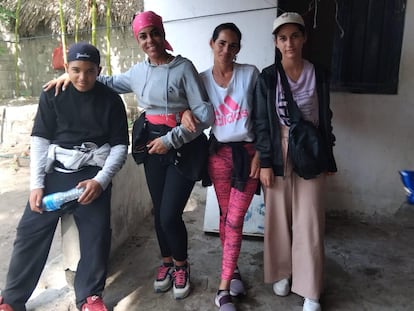
It was there, in that unfinished building surrounded by banana trees, that they began to feel uneasy. A month and a half earlier, Elianis Morejón had left her home in a small town near Colón, Cuba. It was a long journey: she passed through Suriname, Guyana, and finally Rio de Janeiro. An avid reader, sociable, and friendly, she spent almost a month by herself in Brazil. On December 13, she left for Colombia, then El Salvador, then Nicaragua. The route with the guide through Central America went smoothly. “She was treated very well, it was all very calm,” her mother, Isis Pérez, recounts from Cuba. “When she arrived in Mexico... there was something she didn’t like at all, something that didn’t fit. On the first day, she told me: ‘Mom, I’ve fallen into the hands of the mafia.’”
Thanks to Elianis Morejón’s GPS, the families know that the migrants did not leave that home on December 20. Jorge Lozada told a friend that day via WhatsApp: “I’m waiting to catch a boat, but they say the tide is high, we can’t leave like this.” That same afternoon, he texted her: “There’s been a hell of a shootout here. These people came out armed to the teeth and ordered us to come in.” Through phone and WhatsApp conversations, the families also learned that their loved ones weren’t being fed, and that the men guarding them were high on drugs: “These people are crazy, they do this to stay awake.”
On the morning of December 21, two boats full of migrants left the town of San José El Hueyate heading north. They had been told it would be an eight-hour journey to Oaxaca. From there, they would continue on to Mexico City — the final destination their families had paid for. “I was able to speak to her while they were on the boat. She told me, ‘We’re here, and they’re putting life jackets on us,’” says Darian Rivas, Elianis’s partner, who was waiting for her in the U.S. “She was scared; she didn’t know how to swim.”
“Hello, good morning, Lili, how are you?” Ricardo Hernández texts his sister at 7:02 a.m. [Mexico time]. “We’re on the boat,” he adds 53 minutes later. When his sister Lilian replies at 8:30 a.m., the messages no longer went through. The group’s last known location was in the Pacific Ocean — a point in the water near the shore. The timestamp reads 8:25 a.m. After that, nothing.
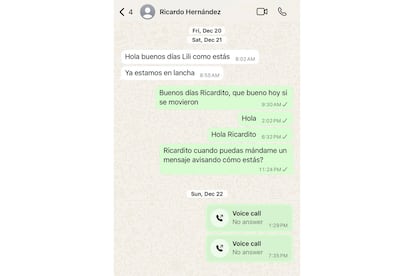
The first explanation from the smugglers was that the group had been detained. “But they told us that since it was already Christmas, nothing could be done to get them out,” Lilian Hernández explained by phone from the United States. Then they told them the boats sank — although local fishermen reported no accidents during those days. And weeks later, the extortion began. “The proof I’m going to send you is that I’m going to shoot her and show you her photo,” someone told Darian Rivas when they demanded $2,000 from him. And he paid. Then it was $3,000, and later another $1,500. He never received a photo, an audio message, or even a phone call. None of the families did. All of them were extorted, some on multiple occasions. The last attempt came from Milton, a Cuban smuggler, who shared a list containing the names, passports, and signatures of their relatives. Everything matched, so the families believed it was real. The list includes 40 names of migrants allegedly kidnapped by the Sinaloa Cartel. They paid $12,500 in ransom, and Milton disappeared with the money.
Their only hope now lies with Mexican authorities who — despite having the exact location where the migrants were held and the phone numbers of those who transported them — have done nothing to find them. EL PAÍS contacted the Chiapas Prosecutor’s Office and the Attorney General’s Office (FGR), as well as the Navy, but received no response.
“It’s not just the mass disappearance of people in vulnerable situations, but it’s also total indifference from the Mexican state,” explains Yesenia Váldez, a lawyer with the Foundation for Justice, which is representing the families and filed the complaint with the FGR. She explains that the longer someone remains disappeared, the greater the risk that other crimes may be involved — such as human trafficking or forced recruitment. “In six months, there’s no news, and there’s also no effort to search for them. That’s 40 people. How do so many people disappear? How do the authorities not notice? Either they are allowing it or they’re part of it.”
Jefferson Quindil

Jefferson
Stalin Quindil
21 years old - From Cotopaxi, Ecuador.María has a photo and a video of her son on her cell phone. In the photo, he’s with her and one of her daughters — it’s dark, taken from above, and they’re huddled together. The video is 24 seconds long and made up of images from Cotopaxi, a province near Quito, Ecuador’s capital, where María left two years ago, bound for the United States. One of those images is the photo that appears in this report, showing the 21-year-old smiling in a new jacket. “He’s just a normal kid, not demanding, not like ‘I want this or that,’ no. He didn’t say anything about food or clothes — whatever I bought, he’d wear,” says María, a Quechua speaker, over a video call.
Jefferson Stalin Quindil had been studying at military school, but as the situation in Ecuador worsened — the country is currently under a state of emergency — he grew more eager to leave. “I’m not doing anything here, Mom, I want to go there,” he told his mother, who now recounts the story in tears. “He wanted to come see me.” He left in early December. He flew to San Salvador, and from there a guide picked him up to cross Honduras and drop him off in Tapachula. It was the same guide María had used two years earlier to cross Mexico — that gave her peace of mind. But unlike María, who had made the journey in private vehicles, Jefferson was taken to San José El Hueyate to travel by boat.
On Saturday, December 21, he spoke with his mother in the morning: “They’re taking me out today, Mom, I’m fine, I’m not worried. I’m packing my backpack right now, putting a cover on it so it doesn’t get wet, and I’ll leave soon.” He told her it was an eight-hour journey, which seemed like a long time to her. She was worried and asked him to let her know as soon as they left the house. “He didn’t know how to send anything, no location or anything. At 6:43 a.m. we were talking, and by 7:00 a.m. [U.S. time], I hadn’t heard any sign of him. So I called, sent audio recordings, text messages. Nothing, so far.”
Meiling Álvarez and Samei Reyes

Meiling Álvarez
and Samei Reyes
40 and 14 years old - From Habana, Cuba.Their family keeps images of every stretch of the journey. Meiling Álvarez, her curls tied back, smiling, wearing sportswear, a backpack, and flip-flops. She’s always arm in arm with her only son, Samei, who looks seriously into the camera when the smugglers film him. “Today, December 18, 2024, your people are here, in Tapachula, already on their way to Mexico City,” says the last trafficker — the one Meiling’s sister, Mayelin Álvarez, had paid to take them as far as the capital. He has never explained what happened to them, but remains active on social media, still offering his services to other migrants.
The two left on December 12. “They were desperate to leave here,” says her mother, Margarita Bravo, from Havana. Meiling worked at a bank in Cuba, but left to try to apply for humanitarian parole, the program launched by Joe Biden that allowed Cubans, Haitians, Venezuelans, and Nicaraguans to seek asylum in the U.S. if they had a relative in the country. Meiling’s sister and nephews live in the U.S., but her application was denied, so she “set off on the journey.” They were also considering the possibility of finding work in Mexico.
“She was a really charismatic girl, super friendly, stylish — she loved to dance,” says Margarita. “And a good mother,” her sister adds. When it comes to Samei, both of their voices break with emotion: “He was a cheerful boy, he loved computers, he was in secondary school,” says his grandmother. Mayelin finishes: “A really good boy — calm, kind. Sometimes I wonder… where could they have taken him?
Ricardo Hernández

Ricardo Hernández
32 years old - From El Progreso, Honduras.Since Ricardo Hernández disappeared, his sister Lilian has done everything in her power to find him. She got a lawyer to file an injunction against the migrant detention centers, where she was told on January 29 that he wasn’t being held; she filed a report with the Chiapas Prosecutor’s Office and the missing persons commissions, which began circulating his profile on February 12; she paid extortion money, and she’s written emails and social media messages to Omar García Harfuch, Mexico’s top security official, asking for help. “My goal is for the Mexican authorities to hear us, because how is it possible for 23 people to go missing and no one saw anything or knows anything? It’s impossible — someone has to know what’s going on,” she says over a video call from the U.S.
Ricardito, as she calls him, is the youngest in the family. They haven’t seen each other since she left Honduras 20 years ago. “He’s the one with the biggest heart, the one who’s taken the most care of our parents.” He studied computer science, but couldn’t find a job in his field. His last job was at a tortilla shop, delivering tortillas to restaurants. He has two children, and one of them was about to start school.
“He didn’t want to ask me for money anymore,” says Hernández, who for months thought her brother was the only one missing. She started searching the internet for news and found a story about Mayelin Álvarez’s search. She contacted her, and they realized their relatives had been together before disappearing: “Mayelin had a photo of her nephew, and in the background, sitting on the bed, is my brother.”
The Tapachula house where Ricardo Hernández arrived on December 18 is the same one where Elianis Morejón also stayed. “I pray to God that my brother will show up, but I won’t forget about the others who are missing, because there are a lot of migrants who may not have anyone looking for them.”
Elianis Morejón

Elianis Morejón
19 years old - From Colón, Cuba.Isis Pérez believes the university was a big part of the problem. Elianis Morejón had started a degree in Medical Radiophysics in Colón; she had good grades and moved from her hometown to the city to begin classes. But for months, her mother says, there were no professors or lessons: “She got disillusioned.”
That, combined with the situation in Cuba and the fact that her boyfriend, Darian Rivas, was already living in the United States, pushed her to take the migration route. She was doing “perfectly” for almost the entire journey: “She video called us constantly — she was glued to the phone, day and night.”
Isis Pérez says her daughter was a little tired by the end, having been traveling alone for over a month, but she was happy to have visited Rio de Janeiro and other cities: “She had written down all the places — she told me she was going to write a book about it, that so many stories had happened to her… The trouble started when she got to Tapachula.”
That’s when everything went dark. “December 21 was the last day she spoke to all of us — her boyfriend, her brother, and me. She told us she loved us, to take care. The last thing she said to me was: ‘Take care of Lulú.’ A little dog she has, her whole world,” says Isis Pérez, breaking into tears. “She’s a fighter, a dreamer. She loves life. She has an incredible vision of the future: of fighting, of being happy, and seeing us happy. A super-responsible, organized girl,” she notes. “The authorities— look how we’ve struggled, and no one does anything. So many people disappear in that country, and everything stays that way. It just can’t be. That doesn’t happen in any other country in the world.”
Jorge Lozada

Jorge Lozada
Santos
24 years old - From Santiago de Cuba, Cuba.Alicia Santos speaks from Santiago de Cuba via video call, introducing her mother, her granddaughter, and two of her children as she talks about Jorge — the one who’s missing. She explains that he never had the chance to study a degree, but he was the kind of person who would watch someone build a roof and then know how to do it himself, or take apart a stove and figure it out. She says he was, as they say over there, “very easygoing, very family-oriented,” though he also had a “short fuse”: “But if he made a mistake, he’d apologize right away — it would pass quickly.” He loved to cook and was deeply loved.
For the past six months, Alicia has barely slept, trying to piece together what happened to her son. “There are so many missing links, so many different versions,” she admits. She’s been told all kinds of things: that he was detained by the Navy, by immigration, kidnapped by the Sinaloa Cartel, sent to the guerrillas in Tamaulipas, murdered and dumped in a bag. “You just don’t know what to believe anymore.”
She reached out to Mexican mothers who search for missing people and has shared Jorge’s missing person flyer, ever since he left Cuba on October 23. An ocean separates them, but Alicia is not giving up: “What I want from the Mexican government — no matter what condition my son is in, whether he’s on the streets without papers, without money, kidnapped, or dead, whatever it is — I just want to bring him back to Cuba. I want my son here. That’s all I want.”
Dayranis Tan

Dairanis Tan Ramos
33 years old - From Camagüey, Cuba.In her final days in Mexico, Dayranis Tan had run out of cell phone credit, so the last time she spoke to her mother, Graciela Ramos, was on December 18. “She was fine, resting in a house in Tapachula,” says the woman, who had to walk 40 minutes to find a signal and answer this newspaper’s video call. She lives in Camagüey, in the countryside, where government blackouts leave her without power for days. From there, she now cares for Dayranis’s two children, ages 10 and 14. “She wasn’t a walker. She was quiet, a homebody. Sometimes she would record a few soap operas and watch them... She did like music, she always had it on,” recounts this distraught mother.
She says that Dayranis wasn’t looking to reach the United States, where her husband, Leonardo Regueira, lived, because she knew things had gotten tough with Trump’s victory. “Her goal was to stay in Mexico because it was already difficult to cross into the United States. Because Trump was about to take office. What she wanted was to work for a better life,” she says. Dayranis’ last communication with Leonardo came through Meiling Álvarez’s cell phone. Afterward, there was only silence and questions. “It’s not easy for that many people to be taken away,” says Regueira. “Not even by drug traffickers, right?”
Credits:
Sign up for our weekly newsletter to get more English-language news coverage from EL PAÍS USA Edition