
Migrants stuck in Mexico City consider returning to their countries of origin: ‘America is over’
Around 5,000 foreigners, mostly Latin Americans, are now housed in 16 shelters in the Mexican capital, trapped between the challenges of finding an affordable way to return home or crossing an increasingly fortified U.S. border
This story was co-published with Puente News Collaborative, a bilingual nonprofit newsroom, convener, and funder dedicated to high-quality, fact-based news and information from the U.S.-Mexico border.
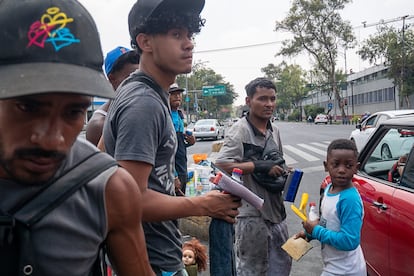
With late morning traffic surging, Yudelis Ferreira slips out of the migrant shelter with her three young children, heading for another day hawking popsicles in the Mexican capital’s hard heart. This has been Ferreira’s life for months now, her family’s plans for a future in the United States scuttled with the arrival of the Trump Administration.
Like unknown thousands of other migrants — mostly Latin Americans but also from Asia and Africa — Ferreira and her children find themselves marooned on the migrant trail, well and permanently short of the goal. “We are stuck,” Ferreira, 29, said, putting a succinct end to two years of migrating since leaving Maracaibo, the sweaty city that that lies on the Venezuelan oil lake of the same name. “We have to have a way to make some income.”
As many as 5,000 mostly Latin America migrants are now housed in 16 Mexico City shelters or in private apartments or houses in some of the capital’s poorer neighborhoods, said Emanuel Herrera, director of Vasco De Quiroga, one of the four shelters operated by the Mexican capital’s government. He cautioned that numbers are fluid. The decision to house them in the city is part of a government strategy to discourage migrants away from the border and into the interior, particularly to the capital, according to Mexican officials in Ciudad Juárez.
The migrant flow north has been all but squelched since then President Biden toughened regulations in Spring 2024, and especially once Donald Trump took office in January.
Crossings through the Darien Gap, the forbidding jungle separating Panama from Colombia, have all but ended. Data from Panama’s immigration service shows a 98% drop in migrant crossing this year compared to 2024’s already declining number. Encounters with migrants at the U.S.-Mexico border nosedived to 9,300 in June, compared to about 96,000 in December, the last full month of the Biden presidency, according to U.S. government statistics.
As if marooned in seafront tidal pools, thousands of migrants remain stranded along trails in Central America and Mexico. With young children to feed and clothe, many are working up various plans as the weeks tick past. They face long delays in finding affordable passage home or a means of jumping a fortified U.S. border. They are also having a hard time settling where they find themselves.
Trapped in Mexico City
The Vasco de Quiroga shelter where Ferreira’s family is staying serves as home for now for some 330 people. Most are Venezuelans, but the shelter residents also include Colombians, West Africans and a hapless handful of men from India. All have been on the migrant trail for months, even years, many stopping en route to earn money to continue on. Relationships have formed. Mothers have given birth on the journey. People have died. But belief in a new and perhaps better American future have pulled them along.
Now, those dreams are dust. This shelter — and what may come afterward — is proof of that.
“Since Trump returned, there are many people trapped in the city,” said Herrera, the shelter director. “They had a light at the end of a tunnel,” he said of the migrants’ hope to reach the United States. “But now that light has been extinguished.”
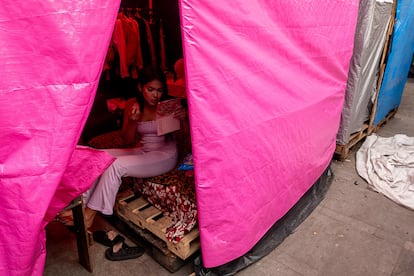

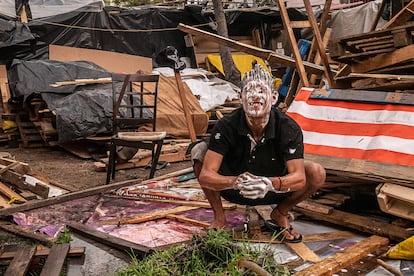
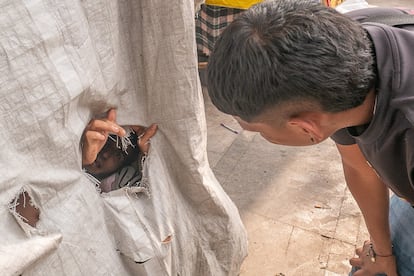
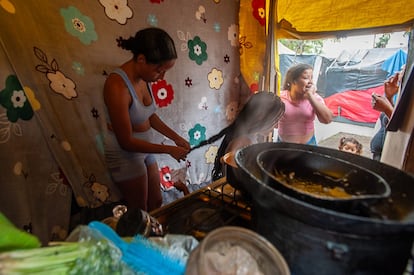
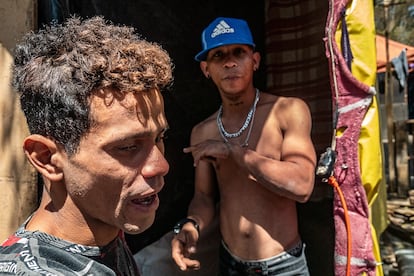

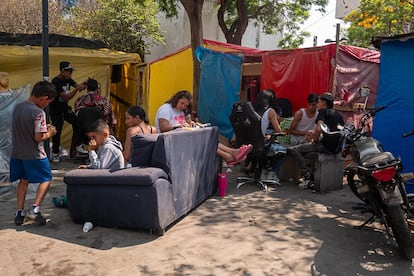
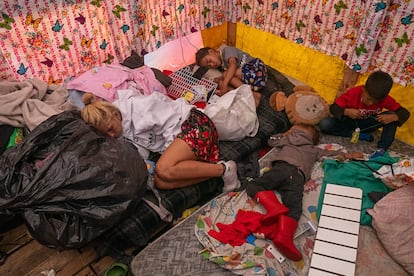
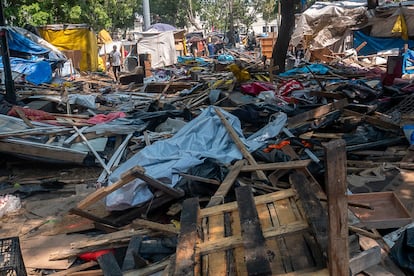
For many now living here, the shelter is a third stop in Mexico City this year. They had previously squatted in a shambolic cluster of wood and plastic sheds erected in a downtown city park in front of La Soledad Roman Catholic Church. After city workers dismantled that camp in March, many migrants erected another makeshift settlement five blocks away on a green patch in front of Mexico’s lower house of Congress. That second camp was torn down in late May.
“The first problem we had to attack was the encampments,” Herrera said, citing the dangers of criminal gangs preying on the migrants in the shanty towns. “We are focused on making a more proper ecosystem for them.” All but two of the formal shelters are managed by non-governmental aid groups. The city government has been issuing migrants identity cards that can allow them to establish debit card accounts and get formal work, Herrera added.
The Vasco de Quiroga shelter hugs the edge of Tepito, a long-established smugglers haven considered by many as one of the most dangerous neighborhoods in Mexico, if not the hemisphere. While the shelter’s residents are free to come and go as they wish — and many leave for jobs or to sell whatever they can at traffic stops — police at the shelter’s gate check identification of outsiders entering.
Migrants are divided into crowded individual dormitories: for single men, women and families with children, with many sleeping in bunk beds three tiers high. Communal bathrooms have toilets and showers. Meals are prepared in a large, seemingly well-stocked kitchen.
During a recent visit, migrant children played volleyball in the shelter’s courtyard while some of the Indian men taught Latin American women the art of making very spicy omelettes like those made in New Delhi.
Young children gather and look over the art they’ve pinned to a wall near the kitchen. Flags from Venezuela and Colombia sit atop the display. There is also a sketched homage to “migrant mothers” and colorful drawings of penguins, unicorns and pirate ships.
Ferreira, her three children and partner Alejandro have been on the road for two years. After first living in Ecuador, they traveled north last year, reaching Ciudad Juárez, bordering El Paso. Mexican officials flew them back to Tapachula on the Guatemala border, and then the five made their way to Mexico City from there.
The reverse migration would have seemed unfathomable a year ago. Now Ferreira’s family — and many of the other migrant castaways — have no plan but to await free flights sponsored by the Venezuelan government. Such flights so far are few and seldom. Others, at their wits’ end, say they will try walking or taking a bus. They’ll use scant funds or get odd jobs for a costly trip home.
For everyone, the wait will prove uncertain.
“Mexico City is not in my plans, for sure. But it is for now,” said Kulqueeb Saim, a 28-year- old from New Delhi who has passed through more than a dozen countries since hitting the migrant trail a year ago. He’s now planning to return home as soon as possible.
“There are too many problems in India,” Saim said with a slight smile. “But America is over.”
...
Dudley Althaus has reported on Mexico, Latin America, and beyond for more than three decades as a staff correspondent based in Mexico City for the Houston Chronicle and The Wall Street Journal, among others. The travails of undocumented immigrants have always been part of his coverage. @dqalthaus
Keith Dannemiller is a Mexico City-based documentary photographer who has worked in Latin America for over 40 years. His work has appeared in The New York Times, Time Magazine, Al Jazeera, The Guardian, and other international publications. His most recent book “Memoria a traves de la Imagen” is visual chronicle of a Guatemalan refugee camp in Chiapas, Mexico over a 30-year period.









































