The migrants heading south: ‘I never imagined I’d be migrating backwards’
Every day, migrants expelled by the Trump administration arrive in Guatemala. Others are turning back before even reaching the US-Mexico border, defeated by the growing difficulties. Returnees carry with them a sense of failure
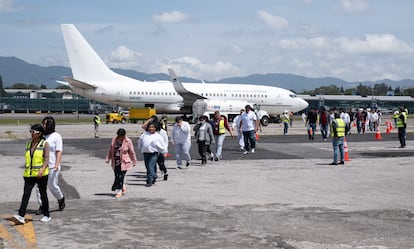
It’s 10:30 a.m. on a Thursday in July in Guatemala City. A charter flight operated by Eastern Air Express, the airline contracted by the U.S. Immigration and Customs Enforcement (ICE) in February to operate deportation flights, lands on the runway of the Guatemalan Air Force. A few minutes later, the aircraft doors open and a silent line of about 50 people, escorted by personnel from the Guatemalan Institute of Migration, step onto the tarmac. Some are still wearing gray overalls and blue slippers, the uniform of U.S. detention centers for undocumented people.
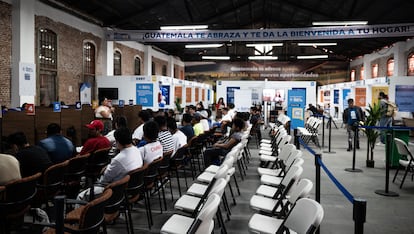
Among them is Olinda, 31, originally from the north of Guatemala. With one hand she pulls on the collar of her sweatshirt to cover her face, with the other she wipes away her tears. Head down, she enters the Returnee Reception Center with the others to receive a welcome talk, food, and legal guidance. Here, the staff of the Institute of Migration is in charge of reception. Job orientation is provided in the new Care Center for returned migrants, inaugurated on June 2, to which most of them move after completing the initial stage. An attempt is being made to make deportation a less traumatic experience. But Olinda continues to cry.
Olinda cannot forget the four months she spent in detention in Pennsylvania, nor the chains that bound her hands, feet and midriff until the plane entered Guatemalan airspace; less still the moment when she was torn from her life in the U.S. – it happened when she and her husband were going to buy material for the remodeling company where they worked in Maryland. When the police stopped the car for a check, she began to shake. Neither she nor her husband had legal residency papers. It was a March day and as they pulled the car over and rolled down the window, only one thought crossed her mind: Will I ever see my daughter again?
“I haven’t seen her since that day,” she says. “She is 13 and was at school when they grabbed me. I have only spoken to her on the phone since the arrest. At first, I asked for her to be deported with me, but I stopped when I realized that there are no doctors in prison, no decent food. I didn’t want my girl to go through this.”
Olinda sobs and blows her nose. Her words are echoed by Micaela, who has already taken off her gray jumpsuit and got back into the clothes in which she was arrested. She lived in the U.S. for 12 years. She has left three children behind: the two youngest are American citizens by birth, a right enshrined in the 14th Amendment, though it could still be revoked by the Trump administration. “They caught me at home. I don’t know how they knew I didn’t have papers,” she says. “My children are still there, but I’ll die if I don’t see them again. I want to bring them over, but I have to get organized first because they have always lived there, and changing everything will not be easy for them. Life here is very different.”
Micaela is 45 and has had a hard life in both countries. She is illiterate and signs with her fingerprint. She is sad because she thinks that not knowing how to read or write will make it even more difficult to be reunited with her children.
[My daughter] is 13 and was at school when they grabbed me. I have only spoken to her on the phone since the arrest. At first, I asked for her to be deported with me, but I didn’t want my girl to go through thisOlinda, Guatemalan deportee
Olinda also plans to bring over her daughter, who now lives with a neighbor and has not been to school since her mother’s arrest. “As she is a minor, she needs me for any school procedure,” she says, still crying. “She’s stranded without me. I hope to find a job here to pay for her ticket no matter what.”
John eyes the scene and sighs. “I was arrested with 15 other colleagues while we were working,” he says. “The police came in and the boss said nothing. After years working there, it was horrible. That guy [Trump] is fucking crazy,” he blurts out in English, clenching his jaw and touching his forehead, before looking for a way to call his relatives to let them know he has arrived.
Although Secretary of State Marco Rubio spoke in February of an alleged 40% increase in deportations, the truth is that expulsions have decreased significantly, especially to Guatemala, one of the countries with the most deportees in proportion to its population. Between January and July 16 of this year, 24,139 people have been returned. That is an average of 103 sent back on flights every day, compared to 168 per day in 2024, when the figure of 61,680 was reached in total.
On the other hand, the number of flights has not decreased drastically, and some are arriving without being filled to capacity. There is no official explanation, but it suggests a strategy used by Trump to appear to be doing more deportations than he in fact is. In June, the news broke that the U.S. had set a new record with 209 deportation flights, without specifying the number of actual deportees on them.
Breaking with the practice of the previous administration, most of the deportees are no longer migrants detained at the border, but people arrested inside the country. In fact, almost no one even manages to cross from Mexico these days. In May 2025, more than 12,400 people were apprehended at the southwest U.S. border, compared to more than 170,000 in the same month last year. A reduction of more than 92%.
Return south
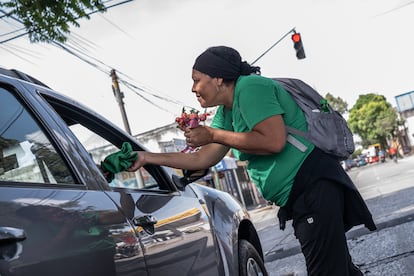
Guatemala, a country that has historically been a source of migrants, is increasingly becoming a place of return and transit, with more people heading south than north. David, a 16-year-old Venezuelan who left Colombia for the U.S. in January 2024 with his mother Marisol, 50, knows this. With a squeegee in one hand and a container of disinfectant in the other, he practices how to clean the windows of a car parked in the center’s carpark. It’s his first day on the job, because he usually helps his mom sell candy at traffic lights. A year ago, they did it to finance their trip to the north. Now they are doing it to pay for their return to the south, after eight months living on the streets of Mexico City, waiting for a humanitarian flight that would allow them to “self-deport” to Colombia or Venezuela, but which never arrived.
“We didn’t achieve the American dream,” Marisol says. “We are depressed, but we couldn’t take it anymore on the streets.” After Trump’s inauguration, which canceled the CBP One application for asylum and humanitarian parole – a temporary permit that benefited migrants from Cuba, Venezuela, Nicaragua and Haiti – thousands of Latin American migrants decided to turn back and make for home.
The backward migrant journey has also been turned into a business. “The crossing between Panama and Colombia is done by raft and costs $300 dollars per person,” says Beti, a 32-year-old Venezuelan. “It’s better than crossing the Darien jungle, but I don’t know how many candies we will have to sell to raise $1,500.”
Beti is five months pregnant. She is traveling with her husband Edwin, 38, and three other children, in addition to the one on the way. They are returning to Caracas after a year and a half, trapped in a round trip that has cost them about $30,000. “I never imagined I’d be migrating backwards,” she continues. “The worst thing is that police and drug traffickers still target us. It’s the same. We are still merchandise, although we just want to return.”
The worst thing is that police and drug traffickers still target us. It’s the same. We are still merchandise, although we just want to returnBeti, Venezuelan migrant
Richard, a 50-year-old Venezuelan who has a cane with an iron whip hidden inside, is going with them. “After what I experienced, you have to be able to defend yourself,” he says, smiling nervously. He was deported from the U.S. to Mexico on March 1, after being arrested while working for Uber in Dallas. “They deported me even though I had a work permit and a driver’s license,” he says. “They took me to the detention center, and I only managed to call a friend to ask him to take care of the car.” Then he traveled by bus to Panama, but after two months he tried to head north again. In June, he reached Mexico, where he lived on the streets for three weeks, defending himself every night from drug traffickers and thieves, but when he was told about the increase in border controls, he decided to give up. “Now I’m going to Costa Rica,” he says. “It has a better economy and is less violent than Mexico, a place that has traumatized me.”
Lorena Pérez, project manager at the Casa del Migrante in Guatemala City, has never seen such a flow of people heading in the opposite direction. “Between 2023 and 2024 we dealt with 2,000 people a month, now it’s an average of 700. Fifty percent are reverse migrants, and the rest are deportees and asylum seekers,” she explains. “Only 5% are headed to the U.S.”
Casa del Migrante has adjusted its protocol accordingly: it now offers up to three months of shelter to asylum seekers and about three weeks to families working to raise money and return home. Previously, they only gave one night of lodging to those going north. “We are expanding psychological support because those who return, although it seems voluntary, feel sad and carry a sense of failure,” she says.

Although Guatemala has never been a regular destination for asylum seekers, requests are on the rise: from 962 in 2022 to 1,837 in 2024 and 664 through May 2025, more than in the same period last year. Among them is Pablo, a civil engineer of Venezuelan origin. Since November 2024, his has been a familiar face at the center. With his Elmo puppet he gives shows at traffic lights in exchange for a few coins with a sign on his neck that reads: “Help me bring food home. God bless you.” The phrase ends with chamo which in Venezuelan slang means friend. “I have applied for political asylum and I have already brought my whole family from Venezuela,” says Pablo. “My children are already in school and I plan to live here forever.”
Sign up for our weekly newsletter to get more English-language news coverage from EL PAÍS USA Edition