
How Mexican consulate staff struggle to defend migrants in the US while living on the brink of poverty themselves
Foreign Service employees are receiving the same salary as in 1998, getting by on subsidies, and coping with grueling workdays to deal with the surge in requests for help stemming from Trump’s deportation drive
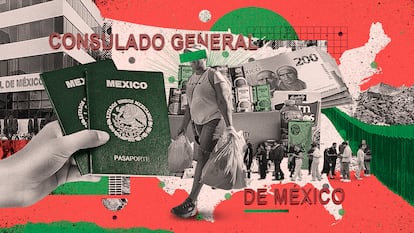
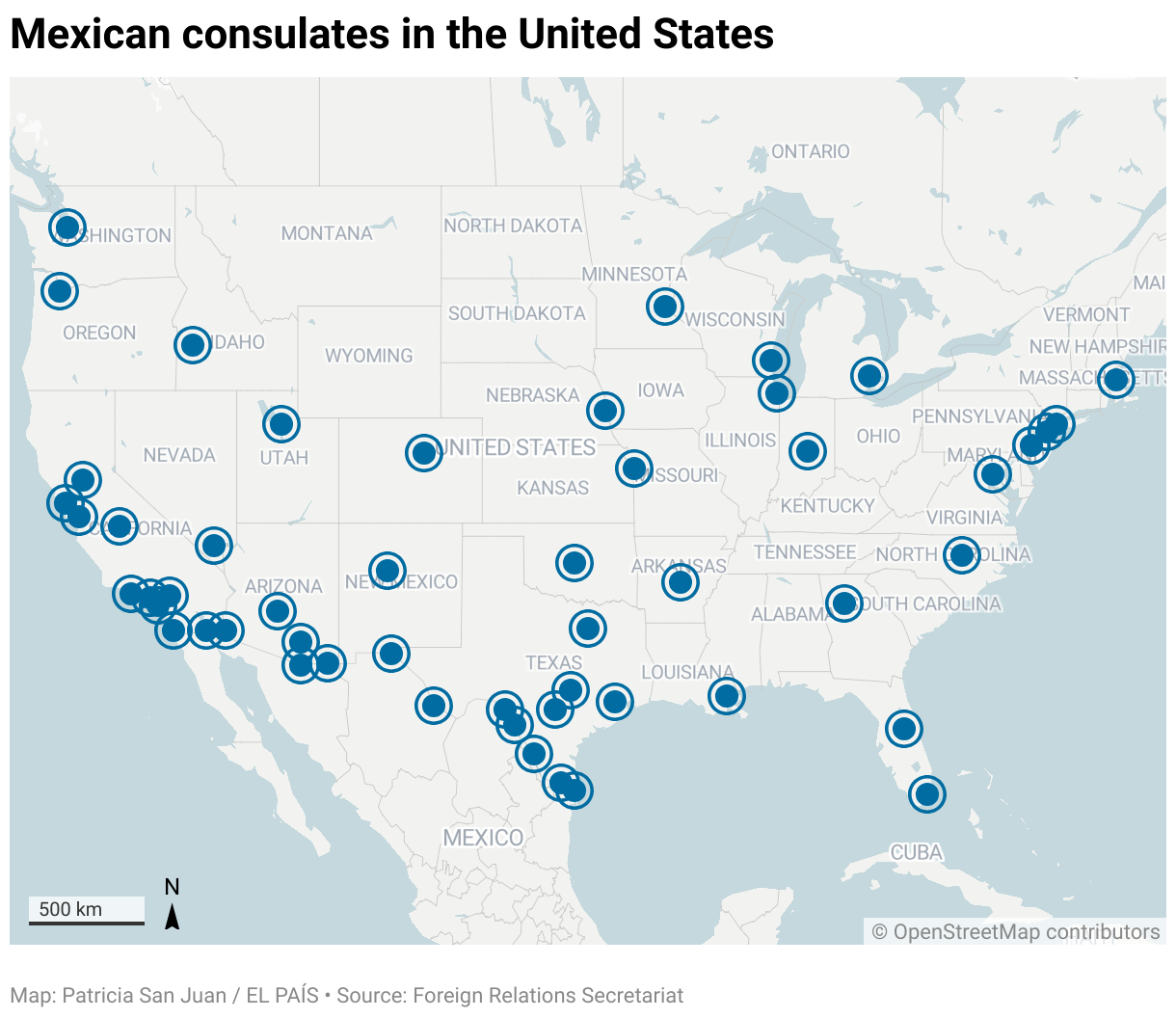
Susana is a member of the Mexican Foreign Service and currently serves as the administrator of one of the 53 Mexican consulates in the United States. She begins her workday at 6 a.m. with calls from Immigration and Customs Enforcement (ICE) to receive the list of detained migrants for that day. Her shift ends, if she’s lucky, at 10 p.m. One of her monthly paychecks came late recently so she had to pay a surcharge on her apartment rent. She also paid late fees on rent, utility bills and security for the border consulate where she works. Susana—not her real name—goes to the food bank in her city once a month because she doesn’t have enough for groceries, and seeks any extra help the U.S. government has to offer: “I have an electricity subsidy of $16; it’s not much, but every little bit helps.”
The salary that comes with her position, $3,295, has been the same, down to the last cent, since 1998. In 27 years, while the cost of living in the United States has skyrocketed, there has been no salary adjustment for these officials, placing a good portion of Mexican Foreign Service (SEM) employees below the country’s poverty line. This forces some of them to live in social housing, receive subsidies from the U.S. government, or even eat donated food. Saving, going on vacation, or dealing with medical emergencies is practically unthinkable.
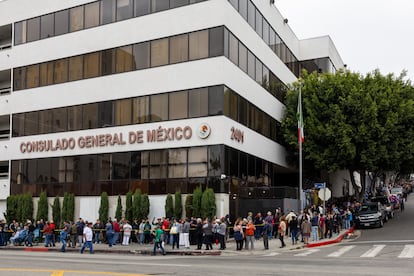
Donald Trump’s return to the White House has intensified the pressure. The workdays are getting longer, the calls for help are multiplying, and the panic among the Mexican migrant community is shifting to their first line of defense: the consulates. These are facing the onslaught with widespread cuts to the budget, which has shrunk by 6% compared to last year and 38% compared to 2018. “They’re asking us to do more with less,” sums up Óscar (not his real name), who is stationed in another diplomatic post. President Claudia Sheinbaum’s support, he notes, has remained only rhetorical. “I listen to what the president and the foreign minister say about protecting Mexicans here [in the U.S.], but they talking about resources that don’t exist,” adds César (also not his real name).
Stress and poor working conditions have caused a stampede within the Mexican diplomatic corps. In the United States alone, there are 69 unfilled positions, 17% of the total, according to public information from the Foreign Ministry. Only 17 of the 53 consulates are fully staffed, and in some consulates, half of the positions remain unfilled. Meanwhile, the number of handpicked appointments, especially of sympathetic politicians, has become more visible. All interviewees agree: the problems have been dragging on for too long, but the arrival of the leftist party Morena to power has made them even more pressing.
EL PAÍS reconstructed the odyssey in different consulates in the United States with sources who worked in the Mexican Foreign Affairs Secretariat and with the testimony of 10 members of the Foreign Service, who requested anonymity for fear of retaliation in their jobs. Contacted by this newspaper, the Secretariat declined to respond and said information should be requested from the transparency unit. However, this department, which did not respond by press time, does not make political statements.
A subsidized “elite” body
In the 27 years that Foreign Service pay has been frozen, some things have changed in the United States. A dozen eggs have gone from costing an average of $1 to $6.20; the price of a gallon of gasoline is now three times what it was then; education costs 47% more, and healthcare, housing, a kilowatt of electricity, bread and potatoes have at least doubled, according to data from the Federal Reserve Bank of St. Louis (FRED) and the U.S. Government’s Bureau of Labor Statistics.
In this context, all the workers surveyed said they spend half of their salary on rent alone. This percentage can rise to 70% if car expenses are included. Several of these workers occupy the lowest rung of the hierarchy due to the bottleneck that has formed in the promotion system, and as a result, they live on the edge of the poverty line in their cities. Ana’s apartment, on the east coast of the U.S., is part of the subsidized housing program, and yet she sometimes fails to pay rent on time. Susana has had several health emergencies that have led to complications because she wasn’t able to pay for care, as “medical care is unaffordable.”
“It gives you a total feeling of being unprotected. It’s a very desperate situation. You’re working for the Mexican government and living off aid from the United States government,” she notes.
Most of these workers handle all kinds of tasks, from ironing flags to tasks that go beyond their duties. They are the ones who suffer the most from the stress and the hate speech. César used to put in 12 hours a day, six days a week, at his consulate in California, and yet he explains: “There wasn’t enough time to cover all the services. They didn’t hire more people, nor did the number of scheduled appointments decrease. It was horrible. I lost a lot of weight and started going to therapy. Those levels of anxiety led me to the emergency room with a crisis I’d never had before.”
Some foreign service employees have dependents—which makes their situation even more precarious—and several said they were hesitant to start a family for fear of not being able to support them: “We are the weakest link in the chain; for me, it’s impossible to plan for children with this job,” says Jesús, 31. Vanesa, 40, echoes this sentiment: “It’s lucky I don’t have children, because I wouldn’t have time for them. You have to be always available for the consulate, no matter what, and there’s no compensation for extra work.” The idea of an elite corps full of privileges crumbles when you look closely.
Failures in the protection of Mexicans
Even in this precarious situation, many workers finance the consulate’s work out of their own pockets. The Secretariat of Foreign Affairs has owed Óscar nearly $2,000 for six months. As required by law, he used his own funds—and was later reimbursed—for several Consulates on Wheels (travel by diplomatic staff to locations far from headquarters to serve Mexicans unable to travel): “We are financing the Foreign Secretariat, interest-free.” This is also the case with Vanesa, who works in California and acknowledges that her office is phasing out these programs: “We canceled several because no one wanted to contribute their own money to pay for them anymore.”
One of the situations most often reflected in the testimonies from all over the United States is that, at a critical moment in time, resources are failing to arrive. “The Secretariat has asked us to close ranks, to redouble our efforts, and we are fully prepared to comply, but we lack the tools for it,” says Jesús. “We focus on putting out fires and addressing the most urgent issues, but it is very difficult to care for our fellow citizens and protect them when you don’t know if you’ll be able to pay the rent.”
The budget for the “Consular Care, Protection, Services and Assistance” program was 524.2 million pesos ($28 million) for 2025 out of a total of 9.294 billion pesos ($491 million) received by the Foreign Affairs Secretariat. In nominal terms, this is the third lowest amount since 2017, but when adjusted for the real value of the peso and taking inflation into account, it is the lowest in the last 15 years. And it’s happening at a critical time. “They commissioned us to carry out massive protection campaigns, but there are no resources for it,” says Vanesa. “The community has responded with hysteria, and demand for dual nationality procedures has increased significantly, but we don’t have the capacity to respond.”
In some consulates, the budget cuts were primarily felt at the health office, mobile consulates, and office expenses, according to staff, but others also reported a decrease in funding for protection, which includes labor, civil, criminal, and immigration assistance. This key item has even been cut for border offices, where the recommendation is that it should be their priority. “They created an app with an alert button, which generates false expectations because the consulates don’t even have the resources to assist people,” Kiara points out.
“They want us to provide support, but they don’t send any money. We already owe money to the lawyers they hired to provide legal advice,” Susana adds. In the last five years, Mexico has been the country with the highest number of detentions and deportations from the United States. The consulates also handle these cases. “People come with very serious needs, and we have to define priorities, and there are people who are left without help,” this worker states. The Foreign Affairs Secretariat has declined to comment on these situations.
The kingdom of consulates
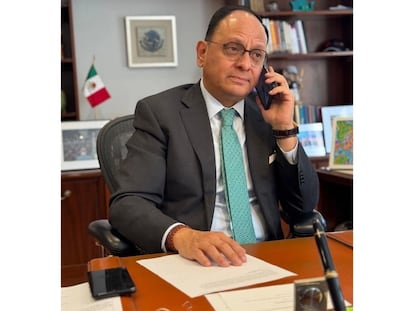
Graciela Rock served as consul for six years in three different locations. After her journey, she describes the consular offices as “a collection of micro-kingdoms in which the heads of the consular offices are total dictators.” Rock was one of the women who denounced harassment by Jorge Islas, who was then consul general in New York. In 2024, 16 current and former employees published a letter denouncing abuse of power, harassment, and stalking by Islas. Despite this, Mexican President Claudia Sheinbaum proposed him to lead the General Coordination of Consulates, which he later declined, although he denied the accusations in a public statement. “Islas’ is not an isolated case; it was an extreme case, but not an isolated one. The four heads of consular offices I worked with engaged in this type of dynamic to a greater or lesser extent,” the diplomat asserts.
Rock describes the lack of transparency in Foreign Affairs’ internal processes and the lack of consequences for those engaging in harassment. “When you file a complaint, there’s a feeling of ‘Why am I doing all this?’ The Mexican Foreign Service is a very small world that depends heavily on your good relationship with your staff: your quality of life, your job, your promotions, your transfers... depend on your relationship with them,” she says.
The employee claims that the then director of consular services, Jaime Vázquez Bracho, sought her and other New York employees out individually after a visit to the consulate. “We hesitated to speak to him because we didn’t know if it was an attempt to find out what was going on or a witch hunt. Finally, several of us spoke to him, and he assured us that the matter would be seen to. Obviously, it never was, and most of us ended up leaving,” she laments.
Rock’s account echoes the concerns of two victims of harassment by permanent consuls, one in Texas and the other one in California. Both employees filed their complaints with the Internal Oversight Body, but they note that the reporting procedures, in addition to being revictimizing, are ineffective, and that they have not found any solution to their situation.
In general, one thing all testimonies agree on is the Secretariat’s total and complete silence regarding employees’ demands and complaints. “We struggle to get our work done. No one has ever paid attention to us; we’ve filed complaints and sent letters to the foreign ministers,” says Óscar. “We’ve never received a response; their attitude is ‘I don’t see them, I don’t hear them’.” This employee, who in 18 years at the SEM has only been promoted once, sums up the current spirit of the Mexican diplomatic corps: “I’m passionate about my job, but the conditions are unsustainable.”
Sign up for our weekly newsletter to get more English-language news coverage from EL PAÍS USA Edition









































