
Suffer in silence or risk being deported: The terrible dilemma faced by undocumented female victims of domestic violence
Survivor-advocates warn of the harm caused by immigration raids: ‘These women are more likely to die now’
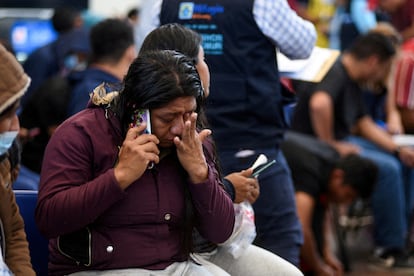

The fear of expulsion and family separation is leaving undocumented female victims of domestic violence facing an impossible choice: report the abuse and risk deportation, or remain in an abusive relationship. They can either endure gender-based violence at home — which can even lead to death — or face the relentless Immigration and Customs Enforcement (ICE).
The Trump administration’s anti-immigration policies and its determination to achieve the largest deportation rate in U.S. history exacerbate the risk that these women have to contend with when approaching the authorities. ICE is eager to fill the government’s quota of 3,000 deportations per day, and when an undocumented immigrant files a report denouncing abuse, the victim is essentially handing themselves over.
“Fear among migrants who suffer from domestic violence has increased dramatically under this administration. When you see people literally detained in the street while taking their children to school or the supermarket, the fear increases enormously, and for good reason,” explains Christian F. Nunes, president of the National Organization for Women (NOW), a feminist advocacy organization.
Even in sanctuary cities — such as Albuquerque, New Mexico — women are afraid to report the plight they experience in their homes. ICE has invaded the country’s streets, searching for people to deport. Bonnie Escobar — who directs Enlace Comunitario (Community Link) — confirms that fear has taken hold among migrants who suffer from abuse. Her organization has been helping victims of gender-based violence for 25 years, providing them with access to therapy, shelters, counseling and legal defense. They serve around 700 survivors each year, and they’ve already felt the effects of Trump’s second term. About a month ago, ICE raided a local Walmart — twice — and detained several undocumented workers, spreading fear among the migrant community.
The weekly support group meeting — where participants learn how to apply for a restraining order and how to write a police report, among other things — is usually attended by 20 survivors of violence. Last week, however, only five attended. “And the five who came told us that they were afraid to leave the house, because they didn’t know if they’d run into ICE,” Escobar sighs. “We’ve seen the chilling effects from just two raids.”
Gender-based violence is defined as abusive behavior, which is intended to control a partner or another family member. The abuse can be physical, emotional, economic or sexual. Escobar explains that, in more “macho cultures” — as is the case with much of the Latino community — it’s more common for women to view abuse as something that they simply must endure in a relationship. Add to that the fear of falling into the clutches of ICE. and they’re even more likely to avoid reporting it.
The Houston Chronicle recently published the case of a Salvadoran woman whose information ended up in the hands of immigration agents after she dialed 911 for help. She was being abused by her ex-husband.
The woman arrived in the United States with her husband and two children in 2018, fleeing gang violence. The couple had a third child in Houston, but separated shortly afterward. In 2024, she obtained a restraining order against him due to repeated abuse. However, the harassment continued. At work and in public, he harassed her, armed with a gun and knives. He threatened to kill her.
This past April, after being approached by him while shopping, she called the police, who provided her with a helpline. The officer who answered the phone warned her that the police had forwarded her report to ICE and advised her not to file a report in person, or she would risk being detained.
“If he were to hurt me again, I don’t think I could report it, because that’s where my story would end,” the woman told The Houston Chronicle.
Her case isn’t unique. Many undocumented women prefer to suffer in silence rather than reveal their identity and end up in the hands of ICE. A recent survey conducted by Advocates for Immigrant Survivors (AIS) shows that 76% of attorneys admit that undocumented victims are afraid to report abuse. The added risk of deportation prevents them from applying for restraining orders, calling the police, or going through the court system.
“This survey shows us the serious chilling effect that recent changes in immigration policy are having on immigrant survivors of violence,” says Cristina Vélez. She’s the policy director of ASISTA, an organization that provides assistance to advocates for migrant victims of domestic violence. “This is the message they’re receiving: either stay with their abuser, or risk deportation.”
The Trump administration’s collaboration with state and local law enforcement agencies has exacerbated the situation that these women are trapped in. Immigration agents’ raids on courthouses also discourage them from suing their abusers.
Undocumented women have fled violence, poverty and persecution of some kind in their countries of origin. Their vulnerability is greater than that of other women, meaning that they’re more exposed to gender-based violence and sexual abuse. A 2017 NOW report — conducted during the first Trump administration — already showed that abuse rates among immigrant women reached 49.8%, almost three times the national average.
The abusers — who are often the only ties that these women have to the United States — take advantage of this dependency. They can blackmail their victims with various threats. These include reporting them to the authorities, halting or not starting their regularization processes, separating them from their children, or withdrawing financial support. In many cases, victims also don’t speak English, further complicating their situation and increasing their isolation.
The NOW report showed that, among abusive spouses who could have filed legal immigration documents for their victims, 72.3% never filed them. And the 27.7% who filed did so with an average delay of 3.97 years.
“You’re my wife. I warned you.”
The vulnerability of undocumented women led the U.S. Congress to pass the Violence Against Women Act of 1994 (VAWA). This legislation allows foreign nationals — who have been abused by a relative who is either a U.S. citizen or a lawful permanent resident — to independently apply (self-petition) for permanent residence without the abuser’s knowledge, consent, or involvement in the immigration process.
According to data from the U.S. Citizenship and Immigration Services (USCIS), 35,917 VAWA petitions were filed in 2024. The number of applications has increased by 350% in the last decade.
A 31-year-old woman who left her husband after several incidents of physical and verbal assault showed CBS News some of the messages she received from her abuser. One message read: “1. You are my wife. 2. I am your petitioner. Lawfully you cannot just leave, as an American you are my responsibility. I’m sorry but I warned you.” He also sent a warning to the victim’s sister: “I will contact immigration soon” and “ICE can show up any day and deport,” the text messages read.
Nunes explains that the raids ICE is carrying out in places that were previously considered safe — such as churches, schools and hospitals — are causing undocumented women to feel more unsafe than ever. “There’s real cruelty and inhumanity in what’s happening with the current immigration policy. There’s extreme fear,” she says.
ICE agents now also have access to shelters that house women who are victims of gender-based violence. Trump ended the protection that these facilities had during the Biden administration, which prevented immigration agents from entering the shelters. The director of one shelter — which primarily serves Hispanic women in El Paso, Texas — told USA Today that she had observed a 25% decrease in the number of people seeking help. The director requested anonymity for fear of retaliation from ICE.
The hostile environment that the Trump administration has created for migrants also influences the domestic sphere. If there was already violence taking place, it’s now been exacerbated by the government’s policies. “If there’s ever been a strangulation incident [in the past] — or if there’s a gun in the home — these women are more likely to die now,” says Escobar.
Sign up for our weekly newsletter to get more English-language news coverage from EL PAÍS USA Edition









































