
Florida’s undocumented immigrants afraid to enter hurricane shelters due to ICE fears
While authorities insist that no one will be turned away based on immigration status, recent local-federal enforcement deals are fueling mistrust
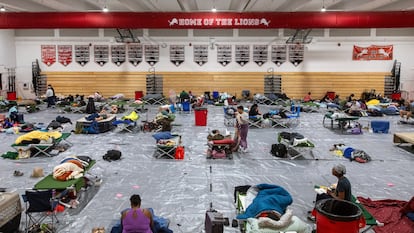
Florida is the epicenter of hurricanes in the United States. Nearly half of the hurricanes that reach the country make landfall on the peninsula, nestled between the warm waters of the Gulf of Mexico and the Atlantic Ocean. Most are detected well in advance, and the state often issues evacuation orders for millions of people.
However, there is a long history of hurricane-related deaths. In 2022, Hurricane Ian slammed into Pinellas County on the West Coast, causing waves measuring more than 16 feet and killing 150 people. In 2023, Hurricane Idalia hit the Big Bend north of Tampa, causing a dozen deaths. And last year, Hurricane Helene did the same. State and local officials have spent millions of dollars on elaborate contingency plans that include information, shelters, supplies, and rescue operations for the Atlantic hurricane season — from June 1 to November 30.
But as hurricane activity ramps up this season, pro-immigrant activists worry that many undocumented people will avoid seeking shelter out of fear of authorities, given the anti-immigrant crackdown in Florida led by Governor Ron DeSantis and supported by President Donald Trump.
“The level of fear people have could put them in a position of risking their lives just to avoid being arrested and deported,” said Tessa Petit of the Florida Immigrant Coalition (FLIC). The organization has been trying for years to “convince people to seek shelter” in the event of a hurricane, Petit added, but their fear has become so intense that “many are afraid to even be in public places.”
In previous years, U.S. Citizenship and Immigration Services (USCIS) posted notices stating that immigration raids would not be carried out at hurricane shelters. FLIC used those announcements to encourage people to seek refuge, but now “we don’t know if this administration will do the same,” Petit said. “Even if they say this, people aren’t going to trust them.”
For years, Immigration and Customs Enforcement (ICE) maintained a policy of avoiding raids in so-called “sensitive” locations, such as schools, hospitals, and hurricane shelters. But in January, following Trump’s return to the White House, the administration revoked that memorandum — a move that has since been challenged in court. ICE did not respond to requests for comment about immigration enforcement operations in or near hurricane shelters during emergencies. The Department of Homeland Security (DHS) also declined to comment.
Distrust of authorities has long existed within immigrant communities. In 2017, ahead of Hurricane Irma, then-senator Marco Rubio said that farmworkers in central Florida were afraid to evacuate but should not fear seeking shelter. Rubio and Miami-Dade Mayor Carlos Giménez assured that immigration authorities would not pursue undocumented migrants. Nonetheless, many avoided government shelters and turned instead to neighbors and churches.
But in recent months, hundreds of thousands of immigrants have suddenly lost their legal status after the Trump administration rescinded humanitarian programs and canceled temporary protections for citizens of several countries. Many live in South Florida, where mobile home parks are one of the few affordable housing options for low-income immigrants, including Hispanics and Haitians, according to research groups. Mobile homes are particularly vulnerable to hurricanes. Studies indicate that only about half of their residents would evacuate to public shelters.
Most hurricane-related deaths are caused by water, not wind. The rise in sea level during a storm — known as a storm surge — is the deadliest factor. Nearly the entire coastline on both sides of the peninsula, where the main cities are located, is considered high-risk. Large areas of Miami-Dade County, especially coastal communities or those near canals, are designated as “special flood hazard zones” that require evacuation. Many mobile home parks are located in these areas.
The Miami-Dade Emergency Management Department sets up temporary shelters in schools and other concrete buildings, where cots, portable toilets, and generators are provided to accommodate thousands of people. According to official figures, 70% of Miami-Dade residents identify as Hispanic. County authorities say that no one seeking shelter is asked for identification or questioned about their immigration status. Miami-Dade police guard the shelters.
As part of Florida’s crackdown on immigrants, DeSantis has promoted agreements between local and federal authorities for immigration enforcement activities, such as raids, aiming to meet Trump’s demand to arrest 3,000 immigrants per day. More than 200 law enforcement agencies in the state have adopted these agreements, known as 287(g), including the Miami-Dade police.
A county police spokesperson said the officers assigned to the shelters “are there to ensure everyone’s safety” and “will assist any local, state, or federal partner upon request, as has always been our practice.”
José Ernesto, a former paramedic who worked on rescue efforts in mobile home parks in the Florida Keys south of Miami, said authorities cannot force people to evacuate, and many choose to stay in their homes knowing they are risking their lives. However, the former paramedic — who asked not to give his full name because he was not authorized to speak about the operation — understood “that people don’t want to go to a shelter” out of fear of immigration agents. While authorities “cannot discriminate against anyone because it’s a matter of life or death,” he noted, “when you enter one of those places, you don’t know how you’ll come out.”
“That’s where the problem lies. The fear of those places being checked,” he added.
A spokesperson for Pinellas County on the west coast, where Hurricane Ian struck, said that “while there is a check-in process upon arrival at a shelter — which may include asking for ID and basic questions like name and address — no one will be turned away for not having ID or for not filling out their information.” They added that “if someone doesn’t feel comfortable going to a public shelter,” they recommend finding a friend or family member who lives outside evacuation zones and staying with them.
This hurricane season may also be the last one for the Federal Emergency Management Agency (FEMA), the agency that provides financial assistance after disasters, promotes public education, and coordinates evacuations and rescues alongside local authorities. The Trump administration has suggested dismantling FEMA after this season, which would mean that states and local governments would have to shoulder greater costs in the face of disasters.
Recently, the government canceled a federal grant program, calling it “political and wasteful.” At the same time, it decided to redirect funds from a FEMA shelter program managed by the DHS to finance a new immigrant detention center in the Everglades.
Thomas Kennedy, from FLIC, said the organization is trying to get the attention of the state, local lawmakers, and FEMA, but “unfortunately, it’s the government itself that’s creating this chaos.”
Sign up for our weekly newsletter to get more English-language news coverage from EL PAÍS USA Edition









































