
The Tomato War: Trump breaks an old treaty to hit Mexico with more tariffs
The economy secretary accuses the United States of having rejected proposals for agreements for ‘political reasons’


America’s war of protectionism comes to Mexico every day, under different names: steel, migrants, fentanyl, or tomatoes. This time it’s the producers of the precious red fruit who are affected. President Donald Trump is resorting to an old controversy about unfair competition between farmers on both sides of the border to impose another 17.09% tariff on Mexican tomato exports, which are not insignificant at $2.8 billion a year. This is not about punishing Mexico for not combating drug trafficking, as he has been claiming, or for allowing migrants to cross the border. This is a dispute from 1996, when American farmers complained that they couldn’t compete with the price of Mexican tomatoes entering their territory, but which was resolved for decades with agreements, the most recent in 2019. But the days of normalized trade relations are over.
Trump seeks to protect his country’s productive sectors and has chosen tariffs to do so, with everyone, not just with Mexico, as President Claudia Sheinbaum likes to repeat. True. The difference is that with Mexico, the U.S. maintained trade relations that were enshrined in a trade agreement designed to make North America a competitive region able to compete with other economies that are gaining ground, China first and foremost. That agreement between the United States, Canada, and Mexico is losing steam every day, at least as a negotiating framework. Mexico is now lumped in with the rest of the countries affected by Trump’s policies.
In light of this constant barrage of fulfilled threats, the cool-headed strategy that began yielding results for Sheinbaum is now proving insufficient to stem the commercial attacks falling on Sinaloa, a major producer of everything, including tomatoes. In addition to the open war between cartels, which robs the population of peace and a minimal quality of life, this storm cloud is now hanging over its fields.
International experts have been warning of a certain stagnation in the bilateral negotiations that is preventing progress and leading to a new surprise every day. They believe that Mexico should change its bilateral relations, refocus its strategy, and try to bring the talks within the framework of the trade agreement. To achieve this, some experts consulted by this newspaper believe, it is necessary to modify the diplomatic cadres, starting with the ambassador and continuing with the consulates, so that meetings are established at different levels of governance, including governors, local congresses, and productive sectors that will identify the best way to reconcile interests on both sides of the border.
The strategy, however, remains reactive, meaning the United States speaks out and Mexico takes the hit: sometimes it manages to slow its force, but not much more. It’s an “unfair” decision, said Economy Secretary Marcelo Ebrard, who in a statement said that they were notified this Monday and that in the negotiations between U.S. and Mexican producers, “various proposals have been made to try to reach a good agreement,” but they have been discarded “for political reasons.”
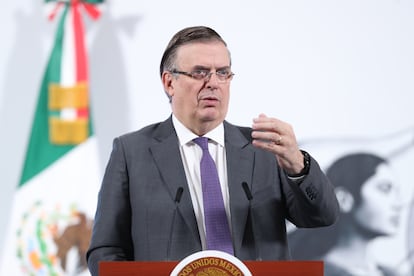
As on other occasions, the secretary has come out on the defensive, denying the previous accusations of unfair competition and asserting that the ground gained by Mexican tomatoes is due “to the quality of the product and not to any unfair practices.” Also following the usual response pattern, his department said that American consumers will be the most intensely affected by any potential price increase, since two out of every three tomatoes they consume are produced abroad. And that “abroad” is Mexico.
Mexican producers warn the United States that it will be unable to replace the tomato production demanded by its population in the short or medium term. The Economy department says it is seeking a possible new agreement or “new international markets” for its exports, as well as exploring tomato processing to gain added value, rather than dedicating the majority of its production to fresh produce exports. “Mexico will know how to find the solution, and reason will prevail.”
The response of producers and the government follows the logic of unity imposed by the external enemy. “This is a resilient sector that has overcome the trade battles that have sought to limit its development over time, so we will continue striving to put the highest-quality tomatoes on the tables of American families despite the obstacle of the tariff, which will inevitably impact consumers’ pockets.”
Producers are grateful for President Sheinbaum’s commitment and support and are prepared to ride out the storm, which perhaps, who knows, will end in an agreement. This has been the case since this issue first cropped up in 1996, with every outburst of complaints from Americans about the tomato industry ending in an armistice. But the same old logic is no longer the same.
Sign up for our weekly newsletter to get more English-language news coverage from EL PAÍS USA Edition









































