
Mexico’s cycle of poverty: ‘I have to work hard to live better than my mother did’
A social mobility survey shows that 50% of people born into the lowest economic strata do not improve their economic condition

María Mancilla is 65 years old and constantly working. She has been cleaning houses for over 30 years, and her debts keep her in the workforce despite her back pain and bronchitis. She earns about 7,500 pesos a month (around $375), much of which goes toward paying off debt. Mancilla barely finished elementary school, her daughter made it to high school, and her mother never set foot in a classroom. She represents a Mexico that perpetuates inequality: 50% of people born into the lowest-income groups never rise out of poverty.
“We have a structural problem with the intergenerational cycle of poverty,” says Roberto Vélez, executive director of the Espinosa Yglesias Center for Studies (Ceey).
The center, which has been conducting a social mobility survey in Mexico since 2006, released a report last week with uncomfortable findings: Mexicans born into poverty face enormous challenges in improving their circumstances. In other words, “poverty in Mexico has a strong hereditary component.” This is the poverty María Mancilla has inherited — one that is further reinforced in her case by being a woman. “I have to work very hard to live better than my mother did,” she says.
Mancilla’s mother had to raise six children — four of them girls — on her own. “She was both mother and father and worked from 7 a.m. until midnight, also cleaning,” she recalls. “As we kids got older and started our own lives, we didn’t have anyone to help us continue studying or support us financially.” The study reveals that 75% of people whose parents had only an elementary school education or less do not reach Mexico’s average level of schooling, which stands at 9.4 years.
Roberto Vélez explains that the economic situation in Mexican society resembles a five-rung ladder. The first rungs represent the lowest income levels. “The question we ask is: if you’re born on the first rung — the very bottom — what are the chances you’ll move up from there? And the probability of staying there is 50%. That means half do move up, but how far?” he says. “It turns out that the vast majority — 28 out of 100— only make it to the second rung.” In other words, he adds, 78% of Mexicans remain stuck on the lowest income rungs.
Women at a disadvantage
María Mancilla managed to move up one rung but got stuck. She worked for years as a laborer in a textile factory, but had to leave the job during her pregnancy, which she says was “very serious.” “I stopped working for two years. Then I started looking for a job in someone’s home where I could bring my daughter. I also took on debt to pay for her needs, to help my mother, and to support the household. And that’s how we’ve managed — taking out loans, paying them off, and taking out more. I never see the end of it,” she says. Her daughter finished high school and then decided to study cosmetology. “Right now, she works in a beauty salon,” she says.
Roberto Vélez uses a term to describe how difficult it is for Mexican women to escape poverty: the “sticky floor.” “You just can’t pull yourself away from the bottom,” he explains. It’s the opposite of what’s known as breaking the glass ceiling, where women overcome the invisible barriers that block them from moving forward in public life.
The study by his organization shows that upward mobility from the lowest economic levels is even more limited for women. It’s also harder for women to remain in the top income group. “If you’re born on the top floor, the fifth level, what are the chances you’ll lose that status? For men, 53% manage to keep it. For women, it’s only 47%. That is, in percentage terms, women are more likely to lose it,” explains Vélez.
The wealthy north vs. the poor south
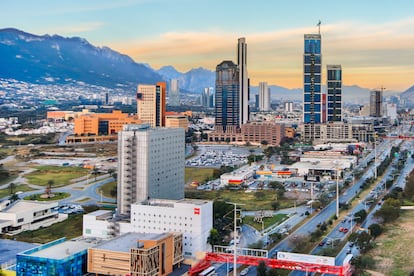
Inequality in Mexico is also shaped by geography. Mancilla is originally from the sprawling urban mass of Mexico City and its surrounding areas. She considers herself fortunate to own a home in Ermita de Iztapalapa, a neighborhood that, while economically disadvantaged, still has access to services, public transportation, hospitals, and schools. This stands in stark contrast to the situation faced by millions in southern states such as Chiapas, Oaxaca, Guerrero, or Veracruz. Vélez notes that in northern Mexico, 37% of those born on the lowest rungs of the economic ladder remain there — while in the south, that figure climbs to 64%.
“Nationally, Mexico is among the 10 countries with the greatest inequality of opportunity, but when you break it down regionally, it turns out that, on the one hand, you’re in the south, in the group of five countries with the greatest inequality of opportunity, but then you go north, and it’s among the 10 countries with the least inequality. There are states like Mexico City, Nuevo León, and Baja California that are next to Portugal; then you find Chiapas, Guerrero, and Oaxaca at the bottom of the ranking, alongside the Caribbean, Central American, and even African countries,” the analyst explains. These are regions where the Mexican state has historically been absent.
It’s a painful reality that former president Andrés Manuel López Obrador sought to address with social programs and direct cash transfers to the poorest populations — policies continued by his successor, President Claudia Sheinbaum. As a result, the national poverty rate dropped by seven percentage points, from 48% in 2017 to 41% in 2023. Still, that progress has not been enough.
Vélez points out that personal effort alone is not enough to escape the trap of extreme poverty — what’s needed is a strong state presence and robust public policies. Among the measures he recommends are fighting discrimination (since the Ceey study shows that darker-skinned people face more unequal treatment in the labor market); ensuring that all communities have access to quality public goods and services, such as good schools; breaking traditional models to guarantee women’s participation in social and political life; integrating the population — regardless of their background — into the formal economy; and ensuring a basic level of well-being.
“Ultimately, it’s about the state being present through public policy, guaranteeing goods and services, and having the capacity — thanks to the social contract — to help people most affected by adversity absorb the shock,” Vélez explains.
María Mancilla couldn’t face a more difficult reality. She works all week cleaning two homes in the Roma neighborhood, and once a month she does a long ironing shift in Condesa — two of the wealthiest areas in Mexico City. She also cares for her 72-year-old husband, who suffers from heart disease and diabetes. While he is treated through the public health system, he sometimes needs medications that aren’t available there. “We have to buy them, and yes, they’re expensive,” she says. Between medicine, food, and debt payments, the $375 she earns quickly disappears — an all-too-common reality for those born into poverty in Mexico.
Sign up for our weekly newsletter to get more English-language news coverage from EL PAÍS USA Edition









































