
Fear at the day labor spot: The migrant workers struggling to find jobs outside a Home Depot
Cheap foreign labor have long been a fixture outside these stores, but recent immigration raids nationwide are now driving job-seekers away

Juan Carlos doesn’t even realize it, but the message on his orange T-shirt reads “We built this city” — a fitting tribute to people like him who have helped construct the 6,300 miles of streets and highways, the 300-plus skyscrapers, nearly 800 bridges and tunnels, and the million buildings that make up New York City.
He’s in the neighborhood of Woodside, in Queens, sitting on a container outside a Home Depot — the giant DIY retailer designed to let you build a dream in a day: a blooming garden, or a backyard ready for Thanksgiving. Home Depot, which sold nearly $15 billion in nails, hammers, tiles, lumber, and cement last year across its more than 2,000 locations, is where Juan Carlos now waits under the scorching July sun.
He raises his right hand — saying everything with the gesture: he’s looking for work. He knows how to paint. He can lay floor tiles. He could build a wall. He’s 52 and carries the strength forged by a childhood diet of seeds and legumes, thanks to his mother in Ecuador. “It was all grains, and that made me strong,” he says.
Around 7 a.m., a car approaches Home Depot. Juan Carlos signals. The driver asks if he knows how to paint. He says yes. He’s carrying a backpack stocked with a brush, scraper, and roller. He’s been in construction for more than 30 years. Back in Quito, he did the same thing — waiting outside Granados Plaza with other plumbers, electricians, painters, or tilers until someone came to hire them. The process in New York isn’t much different. This morning, he got in the car, went to the house, painted the walls and ceiling. For six hours of work, the owner offered him $150. Juan Carlos said no — $200. The owner agreed.
He can say today was a good day — not as good as the one when he earned $300 for a six-hour move, but certainly better than the time he got just $100 for five hours of work. Juan Carlos is grateful. “This corner has fed me, it’s given me a livelihood,” he says.
It was his brother — an undocumented immigrant who has been living in the city for 25 years — who first brought him to the day labor corner 10 months ago, just a week after he entered the U.S. with his wife and two of his five daughters through the CBP One app, which between January 2023 and December 2024 opened the country’s doors to nearly a million people. On his first day back in office, Donald Trump scrapped the program and later revoked the residency and work permits of its beneficiaries — including Juan Carlos.
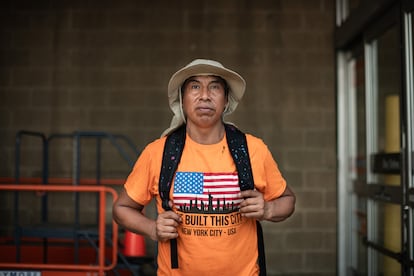
His plan is the following: if he can, he’ll work hard for another nine years or so and then return to Ecuador — the place he never truly wanted to leave. “I never thought I’d emigrate. I have a house there, I have my daughters, but things got tough — crime, bad governments, low wages.”
In the meantime, he’ll keep showing up outside Home Depot from 7 a.m. to 7 p.m., then head back to the apartment he rents for $1,500 in Greenpoint, Brooklyn, where he lives with his family. And when there’s a little extra money, they’ll go out and explore the city — like the day they visited “the place with the screens,” Times Square.
He says this while watching every car and truck that pulls into the Home Depot parking lot in a steady stream, raising his hand at each one. After his morning job, he came back hoping to get lucky again — maybe another contractor or homeowner will need an extra pair of hands.
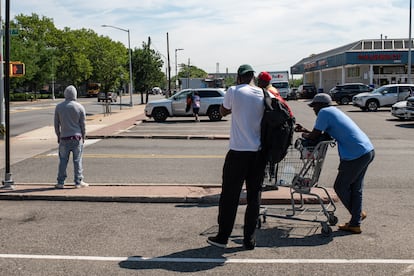
By a little after 3 p.m., there are only a few day laborers left at “la parada” — as he refers to the day labor corner outside Home Depot —just him and maybe three others. The rest, about 10, left a while ago. There was a time when the crowd here was much bigger, and everyone had to hustle: sprint toward the first car that stopped or signaled, negotiate a price, and be the fastest to hop into the truck.
But these days, people are scared. The Immigration and Customs Enforcement agency (ICE) is everywhere. Outside schools, workplaces, immigration courts. And it’s circling the country’s Home Depots, knowing this is where people go when they can’t get other work — people paid under the table: immigrants.
The recent mass protests in Los Angeles erupted precisely because ICE officers, wearing masks, raided a Home Depot and detained some 40 day laborers.
Even so, Juan Carlos — Catholic to the core — says he isn’t afraid. “Only of God. Not Trump, not [Ecuadorian President] Daniel Noboa. If ICE comes and picks me up, I’ll go with my head held high. I didn’t come to do wrong in this country — I came to earn my food, my livelihood, with the sweat of my brow. And if God wills it, I’ll leave in peace.”
“Labor shortage” in the construction industry
Sandra Alvarado arrived around 6 a.m. at the Home Depot in Mill Basin, a low-rise residential neighborhood in southeast Brooklyn. There was a time — when she came from Ecuador two years ago — when Sandra spent nearly every night sleeping on the seats of the F train, her rest lasting as many round trips between Jamaica and Coney Island as could fit into the stretch of a single night. That was until she learned about the Home Depot day labor pickup spot.
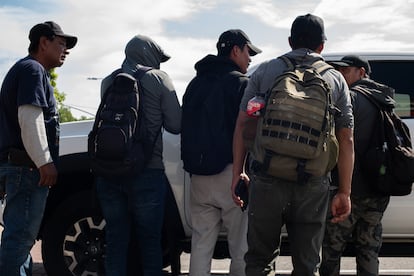
She wears a long-sleeved pullover to shield herself from the sun, work pants, boots, and a hat. Some wear dark glasses, others never show their face at all — in order to guard their identity, especially from ICE officers. Sandra, 38, admits she feels afraid when she leaves the room she now rents in Queens. But what else can she do? “They say ICE is out looking for us, but we’re not criminals — we’re doing honest work.”
She’s been at the pickup spot for three hours and still hasn’t been chosen by a contractor or homeowner. She’s available for house cleaning and construction work — as long as she’s paid, unlike the time she was taken to haul heavy slabs of marble and never saw a dollar. “The man said he’d call me,” she says, “but I’ve been the one calling and begging him to pay me for the work I did. Nothing.”
She’s not the only one who’s experienced this. Sometimes they promise one rate and pay only half. Sometimes they don’t pay at all. In some cases, the job turns out to be far bigger than what was originally described or shown in a photo. More than once, when workers have dared to demand their pay, they’ve been threatened with calls to the police or immigration authorities.
At the same pickup site, there’s also David, 30, who arrived from Ecuador four years ago. He waits inside his Ford truck, surrounded by toolboxes. Those with vehicles, like him, tend to stay inside — to stay out of sight. He doesn’t hide his fear of being reported or ICE showing up. “I’m really scared. I don’t feel safe anywhere. I don’t even go to parks or stores anymore. I only come here because I need to work. If I didn’t, I’d never leave the house,” David says.
So far, Home Depot has made it clear that while they want day laborers to keep their parking lots clear, they will not assist ICE in conducting raids. They also say they’re not informed when agents plan to show up.
When a caravan of cars enters the Home Depot parking lot, David and the other day laborers rush forward en masse, scrambling for the day’s job. Some speak a bit of English — which gives them an edge with employers who only want to communicate in that language. Other times, they say, speaking English can backfire: bosses assume they can demand more, or that they’ll cost more on the informal labor market.
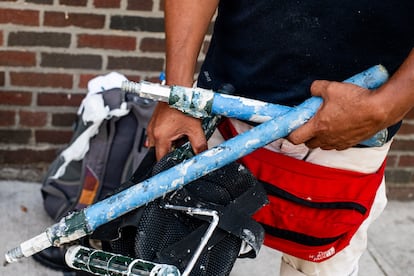
David doesn’t speak English, but a Senegalese man — who hasn’t shared his name — gets by as best he can and steps forward when he sees a contractor, offering his services. The contractor says he’s not what he’s looking for, but the Senegalese man gives him his phone number just in case. He wakes up every day at 4 a.m., says his prayers, and heads out to look for work. Today he’s had no luck — just like the Haitian man, who also prefers to remain anonymous. He arrived in New York eight months ago and says the only thing he enjoys is “working and making money.”
At the day laborer corner, the Latinos gather on one side, the Haitians and Africans on the other. They might seem divided, but they have more in common than not: they’ve come from far away, they live undocumented, they work under the sun, doing the jobs that “gringos” won’t. Of the more than 11 million people working in the construction industry, one in three day laborers is foreign-born, according to the National Association of Home Builders. And with the latest immigration policies, the sector is already feeling the strain.
David says that two years ago, there was almost always work outside Home Depot. Now, there are days when he only works two hours — not enough to help support his wife and child. Other days, he comes home to Far Rockaway without earning a cent. He doesn’t know if contractors are afraid to hire undocumented workers now, or if Home Depot has warned them off.
Jorge Carrillo, president of the Hispanic Construction Council, told EL PAÍS that there was already a “labor shortage” in the industry, but that “now the situation is only getting worse.” The deficit stands at 500,000 workers. Among the undocumented Latino population — one of the groups most affected by ICE raids and deportations — around 4.3 million people work in construction, with 52% in the physically demanding trades.
Carrillo warns that the lack of personnel and the growing absence of immigrant workers on job sites is “slowing down projects.” Where there was a 14% delay rate before the current administration, that figure has risen to 22% since January. His organization has introduced a bill called Building a Stronger America, which would allow people who have lived in the U.S. for at least five years — and worked in construction for at least three — to apply for a work visa.
No future for day laborers
The network of day labor spots in New York City isn’t limited to Home Depot parking lots; it spans various locations and neighborhoods across the city. In Williamsburg, there’s what’s known as the “cleaning parada,” the same place María has been coming to for over 10 years to offer cleaning services to the Jewish community.
She used to wait outside a building to get hired, but now the owner sprays water on her and about 15 other women from Mexico, Ecuador, Peru, or El Salvador, and even put up signs forbidding them from standing there. So they moved to a nearby tree and grabbed plastic milk crates to sit on while they wait for someone to pass by. When someone finally does, María calls out, “Mr. Clean, hello Mr. Clean,” after the household cleaning brand they use for their work.
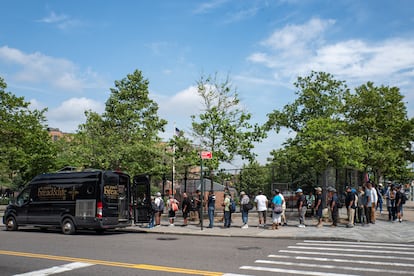
Some days they’re paid $150, other times they’re offered a bit more. Sometimes they leave without being hired at all. Many agree that work has become harder lately: first, the pandemic collapsed the country’s economy; then thousands of migrants arrived in New York City; and now ICE’s presence keeps them under constant pressure.
Carlos Castro, a 47-year-old Guatemalan who arrived eight years ago, was laid off from his job cleaning a house during COVID-19 because the homeowner simply couldn’t afford to pay. That’s when he turned to day labor and now waits in Jackson Heights, Queens — considered the most diverse neighborhood in the world — surrounded by Latinos from many nationalities. He’s learned the ins and outs of the bosses who hire him. “Filipinos are really nice — the first thing they ask is if you’ve eaten or if you’re thirsty. Bangladeshis think any money is too much. The Irish will pay you if you don’t cheat them, they’re straightforward. And Latinos are serious — many don’t want to pay,” he says.
The area near the Roosevelt corner, deafening with the metallic noise of the train, is another common gathering spot for day laborers. Those with more skills stand in front of a hardware store; the less skilled gather elsewhere and usually get paid less. Contractors already know where to find them. Some contractors specifically ask for Mexican migrants. “Because they work very hard, they can put in up to 10 hours and not complain,” says Carlos.
A few days ago, police showed up looking for two migrants working in the area to take them away. Other than that, Carlos and the others haven’t seen ICE agents around. He says he’s not afraid but wouldn’t want to return to his country “as a deportee.” “I’d be angry; they’re taking innocent people, whose only sin is coming here to look for work.”
Today, church members brought them lunch — ground beef and mashed potatoes. Carlos knows “work at the corner is bad,” but at least he gets food, leaves the house, talks with other day laborers, and eases the loneliness. He’d love to have an eight-hour stable job that would allow him to save money and someday return to the place where he was born. “We help a lot of people get by in this city,” he says. “But here, at the parada, you come just not to stay at home. There’s no future here.”
Sign up for our weekly newsletter to get more English-language news coverage from EL PAÍS USA Edition









































