
The nightmare of the González brothers, detained at Alligator Alcatraz for a traffic ticket: ‘Their civil rights are being violated’
Their father says they haven’t been able to see their lawyer since their arrest two weeks ago. Fourteen Mexicans are detained at the Trump immigration center


A traffic violation has turned into a nightmare for Carlos Martín González, 26, and his brother Óscar Alejandro, 30, who were arrested in the United States on July 7. Carlos was driving through the tourist city of Orlando, Florida, when he was stopped by police, who also arrested his brother when he went to help him. Carlos had a tourist visa to legally enter the United States, while his brother is married to a U.S. citizen. Both were transferred to the dreaded temporary immigration detention center in the Everglades, the wetlands located west of Miami, which Florida Attorney General James Uthmeier has dubbed “Alligator Alcatraz.” So far, the Mexican brothers have not been able to see their lawyer. “All their civil rights are being violated,” says their father, Martín González.
Martín traveled from Mexico City to Orlando on July 10 to see his children. He hasn’t yet been able to have direct contact with them, although the family has spoken by phone. “No one has been able to see them; neither the lawyer nor the consulate staff. I have contact with them because they call me and tell me they’re fine, but no more. This is illegal, and all their civil rights are being violated here in the United States, but neither the lawyer nor the authorities have been able to do anything. We would like some kind of response to this situation so we can expedite their return home, but there are no answers from the United States government or the Florida government,” he explains in a telephone interview.
González says his son Carlos entered the United States as a tourist to visit his brother, following the death of their mother in October. The young man visited New York and also attended the Formula 1 Grand Prix in Miami before being detained. Óscar Alejandro’s residence permit had expired, although he is married to a U.S. citizen. Martín González says that at the time of the arrest, traffic officers seized their documents and cell phones. “They’re locked up and they don’t let anyone in,” says the father.
Juan Sabines, the Mexican consul in Orlando, has warned of possible “violations of the civil rights” of his fellow countrymen. The González family’s case has been escalated to the Mexican Ministry of Foreign Affairs, which issued a statement Monday night stating that the siblings now have legal support. “A lawyer from the Legal Assistance Program for Mexicans (PALE) is assisting with both cases, while the consulates maintain constant communication with the families to inform them of progress regarding their detention and upcoming scheduled visits, while their situation is resolved,” the Ministry of Foreign Affairs stated. The Ministry did not respond to an interview request.
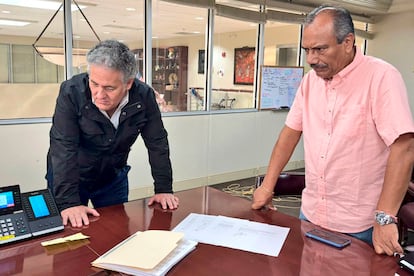
Consul Sabines has been more explicit, having closely followed the case and personally supported Martín González. The diplomat reported that, following instructions from President Claudia Sheinbaum, the consulate assigned them legal representation with attorney Andrea Reyes, a member of the American Immigration Lawyers Association (AILA), a U.S. association of more than 17,000 lawyers and law professors who practice and teach immigration law.
“During a call, the lawyer warned us about potential civil rights violations against both Mexicans, as the prison where they are being held does not belong to the federal government, but to the State of Florida. Therefore, they do not yet have an alien or case number, preventing them from accessing adequate defense and a fair trial,” Sabines warned. “Given this situation, we demand immediate access for their lawyer and, given the conditions observed, I will suggest that the Mexican authorities consider issuing a travel alert for Mexican tourists to Orlando. This case will be monitored by our Consulate in Miami, as that prison falls under its jurisdiction,” he added.
The constant persecution by Immigration and Customs Enforcement (ICE) officers has led Mexican authorities to adopt protective measures for their fellow citizens in the U.S., despite the fact that Mexican consulate staff face the task of defending migrants while living on the brink of poverty: Foreign Service employees receive the same salary as in 1998 and face grueling work days.
Sheinbaum announced Monday during her morning press conference that 14 Mexicans are being held at the Florida migrant center and stated that “every effort is being made to ensure their immediate repatriation.” The president also reported that “a diplomatic note has been sent, and the Mexican Embassy in the United States and the consulates are insisting that they be integrated into Mexico as quickly as possible.”
Sheinbaum has had to carefully navigate tense relations with her U.S. counterpart, Donald Trump, with whom she has had to negotiate the weight of tariffs on Mexican products. The persecution of Mexican citizens is one of the thorniest issues in the bilateral relationship, which the president handles within the bounds of diplomacy. “We are constantly in contact with the consulates. When it came out that they were going to send migrants to Guantánamo, we sent a diplomatic note. And the moment they published the existence of this detention center, we sent another note so that any Mexicans would be deported immediately and would not have to spend time in this center,” she reported. “The consulate is checking to see if there are human rights violations. If so, the protocol that should be followed will be followed; but what we have requested is that they be deported immediately so we can repatriate them,” Sheinbaum stated.
While diplomats are pushing for the young men to be returned to Mexico, Martín González is working in Florida with the support of Mexican authorities to get his sons out of prison. “We haven’t gotten the results we wanted, but the support from the consulate has been tremendous,” he says. “We continue to push, trying to get everything underway to get my children a case and be able to return them to their homeland. At some point, they’ll have to give in so we can develop their legal defense and find out what they’re being accused of.”
Sign up for our weekly newsletter to get more English-language news coverage from EL PAÍS USA Edition









































