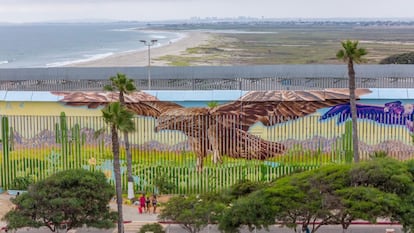
A condor and a golden eagle to restore humanity to Tijuana’s border wall
While the US wants to paint the fence black to deter migrants, Alfredo ‘Libre’ Gutiérrez used it to create a mural promoting unity between the two neighboring nations, based on an Indigenous prophecy
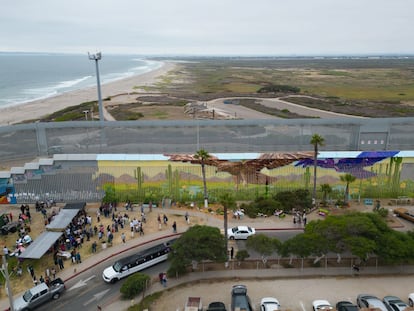

Alfredo “Libre” Gutiérrez continues to stare at the border wall that saw him grow up in Tijuana 43 years ago. A wall that the United States now wants to paint black so that the heat will make it even more hostile and more difficult to climb. Libre smiles and says: “We responded with color, with love. That is our strength.”
Just a few days ago, he finished covering a section of the border fence in Playas de Tijuana with a monumental mural: a condor and a golden eagle flying wing to wing. The work, titled Shared Flight, is inspired by an Indigenous prophecy that predicts peace will come when the two birds fly together. In contrast to the U.S. plan to darken the wall, the painting by Libre proposes filling it with color.
“I do believe that art can raise awareness. If we don’t try, we’ll never know. For me, painting this wall is a way to humanize the inhuman,” he says during an online interview with EL PAÍS.
Migration as a destination
A son of Tijuana and an internal migrant in Mexico City for 15 years, Libre carries stories of displacement in his own life. “As long as I can remember, I’ve seen and experienced it: in neighbors, family members, friends. In Tijuana, migration is a latent part of everyday life.”
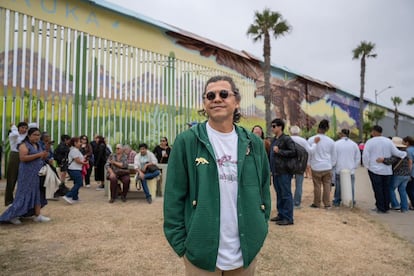
He studied architecture at the Tijuana Institute of Technology, but his calling led him to art. His first project, in 2004, portrayed homeless people, many of them migrants and deportees. Since then, every mural, every sculpture, has been an attempt to give them visibility. “I feel very proud to be Mexican and to be able to represent these stories. Taking art to a level that raises awareness and makes people reflect is what interests me the most,” he explains.
His work doesn’t stop at walls. He’s given workshops at the Reclusorio Oriente penitentiary in Mexico City, collaborated with migrant shelters like Casa Tochán, and in 2018 he decided to accompany a migrant caravan from the State of Mexico to Mexicali, Baja California, traveling on the train known populary as La Bestia (The Beast). “Traveling with them changes your perspective on migration. You see families, seniors, members of the LGBT+ community fleeing brutal violence that makes it hard to believe they’ll survive the next week. That makes you more empathetic.”
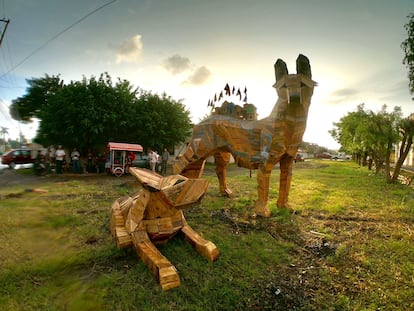
That empathy inspired Transportapueblos, one of his best-known projects. It’s a series of wooden coyote-shaped sculptures designed to be placed at strategic points along migrant routes in Mexico, from Central America northward. Their bodies carry maps, information about shelters, and shelves of donated food, clothing, and supplies. Libre clarifies: “We’ve all been migrants at some point, and we carry our culture, our music, and our colors on our shoulders. The coyote is a symbol of resilience and power, but also of guidance and protection.”
The border wall as a canvas
Working with communities is the backbone of all of Libre’s projects, and during the first weeks of August, he worked with local artists, architecture students, and members of the Kumiai community to cover 405 square meters of the border wall. “From the first day to the last, there was enthusiasm. The community lent us ladders, air compressors, and cheered us on. We transformed something hideous into a space that now says: this is us.”
This latest work by the Tijuana-born artist features a golden eagle and an Andean condor, symbols of the fauna of the north and south, united in a continuous flight. The idea arose from a conversation with Dan Watman, program director at Friendship Park, about a prophecy that tells of how, for thousands of years, human societies have decided to go their separate ways, but when these two animals cross paths in flight, there will be peace in the region.
On the Mexican side, the wall has become a hub of artivism. On the U.S. side, it remains gray and soon to be black. Homeland Security Secretary Kristi Noem said that President Donald Trump ordered the color change so the metal will absorb more heat and become harder to climb. “While they darken it so it burns and becomes more cruel, we color it so it heals. That’s the difference,” says Libre.
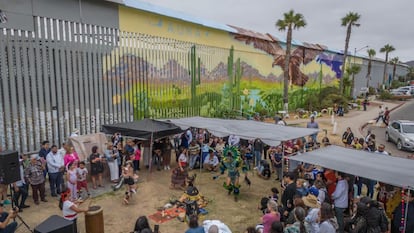
For him, art doesn’t resolve migration or violence, but it raises questions, provokes reflection, and contributes to a shared humanity. “It’s not fair to criticize without contributing. For me, painting this wall is my way of contributing. It’s also an act of pride in Tijuana, because it’s shameful that a foundation from the United States (Mozaik Philanthropy) had to come and fund what our own city should be promoting.”
While the U.S. government allocates billions of dollars to reinforce the border, Libre and his team have painted a symbolic embrace on the high steel bars with just $20,000. Now he wants to replicate the experience in other border cities like Ciudad Juárez or Mexicali. “If there are resources, I’m happy to add more color to the wall. I want to motivate other artists. Let art be our elegant response to violence.”