
Waiting at the border until the Trump era is over: When staying in Mexico becomes the first option
Hundreds of migrants live crowded together in Ciudad Juárez, awaiting legal changes in the US, while others have already settled with the idea of staying
In the north of Ciudad Juárez, a few meters from the Rio Grande, there is a nearly empty camp waiting to mitigate the waves of Mexican repatriates promised by Donald Trump, but they either don’t arrive or aren’t what was expected. Elsewhere, to the northwest, a convoy of state police trucks patrols the land next to the wall looking for drug traffickers or migrants, but finds nothing beyond holes in the border fence. Between these two points, in the Centro neighborhood, dozens of migrants live crowded in rented housing awaiting some change in U.S. immigration laws; others have already settled there with the idea of remaining in Mexico. The shelters, once overrun, now look empty. Meanwhile, the U.S. president’s media and terror policy is having an effect, even without data to back up his threats.
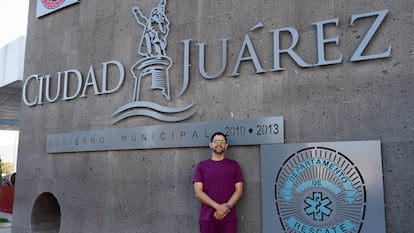
“Life plans have been reconsidered after January 20. Now, for many, it’s a matter of waiting four years at the border for the U.S. presidency to change, if it ever does,” says Daniel Soto, a 37-year-old nurse born in Venezuela who arrived in Ciudad Juárez in 2018 with the firm intention of staying there, where he works providing humanitarian aid to people in transit so they can access the healthcare system.
Migrant shelters are below 10% of their occupancy capacity, and the people there are considering staying in the city and renting a home or returning to their home countries, according to Ivonne López, a social worker at the Casa del Migrante.
“Right now, for example, we have about 30 or 40 people waiting to decide whether to leave or stay. At the most critical moments, we had 1,138. All the city’s shelters are similar,” says López.
According to Dirvin García, coordinator of the Migrant Assistance and Urban Mobility Program of the State Population Council in Ciudad Juárez, Chihuahua, 23 shelters monitored had 625 people staying in them as of July 31. This means that the 23 facilities together are still at just over half the capacity the Casa del Migrante housed at its peak.
David Berrio attempted to cross the border with his family: his wife and his daughter, who was just over a year old. They were sent to Cuba, where all three are originally from. But David, without explanation, was left in Ciudad Juárez. “They separated us; that has been the hardest thing in my life. But at least being here in Juárez, I can send them some money that I wouldn’t be able to get back there,” says the man, who plans to remain on the border, working in a shopping mall parking lot where he looks out for and washes cars. He lives in a rented room with two Colombians in a house with about 12 people in the city center.
Under the “Mexico Embraces You” plan, the federal government implemented a reception strategy along the entire border for Mexicans repatriated by the United States, in response to Trump’s warnings of mass deportations.

In Ciudad Juárez, five days after Trump’s inauguration in January, the tents with a capacity for 2,500 people were ready. They were set up in an area known as El Punto, named after Pope Francis’ visit in February 2016, from where he sent a message of encouragement to migrants in the United States. Anyone who wanted to see the Pope would gather there, hence its name: El Punto.
The “Mexico Embraces You” strategy is comprehensive, bringing together various government agencies at all three levels, international and local organizations, military forces, and Civil Protection agencies, among others. However, what was expected to be a historic crisis has remained below the deportation figures of the Joe Biden and Barack Obama administrations.
“We can’t talk about a mass repatriation. We’re facing a situation that has been managed at all times. It’s not a migration emergency. And it’s good that it isn’t and that we’re not full,” says Mayra Chávez, Chihuahua’s welfare delegate and coordinator of the Mexico Embraces You Support and Services Center, in an interview.
And it’s true: from January to July of this year, 6,983 Mexicans were repatriated through Ciudad Juárez, according to Chávez; during the same period in 2024, 7,052 returned, very similar numbers for discourse as different as that of Trump and his predecessors. While the statistics remain similar, it’s the aggressiveness that makes the difference.
The Mexicans’ stay at the camp is short, just one or two days, during which time they can contact their families, receive financial assistance of 2,000 pesos through a card called Paisano, and transportation support to their places of origin, explains Chávez.
For this reason, although the monthly average of people being served in the tents is 1,200, the actual occupancy rate remains between 30 and 50 people per day. This represents between 10% and 15% of the installed capacity. However, there are approximately 100 federal government employees working there, in addition to the organizations and National Guard personnel guarding the space — more employees than returnees. “The objective of this strategy is to guarantee the welcome and reintegration of our Mexican brothers and sisters to their places of origin. To guarantee their rights and support them in every way possible, which they deserve, with dignity,” asserts Chávez.

Operation Mirror
Two pickup trucks and a Suburban from the State Department of Public Security weave their way through downtown traffic heading north, then travel west along the entire border while a group of U.S. Customs and Border Patrol agents do the same, but on the other side of the wall.
Between the two trucks is the Suburban, with Commander Benjamín Esparza in the passenger seat. As they drive through the Rancho Anapra neighborhood, one of the most dangerous areas for drug and human trafficking, he says: “This remote neighborhood is very suitable for sheltering people who are about to cross. There are safe houses, because they blend in with the surroundings. You think a family lives there, but no, they are very well-hidden houses where they hold migrants.”
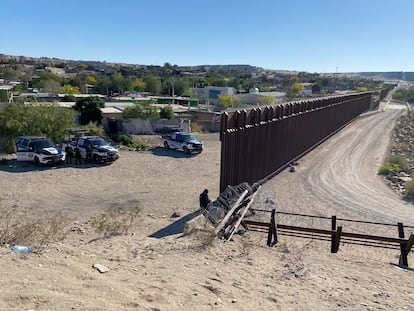
“However, the encounters we’ve had — we call them rescues — have been very few since the new administration took office in the United States. Yes, there has been a significant reduction, but we’ve noticed an increase in other crimes unrelated to border crossings, such as kidnapping, for example,” he added.
Operation Mirror brings together authorities from both countries to locate people attempting to cross into the United States. To do so, agents advance simultaneously on both sides of the border, sometimes with the assistance of a U.S. or Mexican helicopter.
On a July afternoon as the sun is beginning to set, the dust stirred up by a helicopter paints the edges of the wall ochre as it flies low, next to an empty highway about to lead into Santa Teresa, Chihuahua. Only the sound of the propellers can be heard breaking the wind. All around, the border desert appears empty.
Sign up for our weekly newsletter to get more English-language news coverage from EL PAÍS USA Edition









































