
Controversial ‘ICE List’ features photos and names of 100 immigration agents
Dominick Skinner is dedicated to tracking the identities of immigration officials. Hundreds of volunteers have participated in his project, and in the last 30 days alone, his website has received nearly a million visits
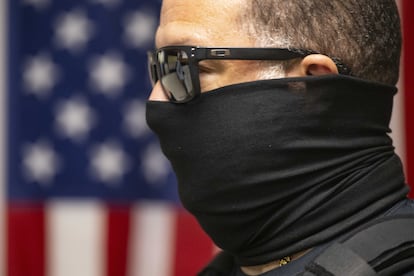

Unknown until now, the name of Dominick Skinner, an Irishman living in the Netherlands, has been mentioned in the United States Congress. A senator cited him in support of a bill she introduced this month that aims to shut down Skinner’s project: a list of the first and last names of 100 immigration agents responsible for the detention of thousands of migrants across the country.
Tennessee Rep. Marsha Blackburn wants the identities of federal officials carrying out President Donald Trump’s deportation campaign to remain secret for security reasons. To that end, she introduced the Protecting Law Enforcement from Doxxing Act, which would make it illegal to publish the name of a federal law enforcement officer with the intent to obstruct a criminal investigation or immigration operation. Skinner, for his part, has proposed the opposite: to publish as many names of the officers and their collaborators as possible.
To this end, he created the “ICE List”, a website that lists the names and photos of the Immigration and Customs Enforcement agents whose identities he has supposedly discovered. The website features photos compiled with the officers’ first and last names, along with information such as their LinkedIn or Facebook profiles and the method by which they were identified. Some appear masked. The search can be filtered by state and by their position. The majority are ICE agents, but the names and photos of immigration judges, Border Patrol agents, officials from the Office of Refugee Resettlement, and other actors involved in Trump’s anti-immigration crusade also appear.
“I want to publicly shame them into resigning, because they don’t wear masks for safety. They wear them because they know their neighbors won’t invite them to dinner anymore, that their children or their children’s friends’ parents won’t want them at a baseball game. They care about their personal lives, but not about their safety,” Skinner said in a telephone interview with EL PAÍS from the Netherlands, where he lives.
Agent safety, however, is the argument Blackburn uses to call for a ban on the publication. “According to Mr. Skinner, if 35% or more of a face is visible, his technology can reveal individuals’ masked faces. Although ICE List does not publish addresses, Skinner has confirmed that a person’s name is sufficient to find personal information about them online,” the senator said in a letter to lawmakers.
Skinner uses artificial intelligence to identify agents in photos sent by collaborators. With AI, he obtains an approximate image based on small, uncovered portions of the face, and then searches social media for accounts with similar characteristics. Finally, he verifies that the identified person works for ICE or another federal agency and posts the information on his website.
ICE List is managed by three people, but hundreds of volunteers have contributed around 400 profiles. Their website claims that all IDs have been verified. The list began in June and has already compiled the identities of around 100 ICE agents. In the last 30 days, it has received nearly a million views.
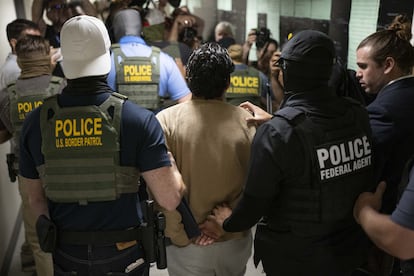
Whether or not to conceal agents’ identities has become a national controversy. Democratic members of Congress are proposing legislation requiring agents to operate with their faces uncovered, and California Governor Gavin Newsom has signed a similar state law. The Trump administration has ordered federal agents not to abide by this law and to wear masks as a protective measure. According to data from the Department of Homeland Security (DHS), assaults on ICE agents have increased by 1,000% since January.
“I’m from Europe. We know what fascism is”
The creation of the ICE List wasn’t planned. Skinner posted on social media that he wanted to write down the names of the ICE agents he encountered, and his post was seen by hundreds of thousands of people. “Private investigators contacted me and were willing to help me create a comprehensive list,” he explains. The fact that he doesn’t live in the United States weighed in his favor. “Kristi Noem (the Secretary of Homeland Security) said something about how if an American tries to identify an ICE agent, they can be arrested. And I thought, since I’m not in America, I could do it.”
Although Skinner is based in the Netherlands, the volunteers mostly come from the United States, Canada, and the United Kingdom. The team has received about 500 volunteer applications, and about 200 have agreed to participate. Their website has been removed by internet service providers three times.
Skinner collaborates with several organizations that help him identify agents, such as StopIce.net, which functions as a phone alert system when ICE activity is reported and already has nearly half a million subscribers. In the Latino community, chat groups on WhatsApp also operate to disseminate information about locations where raids are occurring.
Skinner denies that his list is used to harass agents because it doesn’t provide addresses or personal information, although names can be used to investigate. “If someone wanted to harm an ICE agent, mine would probably be the worst website to go to. In the United States, there are yellow and white pages, and I use them myself to gather information on people. With names and occupations, you can find everything else. I restrict that information. I don’t share addresses,” he explains.
In the future, Skinner hopes the list will eventually serve as a basis for these individuals to be tried for their actions against migrants. “Not only is Trump guilty, but so are the soldiers and the people who obeyed his orders, and that’s the precedent of international law. So, when Trump is done, we’ll know who to prosecute,” he says.
Because of his venture he has received death threats, which he doesn’t take seriously although he prefers to conceal his personal details, such as his place of employment, to avoid further risks. He has no intention of stopping and already has new plans, although he hasn’t revealed them yet. “I’m from Europe. We know what fascism is. This was what I could do, and to be honest, it’s added some obstacles to my life. But I accept it because it’s one of those moments when I think most people should be doing something,” he says.
Sign up for our weekly newsletter to get more English-language news coverage from EL PAÍS USA Edition









































