
ICE’s unprecedented recruitment campaign is transforming US law enforcement
The DHS says it has received more than 150,000 applications to join the immigration agency, but there are growing concerns about staffing shortages in other forces


“Attention Seattle law enforcement,” says a voice in a U.S. Immigration and Customs Enforcement (ICE) advertisement. “You took an oath to protect and service, to keep your family, your city, safe. But in sanctuary cities, you’re ordered to stand down, while dangerous illegals walk free.” As images flash of ICE agents escorting people in handcuffs, the ad encourages local police officers to join the federal immigration agency to “catch the worst of the worst: drug traffickers, gang members, predators.” The offer is enticing: a $50,000 signing bonus, student loan forgiveness — averaging around $30,000 — and “generous benefits.”
The campaign has been rolling out across the United States in various formats for weeks, and according to a Department of Homeland Security (DHS) statement, it has already generated more than 150,000 applications and 18,000 tentative job offers — an unprecedented number for federal agencies. For comparison, ICE recently had about 6,000 agents, while the FBI has 13,700 and just under 40,000 total employees, including administrative positions. The government has also ordered thousands of officials from other federal agencies, such as the Drug Enforcement Agency (DEA) and Homeland Security, to join President Donald Trump’s deportation efforts.
Concerns that this is weakening the fight against other crimes have skyrocketed, along with worries about that the new recruits are not receiving enough training. Many fear this will lead to an even greater increase in abuses of power and denial of due process — problems that have become routine during the first nine months of Trump’s second presidency.
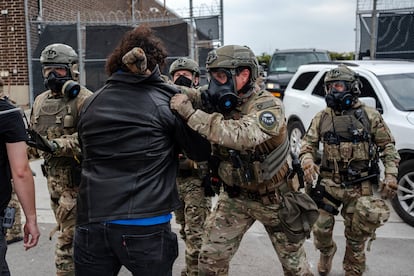
The expansion of ICE is one of the prerequisites for advancing the immigration policy of the current Republican administration, along with achieving a much greater detention capacity in migrant centers. The budget increase included in Trump’s “Big Beautiful Bill” — the massive tax reform law passed by Congress this summer, which grants the immigration agency more than $100 billion, up from its previous $8 billion — has been the first step in that direction. ICE also lowered its application requirements: applicants no longer need to speak Spanish or hold a college degree, among several other changes. The advertising campaign has cast a wide net to attract as many applicants as possible.
“With the Big Beautiful Bill, billions of dollars have been given to immigration, and this is leading to an ICE police force of an unprecedented size,” says Professor Ingrid Eagly, an expert on immigration and the criminal justice system at the University of California, Los Angeles, School of Law.
The situation, Eagly points out, poses serious risks. “Federal immigration law is quite complex. Officers have to comply with constitutional requirements. They must understand immigration statuses and how they change or are protected. So when you bring in officers who don’t have specialized training, that’s going to lead to serious rights violations because they’ll have to make decisions that require legal analysis, and they’re not qualified to do it.”
Eagly is also concerned about the fact that applicants are no longer required to have a basic level of Spanish. “That’s going to lead to even more communication problems if there’s no staff. And that creates the risk that people won’t be able to communicate and assert their rights.”
The DHS did not respond to this newspaper’s request for additional information about the 150,000 applications and 18,000 job postings that were reported. It is not known in which areas of the country the applicants are located; what the applicants’ backgrounds are, in terms of education, race, or age; or how many are already police officers or come from other forces. It is also unclear whether the final number of hires will be 18,000, more, or fewer, since months ago the target was 10,000 new recruits.
In any case, ICE’s hiring campaign is in direct competition with police departments across the country, which have struggled with recruitment for years. In California, for example, ICE’s generous package still falls short of what many police departments offer. In the San Francisco area, starting salaries for new recruits are around $120,000 a year, and in some counties can reach $200,000. But California is among the best-paying states, so in other parts of the country ICE’s conditions are indeed more attractive. This, combined with the lowered requirements to apply, suggests the immigration agency is casting a much wider net —one that could seriously affect police departments nationwide, especially since it is directly targeting active officers.
“We’re not trying to pillage a bunch of officers from other agencies,” ICE spokesman Tim Oberle told the Los Angeles Times. “If you see opportunities to move up, make more money to take care of your family, of course you’re going to want it,” he added, downplaying the scope of the campaign.
But according to a study by David J. Bier, director of immigration policy at the Cato Institute, diverting thousands of agents from other forces is exactly what ICE is doing. Records from ICE’s Enforcement and Removal Operations (ERO) reviewed by Cato show that ICE is receiving support from nearly 17,000 outside agents, including 14,500 federal criminal law enforcement officers. In addition, DHS revealed in a since-deleted publication that ICE has already trained and deployed 8,501 state and local police officers as part of the 287(g) task force — an agreement between the immigration agency and local police — allowing them to carry out ICE arrests independently. More than 2,000 others are currently in training.
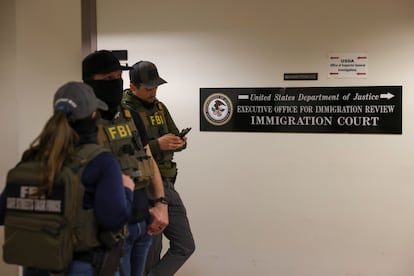
This is no small diversion. It includes one in five U.S. Marshals Service agents (650 out of 3,892), one in five FBI agents (2,840 out of 13,700), half of DEA agents (2,181 out of 4,620), more than two-thirds of Bureau of Alcohol, Tobacco, Firearms and Explosives agents (1,778 out of 2,572), and nearly 90% of Homeland Security Investigations agents (6,198 out of 7,100).
For comparison, ICE itself only has 6,100 agents, which means the agency has redirected a force four times larger than its own size toward deportation work. At present, just one in five officials involved in the mass deportation campaign are actually ICE removal officers. These figures, moreover, still underestimate the scale of the diversion, since they only count Border Patrol agents to the extent that they work directly with ICE. In reality, the Border Patrol is carrying out arrests under its own authority and direction within the U.S. interior.
There was never any doubt that Trump’s immigration agenda would reshape the country. But beyond sowing fear in the streets and in the heart of immigrant communities, it is also dismantling the federal law enforcement apparatus. The long-term consequences of this remain to be seen.
Sign up for our weekly newsletter to get more English-language news coverage from EL PAÍS USA Edition









































