
The demolition of the White House’s East Wing, a metaphor for Trump’s first year in office
The US president has demolished a section of the White House while simultaneously undermining consensus and institutions across the country

“The White House is many things in one […] No other residence reflects so meaningfully the struggles and aspirations of the American people.” That is how a 1961 memo begins — one treasured by Jacqueline Kennedy, perhaps the resident who did the most to turn 1600 Pennsylvania Avenue into a living museum. “Everything in the White House must have a reason for being there,” the charismatic First Lady once said.
Six decades later, and just days before the first anniversary of his election victory — coming up next Wednesday — the current occupant, Donald Trump, has made it his “main priority,” in the words of his press secretary, Karoline Leavitt, to remodel the residence and shape the White House in his own image, turning it into a reflection of his government’s politics.
Having learned from his first term (2017–2021), during which he believes his advisers prevented him from doing what he truly wanted, Trump now appears determined to leave a lasting mark — on the political system, and even physically. Backed by a team wholly loyal to him, and with every lever of power under his control — a Republican majority in Congress and a Supreme Court dominated by conservative justices — he is pushing the boundaries of authority just as he pushed for the demolition of the East Wing of the White House.
In Trump’s view, there is no need for lengthy consultations or approvals — whether it’s ordering extrajudicial killings of suspected drug traffickers in the Pacific or the Caribbean, or turning the once-modest Lincoln Bedroom bathroom into a marble showcase. His majority, he believes, is all the authorization he needs: after all, didn’t Americans elect him to get things done?


Trump regards his arguments as irrefutable, even if to others they may sound highly debatable. To explain his Lincoln bathroom renovation, showcased on social media this past Friday, he claims the new style is far more in line with the building’s original era, that of the Civil War (1861–65), than the previous Art Deco. In the case of the drug-smuggling boats, he argues there is an open war on narcotics. “We are just going to kill people that are bringing drugs into our country,” he said— precisely on the day the excavators began demolishing the East Wing to make way for a gigantic ballroom.
Anyone who disagrees with his decision, he says, can leave — whether they like it or not. Tens of thousands of officials and senior staff from independent oversight agencies have already been fired, with the Supreme Court’s approval. Last week, the White House confirmed the dismissal of all six members of the Commission of Fine Arts, a group of architecture experts that advises the government on the maintenance and conservation of public buildings.
The changes to the White House began almost immediately after Trump returned to office in January. The first ones took place in the Oval Office, the venerable heart of the U.S. government, where the sober tones of his predecessor, Joe Biden, have been replaced by ubiquitous gold details: in the curtains, moldings, wall sconces, the frames of family photos displayed behind the famous Resolute Desk, and the numerous portraits of Trump’s favorite presidents. Or in the gifts offered by those who come to pay homage: there is, for example, the solid gold record presented by Apple CEO Tim Cook.
These days, the Oval Office practically functions almost daily as a busy television studio, from which the president holds audiences with foreign leaders, billion-dollar corporate executives, or members of Congress and his Cabinet. And live on air, he treats them according to his whims. His favorites — the NATO Secretary General Mark Rutte; Israeli Prime Minister Benjamin Netanyahu — receive lavish praise in real time and are shown renderings of the new ballroom. While other guests — whether it’s Ukrainian President Volodymyr Zelenskiy, South African President Cyril Ramaphosa, or a journalist asking overly probing questions — are humiliated, insulted and belittled.
After the Oval Office, the next renovation was a bit more drastic: the Rose Garden, adjacent to the Oval Office, would no longer be a garden. The historic lawn where Egyptian president Anwar Sadat and then-president Jimmy Carter drafted the Camp David agreements for peace between Israel and Cairo was removed to make way for a cement courtyard with tables and umbrellas, closely resembling the one Trump already has at his private Mar-a-Lago residence.

The garden, which had long served as a place of welcome and inclusion — hosting Cinco de Mayo cocktails with the Hispanic community, historic press conferences, state dinners, and speeches — is now called the Rose Garden Club. Being invited to one of its events is the most coveted ticket in the MAGA world, the conservative movement created by Trump, and a prime opportunity for politicians and businesspeople to lobby.
One of the most recent high-profile events was a luncheon thanking Republican lawmakers for confirming the candidates Trump had proposed for senior positions. Meanwhile, outside the Rose Garden Club, the country struggles with the consequences of a government shutdown that has already lasted a month: services to citizens are being cut, and federal employees are left without pay, forced to stay home or work for free, due to disagreements between Republicans and Democrats over cuts to healthcare.
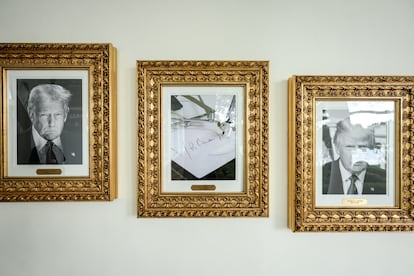
The next step in the changes — a “Presidential Walk of Fame,” a series of portraits of his predecessors in the exterior gallery connecting the residence area with the West Wing — was unveiled this summer, as Trump escalated his attempts to consolidate power and take revenge on his enemies. And no one looms larger as a target than his predecessor, Joe Biden, ridiculed in those portraits. Instead of Biden’s photo, there is an image of an autopen: Trump claims that the Democrat, too old, let others make decisions on his behalf, which were simply formalized with one of those machines. Biden has categorically denied these allegations.
Outside the White House gates, Trump’s reprisals against his enemies have gone far beyond mere theater. Since this summer, Trump has sent National Guard troops to cities governed by Democratic opponents, ordered Republican-led states to redraw electoral districts to secure more seats for his party in next year’s midterms, and has dismissed — or attempted to dismiss — senior officials of institutions resisting his control, such as Federal Reserve Chair Lisa Cook. Above all, he has sought the prosecution of those who once stood in his way: former FBI director James Comey, New York Attorney General Letitia James, and his former national security adviser John Bolton are all facing charges in court.
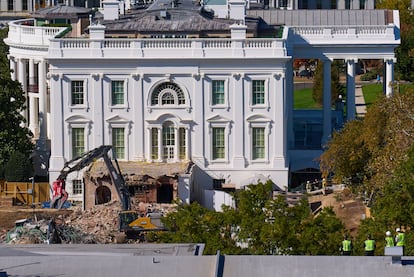
The most shocking act of destruction — the most symbolic demonstration of Trump’s strategy to obliterate anything in his path, whether a building or a government system — was still to come. Since taking office, Trump has gutted approved budgets and entire federal agencies, such as USAID and the Voice of America network. In October, he oversaw the complete, surprise, and rushed demolition of the entire East Wing of the White House.
Built in 1902, the East Wing housed the offices of the First Lady — from which Jacqueline Kennedy planned the restoration of the building — and served as the public entrance to the “people’s house.” Now it will be replaced by a grand ballroom of 8,300 square meters, designed in the marble-heavy taste of the former real estate mogul. By comparison, the main White House building measures 5,109 square meters.
As in the United States he now governs — where doors are closed to immigrants, raids are on the rise, unwanted foreigners are expelled, and dissenting opinions are treated with suspicion — the sense of inclusion and welcome that had guided the design of this functional wing in the era of Theodore Roosevelt is being replaced by exclusivity. Now, multibillion-dollar corporations are competing to secure a spot among the private hands that will fund the colossal project.
The demolition of the East Wing was as symbolic as it was characteristically executed. When announcing his grand ballroom project — justifying it as necessary to host hundreds of guests for state dinners and other major events — Trump had insisted that the new structure would not affect anything already standing in the White House. He never disclosed that plans had changed until the work was already complete. There were no consultations with experts, no permit requests, and no established procedures were followed.
Nor has there been opposition. Those who might have presented it — the National Trust for Historic Preservation, for example — found it was too late: nothing remained standing. Federal agencies, such as the National Capital Planning Commission, responsible for federal construction in Washington, maintain that the decision was not within their purview. Will Scharf, the commission’s chairman, said in September that his mandate concerns construction, not demolition: “This commission does not have jurisdiction and it has long denied that it has jurisdiction over demolition and site preparation work on federal buildings and federal property,” he said. “What we deal with is essentially construction.”
For now, the plans for the project remain unknown, and its cost has already climbed from the $200 million Trump cited this summer to $350 million or more. With the government shutdown in effect, no documents have been filed. But one thing is clear: for Trump, construction is a priority — so much so that work is underway while government operations remain minimal. He wants to inaugurate the ballroom before his term ends and leave an indelible mark — on the White House, and on history.
“Everything in the White House must have a reason for being there,” Jackie Kennedy once said. In the Trump era, there is one reason: the president’s own agenda.
Sign up for our weekly newsletter to get more English-language news coverage from EL PAÍS USA Edition









































