
US government shutdown plunges the country into a statistical blackout
The estimated cost of the closure could be as much as $14 billion, according to the Congressional Budget Office
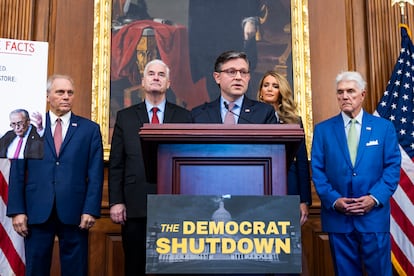

“Due to a lapse in appropriations, this website is not being updated” is the message on the page of the U.S. Bureau of Economic Analysis, which was due to publish the economic growth data for the third quarter of the year on October 30. The agency, which comes under the Department of Commerce, has been inactive due to the federal government shutdown that has now lasted 31 days. This partial closure of a part of the public administration is the first that the U.S. has experienced in seven years and is on track to become the longest — the record so far is the 34-day shutdown that occurred in the winter of 2018-2019, during Donald Trump’s first term.
Republicans and Democrats are unable to agree on various issues which would allow the budget to be extended until the end of the year. This has caused dozens of government agencies, including museums, national parks and even air traffic controllers, to run out of resources. They cannot carry out their activity normally or pay their workers’ salaries.
Although the White House has reserved some resources for the most sensitive departments, whose activity affects national security and the functioning of essential services, most federal agencies are paralyzed or have reduced activity. This is the case for the Bureau of Labor Statistics, that comes under the Department of Labor. This agency also did not publish employment data for the month of September, as it was scheduled to do on October 3. It posted this message on its website instead: “This website is currently not being updated due to the suspension of Federal government services. The last update to the site was Friday, October 24, 2025 [with inflation data that was collected before the shutdown]. Updates to the site will start again when the Federal government resumes operations.”
Beyond the release of inflation statistics last week, the federal government has suspended data collection and statistical reporting, meaning that key indicators such as non-farm payrolls, retail sales, jobless claims, job creation, GDP, and a host of other macroeconomic data are not available.
This statistical blackout makes it difficult for analysts and economists to assess the economic situation, track price trends, and measure the deterioration of the labor market, among other variables. The situation is consequently making it difficult to make economic decisions. This was acknowledged by the chairman of the Federal Reserve, Jerome Powell, who has to decide on interest rates based on the dual mandate of price stability and the evolution of the labor market. “What do you do if you’re driving in fog? You slow down,” he said at a press conference on October 29 after approving a quarter-point interest rate cut — a decision made almost blindly.
Prior to the central bank’s move, Powell did not have access to the many official statistics he routinely uses to make his decisions. “There’s a possibility that it would make sense to be more cautious about moving [on rates],” he said. “I’m not committing to that, I’m just saying it’s certainly a possibility that you would say ‘we really can’t see, so let’s slow down,’” he added.
Powell has a lot to contend with. U.S. President Donald Trump continually harasses and insults him in order to push him into resigning early — his term ends in May 2026. Trump wants to control the Fed and get more aggressive interest rate cuts that would accelerate economic activity before the midterm elections, which will be held in a year’s time.
The Fed has also run out of other relevant sources of data. ADP, a private platform that compiles payrolls for 20% of U.S. workers, has stopped supplying the Federal Reserve with statistics. The rupture came after Federal Reserve Governor Christopher Waller gave a speech on August 28 referencing ADP’s data, according to Bloomberg.
ADP, which compiles its statistics in collaboration with the Stanford Digital Economy Lab, based on the payrolls of more than 26 million salaried employees of private companies, continues to publish its reports, but does not offer the granular detail that it once provided to the Fed.
Analysts are now looking ahead to November 7 when the Bureau of Labor Statistics is due to release the new October employment numbers, but it will likely be delayed by the government shutdown. Consequently, all eyes will be on the ADP, which will publish its estimates on November 5.
Data from private companies or centers has been proving valuable since the government shutdown began. Other companies, such as LinkedIn and Revelio Labs, also offer information about the labor market.
“We’re going to collect every scrap of data we can find, evaluate it and think carefully about it. And that’s our job,” Powell said. When asked if the lack of data could affect what the Fed decides in December, he replied: “I’m not saying it definitely will, but it’s possible.”
However, the Washington-born economist sought to calm the markets: “If something material were happening, if there were material developments, I think we would pick that up. I don’t think we’ll be able to have a very granular understanding of the economy.”
The statistical blackout throws the spotlight on Trump’s interventionism in official statistics. Last August, he fired Erika McEntarfer, head of the Bureau of Labor Statistics, whom he accused of manipulating monthly labor reports for “political purposes.”
The Congressional Budget Office (CBO) released a report this week, estimating that the U.S. economy will lose between $7 billion and $14 billion due to the federal government shutdown. The document predicts that the suspension of pay for federal workers and the interruption of food benefits for low-income citizens will temporarily reduce GDP by between one and two percentage points in the fourth quarter of 2025, although it also predicts that most of this loss will be recovered as soon as the government reopens.
Sign up for our weekly newsletter to get more English-language news coverage from EL PAÍS USA Edition









































