
Trump vs. ‘Too Late Powell’: Anatomy of the campaign to harass and take down the Fed Chairman
The Republican president’s fixation on getting rid of Jerome Powell early and drastically lowering interest rates is putting the US economy at risk
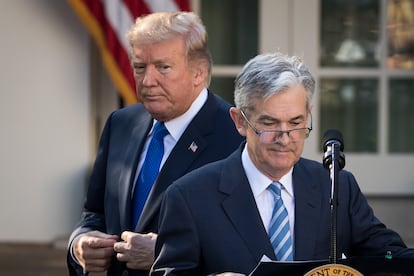

It must be frustrating for someone like Donald Trump, who owes much of his fame and fortune to the phrase “You’re fired!” to be unable to fire an employee he’s dissatisfied with. That employee is named Jerome H. Powell. And Trump has been trying to remove him from the Federal Reserve for months because of his refusal to lower interest rates.
The U.S. president has tried everything: insults (“stupid person,” “very dumb,” “hardheaded”...), nicknames (“Too Late Powell,” he likes to call him), suspicions about the cost overruns in the renovation of the central bank’s headquarters in Washington, or accusations of destroying the country. But Powell is weathering the storm.
Last week, he went a step further: Trump met with a group of congressmen on Tuesday, sounding them out about the possibility of firing Powell, only to tell the press the next day that it was “highly unlikely” he would do so, while adding that he could still fire Powell if “he has to leave for fraud.” It’s unclear whether he meant it or was just playing his favorite game: distraction.
After all, the law prohibits the president from firing Powell, who has little time left in office in any case: his term ends in May of next year. Be that as it may, the mere idea was enough to send the dollar and Wall Street tumbling and bond yields soaring, because markets would view a Trump-friendly monetary policymaker as synonymous with inflation.
At the news conference, Trump expressed a recurring wish: a three-point cut in interest rates, which are currently at 4.25%-4.50%, and which investors assume will remain that way after the central bank’s next meeting, scheduled for July 31. Almost all experts agree that a cut like the one Trump is requesting would be tantamount to economic suicide with global consequences.
The Republican president lied when he said Powell was appointed by Joe Biden. In reality, Powell was appointed by Trump in 2017, during his first term in office, and Biden simply renewed his confidence in him four years later. Powell succeeded Janet Yellen in the position. Those were the days of wine and roses, when Trump considered him “strong, focused, and intelligent.”
Powell, who received the support of the major banks last week, is a registered Republican and has served on the Fed’s board of governors since 2012. The seven men and women who control U.S. monetary policy form the core of the Federal Open Market Committee and act with a dual mandate: to achieve stable prices and maximum employment. Back then, Barack Obama appointed him to a 14-year term on the board, so even if he doesn’t renew his term as chairman, if he so chooses, Powell will remain at the Fed in some capacity until 2028, despite Trump’s displeasure.
Powell holds a degree in political science and graduated from Georgetown University Law School in Washington. Someone who knows him personally described him in a conversation with EL PAÍS as a “quiet man.” He also noted that before entering public service, he worked for 20 years as an investor in the private sector, where he became a partner at the powerful firm Carlyle, and that this guarantees he’ll have the money to confront Trump in court if necessary. His resume also includes a stint as deputy secretary of the Treasury under George W. Bush.
A long tradition
In Washington, economists of all political persuasions agree that Powell will be remembered as “one of the good chairs” of the Fed; he was slow to react to the inflation brought on by the Covid pandemic, but later piloted a “soft landing” for the economy that avoided recession. “I think he has honored the long tradition of commitment to the independence of the central bank. Going against that independence only diminishes the institution’s ability to respond to potential crises,” Natalie Baker, director of economic analysis at the progressive think tank Center for American Progress, explained in a telephone interview Thursday.
“Despite the noise, Powell remains committed to his goal: to leave the American economy in the best possible shape,” clarified a market source, who requested anonymity. “And he hasn’t exactly had it easy: he’s survived Trump, a pandemic, and Trump again.”
The second Trump has proven to be much tougher. The president, without evidence, accuses the Fed of lowering rates last year to favor the election of Democrats. Since Trump’s return to power, Powell has reiterated that, in the midst of an economy that is proving “resilient” despite everything, the “uncertainty” that the Republican is sowing with so many tariff swings makes it advisable to leave rates as they are (at least until September, when a cut is expected).
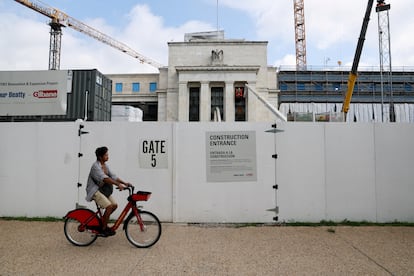
Given Powell’s firm convictions, Trump and his people have resorted to a new plan of attack: accusing him of wasteful spending in the renovation of the two neoclassical buildings that serve as the Fed’s headquarters in Washington. These date back to the 1930s and have never been remodeled since. The scaffolding partially covering them has been filled recently with curious onlookers and journalists trying to confirm through them if, as Trump’s allies claim, there are signs of waste, such as “rooftop garden terraces, fountains, VIP elevators, and top-quality marble” in abundance, which would explain a deviation from the initial budget of $600 million to $2.5 billion.
In a letter sent to the White House last Thursday, Powell attributes this increase to higher-than-expected material and labor costs or a toxic soil contamination problem that came to light along the way and had to be resolved. He also denies that there are elevators or VIP dining rooms. The marble part was answered by an AP report: it turns out that it was Trump’s envoys who in 2020 requested more of that noble material, the “Georgia white” variant, on the facades, following instructions from the then president, whose penchant for ostentation is well known. The architects of the renovation preferred glass, to underline “the transparency of the institution.”
Trump, as comfortable as ever with being caught out in his contradictions, said this week that if there was “fraud” in that renovation, he would fire him. A Supreme Court ruling last May expanded the president’s powers to remove members of independent agencies, such as the Federal Communications Commission (FCC) and the antitrust regulator (FTC), but excluded the Fed, considering it distinct from the rest.
“The ruling, as Justice Elena Kagan noted in her dissenting opinion, didn’t clarify why there is this discrepancy, so I don’t think the possibility of dismissal can be ruled out,” said Paul Collins, a law professor at the University of Massachusetts and an expert on the politicization of the Supreme Court, in an email. Collins cautions, however, that “even lawyers advising Trump” doubt that the pretext of overcharging is “sufficient to justify it.” “I’m not sure that would matter to the conservative justices [on the high court], who have proven very reluctant to contradict the president,” the expert adds.
For now, Trump and his Treasury Secretary, Scott Bessent, have already floated the idea of naming Powell’s replacement after the summer, much earlier than is customary in Washington. Such an approach, according to former IMF chief economist Kenneth Rogoff, risks creating a “parallel” Federal Open Market Committee, which would put additional pressure on Powell’s committee.
The track record for a political intervention like the one now looming over the Fed is not encouraging. “The classic case is [President Richard] Nixon, who pushed for a rate cut [on Arthur Burns] to win the [1972] election; that led to a surge in inflation that took a decade to subdue,” Baker recalls, adding that “changing the chairman” is not the same as controlling the central bank. The decision to lower or raise rates would still be made by the majority of a board where, let’s remember, Powell would remain a member until 2028. That its 12 members do not think in a monolithic way was demonstrated once again this week by Governor Christopher Waller, who declared that he favors a 125 basis point rate cut in July (he also said that if Trump asked him to be Powell’s successor, he would say “yes”).
While Waller was busy scoring points, The Wall Street Journal published an editorial last week saying that “firing Powell would be a blunder.” It argued that “it’s in everyone’s interests, including Mr. Trump’s, that markets perceive that person as a serious policymaker and not an Oval Office pushover.” The Journal’s own commentators went on to ask Trump for “some uncharacteristic restraint.” That was perhaps too much to ask of someone who owes much of his fame and fortune to the impulse to shout, “You’re fired!”
Sign up for our weekly newsletter to get more English-language news coverage from EL PAÍS USA Edition









































