Caro Quintero: The legendary drug lord with whom the US will ultimately strike a deal
The ‘Narco of Narcos,’ is seeking a deal to plead guilty and improve his prison conditions, where he could spend the rest of his days
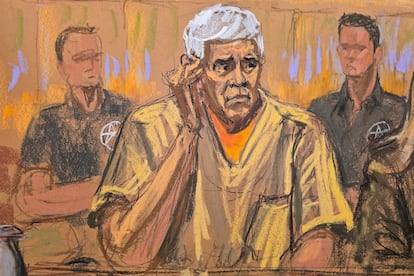

The United States Drug Enforcement Administration (DEA) neither forgets nor forgives. On its official website it hosts a microsite called “Justice for Kiki” dedicated to agent Enrique Camarena, who was killed in Guadalajara in February 1985. In the welcome message for the memorial, the DEA names Rafael Caro Quintero as the principal perpetrator of the kidnapping, torture and murder of its most famous agent, describing him as “a cartel kingpin who unleashed violence, destruction, and death.” The “Narco of narcos” is back in the headlines as he negotiates a deal that could lead him to plead guilty for events that took place 41 years ago. The story of this drug trafficker — one of the founders of the powerful Guadalajara Cartel in the 1980s — could end with an image far removed from the terrifying legend that surrounds Mexican kingpins of that era: a 74-year-old, battered man with a head full of gray hair, asking forgiveness for his sins before a jury in the U.S. Federal Court in Brooklyn.
In pretrial hearings ahead of the trial scheduled for March 2027, Caro Quintero appears increasingly diminished; nevertheless, his presence — and his future — continue to unsettle the Mexican government, which has been reluctant to accept that his recapture in 2022 and his transfer to the U.S. in 2025 were the result of pressure from the White House on former president Andrés Manuel López Obrador and President Claudia Sheinbaum. The Sinaloa-born capo appeared before the court in New York on October 14 and — in a hearing lasting less than 20 minutes — prosecutors and the defense discussed a possible plea deal that would avoid a trial: Quintero would accept responsibility for the killing of agent Camarena in exchange for an end to his solitary confinement and other favorable detention conditions, as other cartel kingpins have done. At that hearing, Judge Frederic Block urged the parties to speed up the path to a deal, reminding them that he is already 92 years old. Time is running out for both the judge and “Don Rafa.”
Release and recapture
Rafael Caro Quintero (Badiraguato, Sinaloa, 1952) was one of the founders of the Guadalajara Cartel, the most powerful drug trafficking organization operating in Mexico in the early 1980s, when organized crime began to corrupt and strike deals with Mexican politicians while the Reagan administration stepped up its “war on drugs.” On February 8, 1985, Quintero and other cartel members kidnapped undercover DEA agent Enrique “Kiki” Camarena. Shortly before, the cartel had suffered a blow when a 1,000-hectare marijuana plantation at Rancho El Búfalo in the northern state of Chihuahua was destroyed. Although the operation was carried out by the Mexican army, the cartel believed the discovery had come from Camarena, who was passing information to Mexican authorities. On February 8, in broad daylight, he was taken outside the U.S. Consulate in Guadalajara, brought to a safe house to be interrogated and tortured for days — some accounts say he was injected with xylocaine to revive him so the beatings could continue — until he died. The search for Camarena lasted several days until his body was found in the neighboring state of Michoacán, sparking outrage in the United States, which pressured Miguel de la Madrid’s government to apprehend those responsible.
Caro Quintero was arrested in April 1985 in Costa Rica, but it was not until 1989 that he was sentenced: 40 years in prison for kidnapping, homicide, drug trafficking, and criminal association. The Mexican president at the time was Carlos Salinas de Gortari, obsessed with signing a trade agreement with the United States; his government opened a maximum-security prison in Almoloya — today known as El Altiplano — and transferred the alleged killers of Camarena there: Ernesto Fonseca, “Don Neto,” and Caro Quintero; Miguel Ángel Félix Gallardo, the “boss of bosses,” was also arrested in 1989.
In August 2013, during former president Enrique Peña Nieto’s first year in office, Caro Quintero was released by a court in Jalisco, which granted him an injunction due to a procedural error: the Kiki Camarena case should have been handled by a local judge, not a federal one. The injunction was overturned by the Supreme Court of Justice of the Nation three months later, but by then Quintero had already gone into hiding. On January 16, 2015, a federal court again found him guilty of Camarena’s murder and the U.S. government added him to its list of the 10 most wanted fugitives, offering a $20 million reward for information leading to his capture.
From hiding, as the DEA and Mexican authorities accused him of rebuilding his criminal enterprise, Caro Quintero gave an interview to journalist Anabel Hernández for the magazine Proceso. In it he claimed he had left drug trafficking behind after his 1985 arrest: “The government knows that I’m not at war, that I’m not working; I stopped being a drug trafficker 31 years ago, and I’ll never go back to it. It took a heavy toll on me — what I’ve been through and continue to go through has been more than enough. Whatever time I have left — whether it’s a lot or a little — I want to live it in peace, if they’ll let me.” In that interview he asked forgiveness from the family of Kiki Camarena, the DEA, and the U.S. government, presenting himself as a man defeated after 29 years of incarceration, impoverished, divorced, and with various ailments. “I had two ranches and some cattle left, and I sold them now that I’m out, and that’s what I live on,” he said, dressed in a shirt and cap, sitting on a cot in a dark room in an unidentified mountainous area.
Six years passed before he was recaptured. On July 15, 2022, the Mexican government reported his arrest in the municipality of Coix, Sinaloa, in an operation carried out by the Attorney General’s Office and the Navy. Hours earlier, President López Obrador had met with Joe Biden at the White House on the sidelines of the Summit of the Americas, which gave rise to reports suggesting an explicit request from the U.S. president. The arrest was marked by an incident that was never fully clarified: the crash of a Navy helicopter in which 14 personnel died — Mexican marines who were said to have taken part in the operation — an investigation that remains unfinished, and by conflicting accounts between the DEA, the U.S. embassy, and the Mexican government. Anne Milgram, head of the DEA at the time, said that “our incredible DEA team in Mexico worked in partnership with Mexican authorities to capture and arrest Rafael Caro Quintero.” Hours later, however, Ambassador Ken Salazar clarified that no U.S. agents participated in the operation. López Obrador sought to close the matter at his morning press conference three days later, on July 18, insisting that the DEA had no direct involvement in the operation. “No, no, no. Nor did they [the DEA] participate in the operation — it’s not like before. This is misinformation, but fortunately the ambassador [Ken Salazar] clarified the situation,” López Obrador said, visibly uncomfortable, when asked whether he had raised the capture in his meeting with Biden. In March 2023, López Obrador had to return to the subject when again questioned about White House pressure to detain Caro Quintero. “This is not the time when presidents would kneel,” he replied bluntly.
Transfer and trial
In January 2025, just three months into Claudia Sheinbaum’s six-year term, Donald Trump assumed the U.S. presidency for a second time, and one of his administration’s first acts was to sign a series of executive orders on homeland security, the U.S.-Mexico border, migration, and drug trafficking. In one of those decrees, Trump designated six Mexican cartels as “foreign terrorist organizations,” which exponentially increased pressure on the Sheinbaum administration to crack down on criminal groups.
The Mexican president’s response came a month later with the transfer to the United States of 29 inmates — held in various Mexican prisons — who were wanted by the U.S. Department of Justice. Among that first group was Rafael Caro Quintero, whose transfer was celebrated enthusiastically by the DEA. The next day, DEA employees staged demonstrations dressed in red, and on the commemorative page for Kiki Camarena, the agency’s then-administrator, Derek S. Maltz, posted a message that shows how important the matter still is: “This moment is extremely personal for the men and women of DEA who believe Caro Quintero is responsible for the brutal torture and murder of DEA Special Agent Enrique “Kiki” Camarena. It is also a victory for the Camarena family. Today sends a message to every cartel leader, every trafficker, every criminal poisoning our communities: You will be held accountable. No matter how long it takes, no matter how far you run, justice will find you.” The site displays photographs of the Camarena family and the letter written after 40 years demanding justice, in which they state: “For 14,631 days we held on to the hope that this day would come.”
Three months later, Kiki Camarena’s son visited Trump at the White House, thanks to the efforts of then–U.S. attorney general Pam Bondi. The official took a photo of the meeting in the Oval Office and kept it for four months. On September 17, 2025, Bondi posted it to her social media with a message that hit the Mexican government like a bomb: “In February, by order of President Trump, we received custody of Kiki’s killer from Mexico. Kiki was a hero who lost his life fighting cartels in 1985. His son, Enrique, is now a judge in California, continuing his father’s proud law enforcement legacy.”
Sheinbaum, who had kept her distance from the transfer of cartel inmates to the United States — particularly because of doubts about the legal mechanism used, which was not strictly an extradition — had to address the case at her morning press conference on September 18. “They (the United States) did request it; but the decision was made here,” the Mexican president clarified, without mentioning Caro Quintero.
The Sinaloan kingpin is scheduled to appear at a new hearing on November 20 as parties explore a plea agreement. Caro Quintero will likely die in a U.S. prison, but he will not take the stand; there will be no jury trial. In the end, after four decades of waiting, searching, and seeking his extradition, the U.S. government will have struck a deal with the narco of narcos.
Sign up for our weekly newsletterto get more English-language news coverage from EL PAÍS USA Edition