
Rubén Blades wants to return home: ‘I have neglected my family and friends’
The Latin American music legend, currently touring Spain, reflects on the early days of his career, his traumatic departure from Panama more than 50 years ago, his views on reggaeton, and his plans to return to his homeland
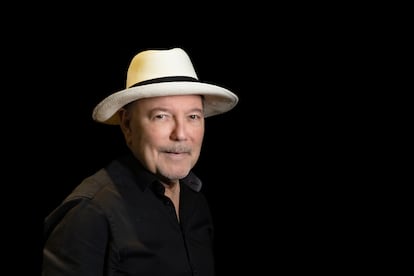

As soon as the interview ends, he pulls on a black beret, dark sunglasses, and a black hoodie with a high collar that covers his mouth. More than a salsa legend, Rubén Blades looks like a ninja on a mission: walking to his favorite restaurant. It is only four blocks away, but strolling through Panama City’s old quarter with him is almost an obstacle course. He knows it well and, at 78, sets a blistering pace, leaving behind both his manager and the reporter accompanying him.
Despite the camouflage-like outfit and the hurried stride, he cannot avoid being recognized by virtually everyone he passes. He greets police officers warmly, signs autographs, and even poses for a photo requested by someone in a taxi that screeches to a halt after spotting him on the sidewalk. When we finally arrive, he does not need to look at the menu. He orders a rum and the restaurant’s signature dish straight away: Rubén Blades’s Steak.
More than 50 years ago, while still a young lawyer writing and singing songs, Blades left Panama City for New York, where he would become a giant. First, he emerged as a standard-bearer of the second generation of Fania Records, the cradle of salsa. Then, he transcended genres and took Latin American music to unprecedented levels of popularity and recognition, paving the way for today’s boom. He did it riding alongside the finest orchestras of the day and with a lyrical style that blended everyday life, political commentary and narrative poetry. He even managed to reference Kafka in his street anthem Pedro Navaja. Hence the nicknames: the poet of salsa and the intellectual of salsa.
All the while, he never severed his ties to Panama. He still keeps an apartment downtown, not far from where he grew up. He served as the country’s tourism minister from 2004 to 2009, after running for president a decade earlier. More recently, he has supported initiatives aimed at strengthening independent candidates in Congress.
Seated in a hotel lounge in the old quarter before dashing off to lunch, Blades says that, for one reason or another, he has never stopped returning to Panama. This time, he is here at the invitation of the literary festival Centroamérica Cuenta. But since his father died a couple of years ago, he has not visited as often. And, nearing the end of the road, he says he has begun to feel something close to regret.
“I have been negligent in my treatment of my family and friends,” he says. “I haven’t given them the time I would have liked. I think about my people, but I don’t tell them, and that can’t happen. My long-time friends, people I’ve known for 60 years or more, are dying. I want to have those conversations I’ve postponed to see if they’ll give me back the dollar I lent them when I was 17; I want to hug them and thank them.”
After the confession, he pauses and adds: “God willing, in two years I’ll be here for a longer time.”
Rubén Blades left Panama in 1974, in the midst of General Omar Torrijos’s military dictatorship, because his father was accused of being a “traitor to the homeland.” The accusatory finger came from another sinister military figure, Manuel Antonio Noriega, then head of the repression and intelligence apparatus and future dictator of Panama. Noriega would be toppled a decade later by the United States, accused among other things of drug trafficking, but before that he had been a CIA informant. Blades’s father was accused of being part of a DEA plot to assassinate the military leadership.
—Your father was a political activist at the time.
—No, my father was a detective.
—Then why did Noriega accuse him?
—Because my father was the DEA contact here in Panama.
Amid the tangled U.S. interests that largely shaped Latin America’s fate in the 20th century — and whose specter seems to be reappearing now with Trump — his family had to flee to Florida, where his mother, who was Cuban-born, had some contacts. Blades stayed one more year in Panama finishing his law thesis. “I finished and left before my graduation. That’s why I later went to Harvard — where I earned a master’s degree in international law — not because my family came from money.”
Throughout the interview, he repeatedly insists on dismantling self-serving versions of his life story, with questions of class occupying a central place, from his adolescence in Panama to his relationship with Fania’s salsa gangsters in New York. In fact, he is writing his autobiography on the recommendation of his friend Gabriel García Márquez. “One day I told him I wanted to write my stuff. And he told me: ‘Write it yourself, because if you don’t, someone else will write it for you.’”
He recalls that conversations with the Colombian Nobel laureate were like “a pinball machine; suddenly the ball goes that way, then it bounces here.” Talking to Blades today feels much the same: a frenetic but structured exchange delivered with the rhythm and punchlines of his song lyrics. He recounts how in 1964 he wrote his very first song, inspired by peaceful protests that same year by students in the Canal Zone, an enclave that had long been central to U.S. interests in Panama. The protest ended in a massacre at the hands of the U.S. military.
“At first the issue was ‘what are these unruly kids doing,’ then: ‘but what the hell are the gringos doing?’” he says. “Because there were 21 dead. Five hundred civilians wounded. Unarmed. Up to that point, we had admired the United States enormously. They had beaten the Nazis. But the army that finished off Hitler was now shooting at us. It was a kick in the butt. Like your grandmother kicking you in the butt for no reason, and you feel it as a betrayal.”
That song, 9 de enero, would become a Panamanian symbol and was performed by Marcos Barraza’s orchestra, the country’s most popular at the time. Blades was only 16 when he wrote it and says he was already writing short stories at the age of eight.
When asked where that precociousness for art and politics came from, he replies: “It’s all my grandmother, my father’s mother, who was a hippie. She went to university, graduated as a teacher, fought for women’s suffrage. She was a painter, poet and playwright. She practiced yoga; she was a free thinker.”
She was a kind of tutor to young Rubén, teaching him to read at age five with a book by Rilke, the poet of anguish. “I read that, and it depressed me, damn it! That stuff with crows, all cold. But that was my grandmother: ‘Read,’ ‘educate yourself.’”
With all that baggage, Blades arrived in Florida with his family. He was 25 and had “a law degree that in the United States wasn’t worth shit,” while watching his family “go hungry” because his father could not find work. He had stopped composing for a few years because law school had forced him to choose, “either you’re going to be a lawyer or a musician,” but he had already written songs for salsa stars such as Richie Ray and Bobby Cruz. So he decided to call Fania’s New York headquarters and ask whether they could hire him as a songwriter.
They said no and told him that if he wanted a job, he could stick postage stamps on the record label’s outgoing mail. “They paid $125 a week, so I took it and went there.” A few months later, Ray Barretto, another Fania mainstay, brought him into his orchestra, and the rest is history. Albums like Siembra (1978), with Willie Colón, are among the crown jewels of Latin American music.
But tensions eventually emerged, something common at Fania because of disputes over money. They included a falling-out with Colón, who had already recorded classics with Héctor Lavoe in the 1960s, such as Hustler and Cosa Nuestra. Those albums drew on the imagery of gangster films to reclaim the harsh reality of Latino immigrants, especially Puerto Ricans like themselves, in neighborhoods such as the Bronx and Spanish Harlem.
During the later years of their feud, Colón was known to remark in music circles that the Panamanian musician, white and well educated, with whom he had helped revolutionize salsa, was nothing more than “a tourist in the ghetto.” Blades acknowledges that there was always a degree of tension because he did not entirely fit the mold, and that it is a difficult issue to resolve. “What are you going to do? Always be explaining that it’s not like that?”
Blades dislikes the labels people have tried to stick on him. Like when Sting said his music was “salsa for the intelligent people.” “We haven’t always expressed ourselves correctly; I’ve said stupid things too, but all that comes from the fact that salsa had recurring themes: the friend who betrayed you, the woman who cheated on you. And I write about other things.” Something similar is happening now with Bad Bunny, who is pushing the boundaries of reggaeton and taking it to mass audiences.
Blades recognizes that lineage of artists, from Tego Calderón to René Pérez Joglar (known by his artistic name Residente) of Calle 13, and concedes that “Latin music is enjoying a moment of tremendous visibility.” But he also sees a risk: “If it remains only a trend, it will be fleeting. The same thing could happen to Bad Bunny as happened to the cha-cha-chá.”
In other words, Latin music will endure or continue to grow only if it can sustain people’s interest once the hype fades. “Will anyone be singing reggaeton in 40 years? I don’t know; what I do know is that Pedro Navaja is still played and it’s from 1978.”
Sign up for our weekly newsletter to get more English-language news coverage from EL PAÍS USA Edition









































