
Alexis Valdés, Cuban comedian: ‘It’s not just about having freedom, but what you do with it’
The actor, who has been barred from returning to Cuba for more than 20 years, discusses the rise of exile theater in Miami, Trump’s deportation policies and the future of a democratic Cuba
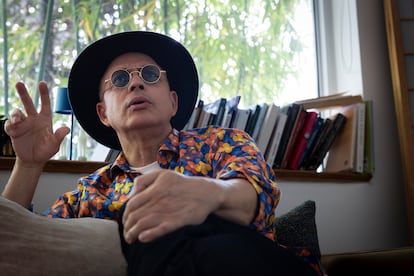

Alexis Valdés, 62, has been unable to enter Cuba for more than 20 years, but on the stage of the Trail Theater on Calle Ocho in Miami, the comedian has recreated, through his characters, conflicts and nostalgia, the country he cannot return to. “An exile is different from someone who’s been banished,” Valdés explains in an interview with EL PAÍS in the living room of his home in southwest Miami.
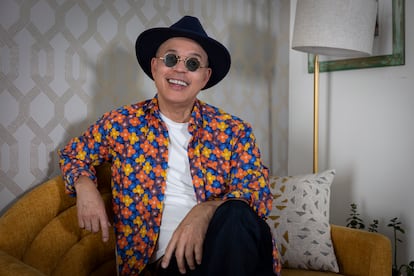
Surrounded by books, wearing a floral shirt, John Lennon–style glasses and a fedora, Valdés is eloquent and quick to laugh; he gestures gracefully and rounds off his thoughts as though bringing down a theater curtain.
“An exile is someone who is in a country that is not their own but who can at some point return. In my case and that of some artists, as happened with Celia Cruz, Arturo Sandoval and many others, it’s a banishment because they won’t let you go back. I have not been able to enter Cuba since 2005,” he says. Cuban authorities never formally explained the reason, although he suspects it may have been because of a joke about Raúl Castro. “Absolute powers do not tolerate humor, nor questioning,” he says.
The ban, however, has not pushed Cuba out of his life or work — quite the opposite. “I am always in Cuba, with the music, the memories, with everything I write. Childhood is embedded there. As Machado said, my homeland is my childhood. If you keep that, you keep your homeland,” he says.
On the Miami stage, the artist has built a fictional Cuba where audiences reconnect with its idiosyncrasies, codes and vicissitudes, where they see Cuban actors living in exile whom they remember from television on the island; and where humor serves as a vehicle for discussing exile, politics and the nation’s future.
This summer, Valdés returns with the most successful installment of his theatrical saga, Oficialmente gay 4 (Officially Gay 4), subtitled The End of the Dictatorship, a comedy that imagines Cubans confronting a democratic transition and the enormous question of what to do with freedom after more than six decades of totalitarian rule.
“It’s not just about having freedom; it’s what you’re going to do with it, with the opportunity,” Valdés says. “You need to see whether, when democracy arrives, you really want to behave like a democrat or whether you want to impose your own ideas. Given Cuba’s recent history — these 60‑plus years — many have been left with the notion of a single way of thinking. I don’t know if Cubans are clear on what democracy really is.”
The first part of Oficialmente Gay, from 2014, follows a macho Cuban forced to pretend to be gay to obtain a government post. It was “in a way the play that reactivated theater in Miami,” says Valdés. “We thought it would run 15 days and it ran two years.”

The success helped the Trail Theater, which at the time was facing an uncertain future, stay afloat. And because it was “a digestible, popular, funny play,” it attracted an audience that wasn’t in the habit of going to the theater. “Many people told me: ‘It’s the first time I’ve ever been to a theater in my life,’” he says.
It also became a kind of professional lifeline for many exiled Cuban actors. Making a living from acting in Miami “is very difficult,” Valdés notes.
From Havana to Miami via Barcelona
The son of actor and comedian Leonel Valdés, Alexis studied engineering, but spent nearly a decade working in radio, television and theater in Cuba before emigrating to Spain in the 1990s. There, he appeared on El club de la comedia (Comedy Club) and in the landmark production of Angels in America that inaugurated the Teatre Nacional de Catalunya. “In Cuba I learned passion, love,” he says; Barcelona completed his training.
After writing, directing and starring in the film Un rey en La Habana (A King in Havana) in 2005, he settled in Miami. In 2008, he launched Esta Noche Tu Night and, after his contract with Mega TV ended in 2013, he focused his career on theater and on writing, directing and producing his own comedies. During the pandemic, he wrote Esperanza (Hope), which Pope Francis included in Let Us Dream, and in 2022 he published the memoir El miedo nos hizo fuertes (Fear Made Us Strong).
For years, Valdés has criticized the Cuban government through his parodies and songs, such as Cuba, muévete (Cuba, Get Moving), “a tune for my people, weary of this living without truly living,” which calls on them to wake up, unite and take to “the streets.”
The criticism became more direct in the wake of the San Isidro Movement, particularly inspired by artist and activist Luis Manuel Otero Alcántara, whom Valdés describes as “a very luminous person, with great charisma and charm.” “Having that kind of person imprisoned is the worst thing that can happen to a society,” he says.
In February 2021 he told the European Parliament that in Cuba “honest men and women who take to the streets to shout the truth inside the island are persecuted, defamed, tortured, violated, imprisoned.” When the July 11 protests erupted five years ago, he felt “a hope that there could be significant change,” and “when they crushed it, I felt great frustration, great disappointment.”
He also expresses disillusionment with the “politicking” of the exile community. “So many people trying to get rich, to profit from the suffering of Cubans, selling themselves as political, messianic figures, but you see they’re getting rich, obviously, which is something I find shameful,” he says.
‘What’s wrong with Donald Trump?’
From his home in Florida, Valdés has witnessed firsthand the consequences of the anti-immigration crackdown launched by Donald Trump’s administration, a machinery that has also affected his own community.
Valdés says fear of immigration authorities in Miami is also evident “in audience turnout. Club owners, bar owners, venue managers tell you. People who might have gone out on a Saturday to see a show no longer go.”
“There are people who are very afraid because they sold their house, everything they had, and came to this country and have nowhere to return to. Those people must be living a terrible life. With a constant worry, a constant anguish. And there’s a double standard, because if you tell people: ‘That society is no good, that country is no good,’ how are you going to send them back there?” he asks, referring to the deportations of Cubans to the island.
“If so many Cubans voted for Trump, I don’t understand why Trump is carrying out this offensive against Cubans and Venezuelans,” he reflects. He also cannot understand how those who arrived years ago now look down on newcomers as inferior and have forgotten “the compassion they wanted for themselves.”
During Trump’s first term, Valdés asked in a song: “What’s wrong with Donald Trump that he wants to pick fights with Latinos?” “This second time he has done much worse,” he says. “I never liked Trump. I generally don’t like people with radical ideas, neither on the right nor the left. I didn’t like that in Cuba, and I left Cuba, so I’m not going to applaud it outside Cuba. I have friends who voted for Trump and today tell me they regret it.”
The future of Cuba
While Trump threatens to “take” Cuba, Valdés says the island’s future should be decided “by the Cuban nation”: those on the island and those abroad. He believes the United States can help and serve as a catalyst in that process, although he has reservations “about whether, in the end, what prevails will be what’s good for people or what’s good for money.”
“All Cubans have something to contribute to change,” he says. “Those outside have learned many things. And obviously the United States, which is the world’s great power and is close to Cuba, has a significant influence and can help tremendously to catalyze and monitor that process. I think it should be that way because Cubans alone cannot do it. Cubans don’t control the military; they don’t control anything.”
He is confident that, if there is a change in the island’s government, there is a certain type of Cuban who will contribute to the reconstruction. “The hard‑working Cuban who wants a better life, who is dedicated to his work, to his profession, to his family," he says. “The Cuban who is affectionate, decent, friendly. Someone who still seeks a bit more culture, more information. That Cuban is the one who can improve Cuba. And that’s the Cuban who will be hardest to win back, because so much time has passed — many years of the glorification of mediocrity, of those who bow their heads, of brutality over the good, decent, and noble human being.”
For his part, he says he would “always” return to Cuba. “That’s my country. And if I could contribute something, I’d be there. The foundation I gained in Cuba allowed me to do well in Spain and elsewhere. So I have to give back, to share with the people what I’ve learned, with the greatest possible nobility.”
Even so, he doesn’t know if he’s ready to face the island right now, “at its worst. I think it would have a negative impact on me. But maybe you’ll run into friends; they’ll tell you a few stories, give you a couple of hugs, and it won’t be so bad after all. I don’t know. But the Cuba I hear about isn’t the one I want to see.”
Sign up for our weekly newsletter to get more English-language news coverage from EL PAÍS USA Edition









































