
The dilemmas over Cuba’s future: Regime change or negotiated transition
The precedent in Caracas looms over the island, but analysts and historians see a horizon of ‘capitalism without democracy’ as more likely than regime change
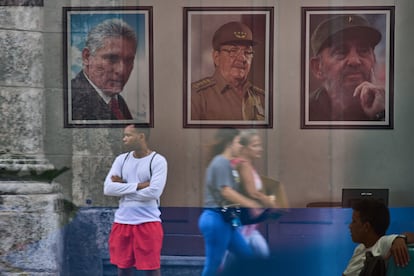

Between grandstanding, contradictory statements, and secret meetings, something is happening in Cuba. A path has opened that is still full of unknowns, but one that now seems hard to reverse. In recent days, events have accelerated with the unusual visit by the CIA chief to Havana, the U.S. indictment of Raúl Castro — the Cuban Revolution’s last great symbol — and the deployment of an aircraft carrier in Caribbean waters near the island.
A shadow play whose central dilemma, for now, is whether all this will lead to a rupture — a toppling of the Castroism and regime change — or to a transition triggered by maximum U.S. pressure but staged as a negotiated pact to preserve at least some of the revolution’s heroic image.
The precedent in Venezuela looms ever larger. First came political pressure, then criminal charges, and finally, U.S. forces entered Caracas and flew president Nicolás Maduro by helicopter to a prison in New York. Since the start of the year, Delcy Rodríguez has served as the president, effectively overseen by the White House, following a visit from CIA director John Ratcliffe, who made clear that she could remain in office as long as she followed Washington’s directives. It’s a sequence that is now unfolding — at an even faster pace — in Cuba, including the aircraft carrier stationed in the Caribbean as a warning.
Despite the parallels, analysts are cautious about predicting a similar outcome. For Michael Shifter, senior fellow at the Washington‑based think tank Inter-American Dialogue, “it is unlikely they will follow that route because they will not find a Delcy Rodríguez in Cuba. It is a very different power structure. They will have to look for people within Castroism, without reaching a regime change, without a sharp rupture.”
Unlike the Chavismo political movement, which evolved largely into a system of competing clans, the Castros have steered the country with an iron hand for more than 60 years, allowing only slight adjustments in the most difficult moments to ensure their survival without ever relinquishing power.
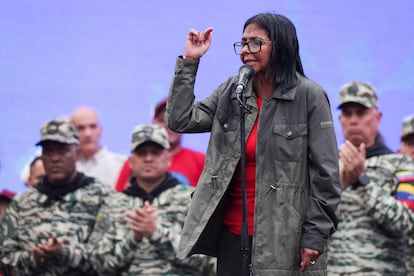
Children, sons‑in‑law, and grandchildren of the Castro family still hold key posts within the regime’s apparatus, as shown by the presence of Raúl Guillermo Rodríguez Castro at the negotiating table with the CIA. Known as “El Cangrejo” (The Crab), Raúl Castro’s grandson and bodyguard has been a constant presence in nearly every decisive moment of this year’s talks between Havana and Washington.
“The strategy seems to be to increase pressure to the maximum to force a deal with the regime. For now, the priority is the economy, security, and intelligence, to ensure above all that it reduces the influence of China and Russia on the island,” adds Shifter.
The escalation of recent days — on top of the oil blockade imposed since January, which has pushed the population to the brink — coincided with U.S. President Donald Trump’s trip to China to meet with his counterpart Xi Jinping. One of the White House’s mantras, as it pursues a political and military campaign to reassert its influence in a region where the international order is fraying, is that Cuba is a matter of “national security.”
The island, described as a “haven for adversaries” in last week’s CIA statement following the meeting, is framed as a strategic threat. It’s rhetoric that echoes the Cold War, now updated to point toward drug trafficking.
“There has always been cooperation in the fight against drug trafficking, but now it has deepened. Cuba is not so much a threat as a security problem. The Pentagon and the CIA are very concerned that if the crisis continues, it could lead to a new mass exodus, violence, and instability,” says Rafael Rojas, a Cuban historian at El Colegio de México (Comex).
U.S. Secretary of State Marco Rubio — the architect of the operation and a son of the Cuban exile community in Miami — has publicly voiced concern about potential social unrest on the island. His statements often mix threats with an open hand to negotiate on his terms. The pattern repeated itself on Wednesday. Hours before Justice Department prosecutors announced the indictment of Raúl Castro for the 1996 downing of two exile‑group planes, Rubio offered a “new relationship” for Cuba: free elections and an end to the military’s accumulated power.
“The two actions are compatible,” the Inter-American Dialogue analyst says. “Raúl’s indictment is a long-standing demand of the exile community, but it has mainly symbolic value. It is a pressure message to gain leverage in negotiations without necessarily leading to Castro’s arrest.”
After the indictment of Raúl Castro, who at 94 still holds the honorary rank of general and has never entirely relinquished power, Trump ruled out an “escalation” against Cuba, saying “there’s no need for one.” “The place is falling apart; it’s a mess, and they sort of lost control,” he added.
Cuban President Miguel Díaz-Canel responded more sharply to the indictment: “If it were to materialize, it would cause a bloodbath with incalculable consequences.” The Cuban leader also hinted that Cuba has 300 drones for military defense, while reiterating that the island “does not represent a threat” to Washington.
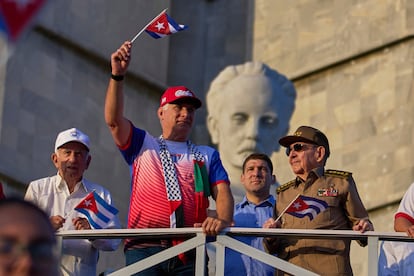
Barely 90 miles separate Cuba’s coastline from Florida’s — another key difference from the Venezuelan precedent. “Cuba is not Venezuela. And if there is an attack, the government will not stand idly by. If even one drone struck near Mar-a-Lago [Trump’s residence in Florida], general hysteria would break out,” says Cuban economist Omar Everleny Pérez Omar.
In that context of calculated threats, Rojas points out that “it seems negotiations involve offering guarantees to the regime’s leadership that they will be respected, but in exchange for a dialogue with comparative advantages. I don’t think a political change is on the table, but it is not ruled out that the Cuban government itself could offer a succession scheme in which it sacrifices a head, along with more reforms and amnesty for political prisoners. A shift toward capitalism without democracy.”
The analysts consulted agree that the hypothetical sacrificial figure could be Díaz-Canel, the first president without the guerrilla lineage. His chapter began in 2018, designed and supervised by the Castro dynasty, and his term is set to end next year.
“He is a figure without much power who has been weakened. He could be the next step, along with lifting some restrictions on the private economy,” says Shifter.
One of the most significant measures during these more than two months of negotiations was to open the door to investments from Cubans living abroad. Oscar Pérez-Oliva Fraga, vice prime minister and great-nephew of Fidel Castro, said in mid-March he was prepared to “maintain a fluid commercial relationship with U.S. companies” and “with Cubans residing in the United States and their descendants.”
The measure seems, in theory, more than a gesture. But Cuban economist Everleny Pérez points out that there are few incentives to invest in Cuba — especially after recent sanctions on any non-U.S. person or entity that maintains commercial relations with the island, particularly in the energy, defense, security, and finance sectors. “Major shipping companies have suspended operations to Cuba. There is no fuel. How will an investor want to enter if almost all private activity is paralyzed?”
What would be advisable, the economist adds, “is to chart a clear route toward a social market economy with a two-year stabilization plan focused on tackling the fiscal deficit and inflation. And above all, to select the sector that will be the core of reconstruction: tourism, sugar, and nickel.” A challenge for a country with a strong agricultural tradition that spends more than $2 billion on food imports.
Sign up for our weekly newsletter to get more English-language news coverage from EL PAÍS USA Edition









































