
Jewish settlers impose their law on Palestinian Bedouins: ‘No one is protecting us’
At least 39 farming and herding communities have been wiped out in the West Bank by Israeli militants during the Gaza war, according to estimates by an Israeli NGO

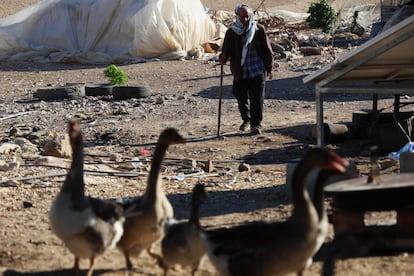
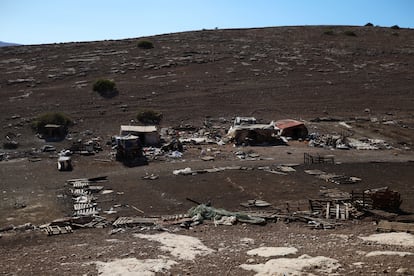
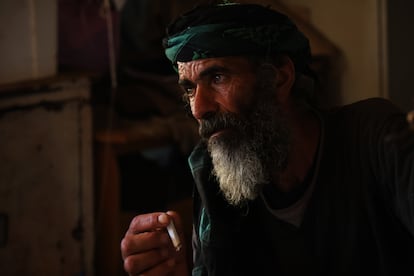
A hen scampers alone amid the remains of a Bedouin community dismantled a few hours earlier near the town of Hamra, in the northern Jordan Valley (occupied West Bank). It must have gotten lost when the inhabitants were expelled by a group of Jewish settlers, who have been increasing their attacks on Palestinian shepherd communities recently. “Uri Cohen pointed a gun at me a week ago. No one is protecting us. We can only stay put to save our lives,” says Hasan (he prefers not to give his real name), a 51-year-old shepherd from the area, referring to one of the Israelis leading the offensive, who continues to intimidate his family into abandoning their precarious home, their land, and their way of life. Hasan, for the moment, is resisting and enduring. Uri Cohen, for his part, declines to answer this newspaper’s questions.
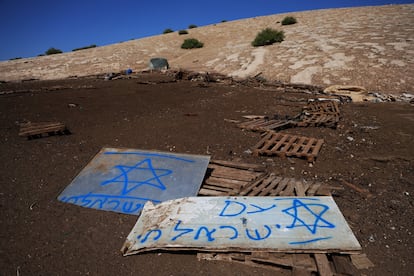
But in Hamra, the chicken and the unrepentant flies are the only breath of life left in the desolate landscape. Amid the pallets, the tarps of the tents, personal belongings, scraps of clothing and shoes, a prayer mat... the graffiti of Israelis celebrating what they consider a victory stands out. The blue Star of David, applied with spray paint in various places, is accompanied by a message: “Am Israel Chai” (The nation of Israel lives). The 89 Jewish outposts (or germs of settlements) created in the West Bank since 2024, according to the Israeli NGO Peace Now, outnumber the 39 Palestinian agricultural and pastoral villages forcibly dismantled. To these are added dozens that remain on the brink of expulsion, according to the Israeli NGO B’Tselem, since the war in Gaza began in October 2023.
Those who are eventually expelled load up with all the animals and belongings they can and go in search of other land on which to settle. “But they are not safe there either,” emphasizes Peretz Gan, a veteran Israeli activist who tries to offer protection to the Bedouins in the Jordan Valley. They are the weakest link in the Palestinian population and easily succumb to the constant attacks by settlers who, with the help of the Israeli military, also block their roads and prevent them from accessing grazing areas or the scarce water sources available. In recent days, after numerous attacks, the settlers have managed to expel the inhabitants of Mu’arrajat, which this newspaper visited last February after they set fire to the mosque and other parts of the town.
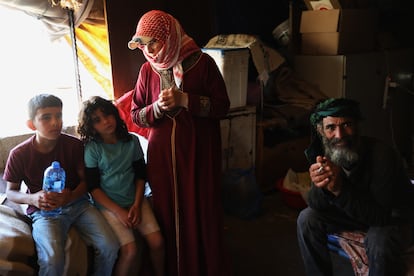
During a visit to the area by several reporters, including this newspaper’s, along with Israeli activists, residents of Farsiya phoned to alert them of the arrival of two young settlers in an all-terrain dune buggy. When activists and reporters arrived shortly afterward, they had already left. One of the young men showed in a video how the two, one of them carrying a rifle slung over his shoulder, strutted in front of women, men, and children while causing some damage to furniture and personal belongings. Hussein, 70, leaning on a cane, described what happened and implied that it was part of his daily life. The last incident took place three days earlier, he added.
This is a radical Jewish ultranationalist movement whose goal is to seize these lands and which enjoys the support and encouragement of the government, some of whose ministers are also settlers. It’s a maneuver of “systematic harassment orchestrated by the Israeli government,” denounces activist Elie Avidor of Combatants for Peace. Riots are frequent, especially in villages with larger populations than Bedouin communities. Six Palestinians have died since the end of June amid the violence.
There is a clear objective in this campaign, Avidor insists: to seize the land. Pressure on Palestinian communities has been increasing in tandem with the war in Gaza and in recent weeks has reached previously unprecedented levels. Two men were killed on July 11 by settlers in Sinjil (north of Ramallah, the administrative capital of the West Bank). One of them, a U.S. citizen, was beaten to death. In the village of Kafar Malek, also near Ramallah, four residents, one of them a teenager, were killed in late June during attacks by Jews who were ultimately backed by Israeli soldiers, who fired their weapons. The call-up of several hundred thousand reservists to feed the army in the conflict makes it impossible to distinguish real soldiers from civilians in uniform, Avidor emphasizes.
The Jordan Valley and the surrounding hills are increasingly dotted with these new settler settlements (“outposts”) from which the native population is harassed. The 59 created in 2024 and the 30 so far in 2025 — compared to seven in 2023 — represent an all-time high, according to the NGO Peace Now. Initially, they are set up in caravans or makeshift dwellings, and later, they eventually host several families and provide water, electricity, and even a paved road — a dream for the Bedouins.
In other cases, they enjoy ranches heavily subsidized by the Israeli government, like that of Uri Cohen, who, in addition to being a rancher, is identified as one of the leaders of the attacks against Palestinians and who held Hasan at gunpoint a few days ago. “Paving this place costs millions,” Avidor laments on the road leading to Cohen’s farm, which runs near precarious Bedouin villages that lack the essentials for survival. Cohen declined to answer questions about the accusations made by Palestinians against him. “We live in peace and happiness. Anyone who says otherwise is lying. I’m not interested in being interviewed,” he stated in text messages.
A few meters away, an Israeli military base crowns a neighboring hill. The pipeline supplying water to these facilities runs down the slope and alongside Khirbet Makhul, another endangered village where Hasan lives, threatened by Cohen. Electricity cables sprawl overhead. The Bedouins lend their land, but they don’t enjoy these essential services, which are only for the troops and settlers, according to the few remaining residents, as most of the families have already left.
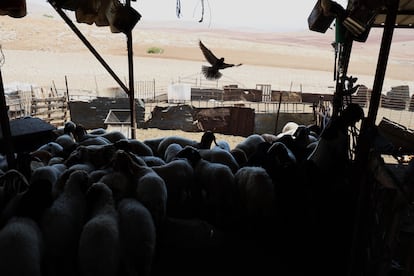
Hasan is the father of nine daughters and one son, but for safety reasons, most of them don’t live with him and his wife in this village with about 350 sheep. He’s been enduring pressure from settlers for years. Cohen arrived in the area about a decade ago, he estimates. “Haram, haram, haram” (in Arabic, “forbidden or illegal”), his wife repeats to describe their situation as she sits in the main room of the house. The walls are made of sheet metal and burlap sacks. There is a basic kitchen, just enough to get by.
In the surrounding area, a whole system of fences, ditches, gated roads, and military checkpoints designed to separate the two communities, Palestinian and Israeli, is visible. At one of them, Elie Avidor remains stationary for an hour with several international reporters. The group had announced its presence in the area and previously requested access permission. But nothing persuades the military to open the way. The goal is for the Jews to gain vital space at the expense of the Palestinians, whom they want to drive toward the urban centers of the West Bank, maintains the Combatants for Peace activist.
In the same area, a house in Ein al-Hilwa, precarious like all the others, had a demolition order posted on its door the very morning of the visit. It’s part of the occupation bureaucracy with which the Israeli authorities pressure Palestinians to leave. Bulldozers, accompanied by the army, are often sent into the villages to raze everything in their path, forcing the inhabitants to flee.
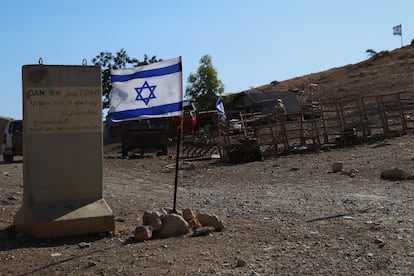
A swarm of Israeli flags planted in the ground surrounds a group of houses in Ein al-Hilwa. At the entrance to the road, a concrete slab warns in Hebrew, Arabic, and English: “Danger. Firing Range. No Entry.” This is another means of pressure, declaring militarized zones where the army is not actually deployed. “It’s just an excuse,” Avidor argues. The owner of the threatened house explains that he has to sell a cow each month to keep the rest of the people alive. He is afraid and doesn’t want his identity or image published. He explains that the settlers roam freely day and night and take whatever they want. “If no one helps me, I’ll have to leave,” he concludes.
Sign up for our weekly newsletter to get more English-language news coverage from EL PAÍS USA Edition









































