
US launches ‘heavy’ wave of strikes in response to Iran’s attack on bases in Jordan
The operation marks a return to open warfare and raises the risk of the conflict spreading to involve actors such as the Houthis and Saudi Arabia
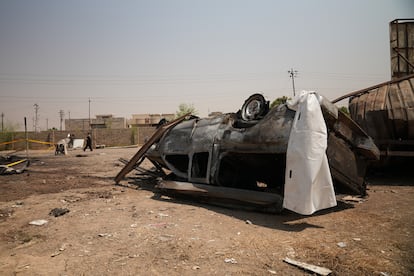

Washington’s response was swift. A day after Iran launched ballistic missile attacks on U.S. bases in Jordan, the United States retaliated with airstrikes. The operation began at 8:00 p.m. Washington time. Two hours later, the military declared victory, announcing that it had successfully completed a “heavy wave of attacks” against the Islamic Republic.
According to a statement posted by U.S. Central Command (CENTCOM) on its X account, the United States struck dozens of targets belonging to the Islamic Revolutionary Guard Corps (IRGC), “including military command centers, missile and drone facilities, coastal surveillance and defense sites, and maritime capabilities.”
“The strikes aimed to further diminish threats posed by Iran and its proxies to American forces, commercial shipping, and neighboring Gulf countries,” CENTCOM added, describing the operation as a response to Iran’s attacks on its bases in the Middle East.
U.S. forces began launching strikes against Iran at 8 p.m. ET today. The strikes are a powerful response to yesterday's attempted Iranian attacks on U.S. forces based in the Middle East.
— U.S. Central Command (@CENTCOM) July 30, 2026
News agencies reported late on Wednesday that explosions had been heard in southern Iranian cities such as Bushehr and Bandar Abbas. The sound of air-raid sirens signalled a return to open warfare, a scenario already seen earlier this month when the collapse of a ceasefire gave way to 13 days of uninterrupted attacks.
U.S. President Donald Trump said over the weekend that he wanted to give diplomacy a chance and ordered a halt to the strikes. But the surprise barrage of missiles launched by Iran on Tuesday appears to have dashed those hopes. Trump himself had hinted at what was coming just hours earlier. “We’ll be hitting them hard. They’re going to get a beating,” he said in an interview with Fox News.
The operation carries even greater risks than the exchanges of attacks between Washington and Tehran earlier this month. It comes at a time when other regional actors are becoming involved in the hostilities, raising the prospect of an all-out war that could engulf the Middle East. The first to intervene were the Houthis, the Iran-backed Yemeni militia, which last week launched attacks on Saudi oil tankers, an operation that has been repeated in the days since.
The conflict escalated further on Wednesday with a joint U.S.-Saudi operation on Iraqi soil targeting pro-Iranian militias. According to a statement from the Popular Mobilization Forces (PMF), the umbrella organization grouping those armed factions, the strikes carried out by Washington and Riyadh left 20 fighters dead and 32 wounded. It was the first time in the five-month-long Iran war that Saudi Arabia, the Middle East’s leading Sunni power, had conducted a military operation alongside U.S. forces.
The combined effect of these developments is not only to push the prospects of a negotiated settlement further out of reach. The involvement of additional national armies and paramilitary groups also risks widening the conflict, with potentially unpredictable consequences.
Sign up for our weekly newsletter to get more English-language news coverage from EL PAÍS USA Edition









































