María Corina Machado prepares a tour of Venezuela to forge a ‘national agreement’ that will drive the transition
The opposition leader’s goal is to unite the country’s political and civil forces around a shared democratic roadmap
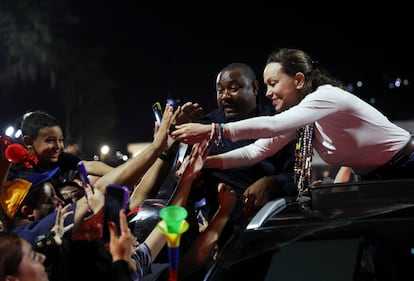
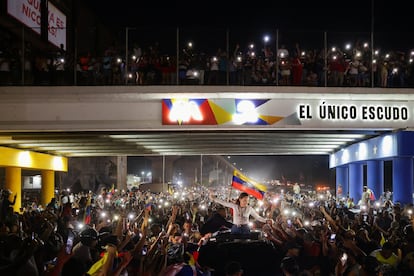
After the outburst of enthusiasm that accompanied her return, María Corina Machado and her political circle have begun a “soft” reintegration into Venezuela. The opposition leader’s collaborators say it is a strategy designed to manage energy and time the next move. Machado is preparing for a press meeting on Thursday where she is expected to provide details about her return to the country after 10 months, and to outline the strategy she intends to use to challenge the regime and push for democratic change. So far it is known that the opposition leader will launch an ambitious national tour for which significant precautions are being taken.
In the hours after her return, according to sources familiar with the situation, Machado — Nobel Peace Prize laureate of 2025 — has met with family members of political prisoners; she visited her friend Perkins Rocha, a jurist, legal adviser and activist in her political party Vente Venezuela who remains under house arrest; she has spoken with party activists; and attended to personal matters before returning home.
The logistical apparatus supporting her is preparing for Machado’s national tour. The security team is being rebuilt: all its members, including its chief, Milcíades Ávila, had been in jail until recently. “We know this can take time and that there is enormous public expectation around María Corina’s return,” says Jesús Armas, national leader of Vente Venezuela. “She knows this, she has studied the issue and she comes with an agenda, with a plan for the times ahead,” he adds.
“I worry about security; that is what we are working on now,” acknowledges Henry Alviarez, Vente Venezuela’s organization secretary. “No one has threatened us, everything is calm for now, but we are obliged to prevent incidents. María Corina’s arrival was improvised, a mass outpouring that completely overwhelmed us. It was her and the people, with no one thinking about security. That cannot happen again,” he admits. “I don’t mean the government; I’m not talking about political police. María Corina is a leader who affects powerful interests, she has enemies, and we must avoid a lone madman showing up; you never know.”
“María Corina is back to drive popular mobilization; that is her goal,” says Carlos Blanco, one of her advisers and political counselors. Blanco explains this is an accumulative process with multiple fronts that will include an exhaustive series of contacts with civil-society actors. “Social dialogue will allow us to build consensus around specific issues, and that will help us move forward more clearly to accelerate the objective of a transition through a broad national agreement. Many engagements with people and organized society are coming,” he explains.
The “broad national agreement” is today a concept on the lips of most politicians linked to María Corina Machado. Some Vente Venezuela leaders are reluctant to provide details about it, and are waiting for her to formalize it. This process of tours and consultations should culminate in a national event — initially planned for the first weeks of 2027 — in which a message to the nation will set out the strategy for returning to democracy.
Machado, a liberal right-wing leader, has clear international political leanings and is often evaluated on that basis: her friendships with Javier Milei of Argentina, Alberto Núñez Feijóo and Santiago Abascal of Spain, Nayib Bukele of El Salvador, José Antonio Kast of Chile and Benjamin Netanyahu of Israel, among other leaders of the emerging global right and far right, are well known. Within the country, however, Machado’s advance is much more cautious. She has woven a heterogeneous network of alliances across politics and civil society. Far from the strident tone of her international allies such as Milei, her strategy in Venezuela avoids polarization.
Today, one of the parties most consistently aligned with Machado within the Plataforma Unitaria is Acción Democrática, the historic social-democratic formation that helped found the democratic regime in the second half of the 20th century and one of her long-standing adversaries in Venezuelan political debate. Machado also counts as steadfast allies Andrés Velásquez of the labor party Causa Radical and Gabriel Puerta, leader of Bandera Roja, a small Marxist party that has opposed Chavismo throughout these years.
This national outreach strategy, its promoters say, will consolidate commitments with the labor movement, the business community, academia, students and political parties around general objectives on which there is already a relatively widespread implicit consensus in the country: transition and constitutional freedoms, the rule of law, fighting poverty and social debt, a market economy, the diaspora, promotion of entrepreneurship and respect for private property. The ultimate goal, according to Vente Venezuela, is to wait for the results of the negotiation table between the opposition and Chavismo — regardless of its rupture with the opposition politicians who heeded Secretary of State Marco Rubio’s call — and place the electoral timetable at the center of citizens’ demands.
Sign up for our weekly newsletter to get more English-language news coverage from EL PAÍS USA Edition