
Juan Miguel Matheus, Venezuelan opposition negotiator: ‘The terms have been defined by the US State Department’
The official for the Justice First party defends the agreements reached in the second round of talks with Chavismo and says elections will take place ‘as soon as they are possible’
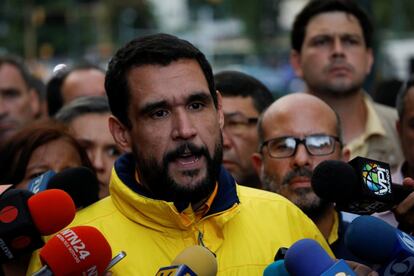
Juan Miguel Matheus acknowledges United States involvement in the process that Chavismo and part of the opposition began on January 12, and which this month opens its third round of meetings. Far from being bothered by it, Washington’s involvement seems necessary to him: in his view, it has made essential compromises feasible for the institutional transformation needed to restore democracy in Venezuela. Matheus is confident that in the upcoming sessions, which will run through December, work will begin on a new electoral system and on restoring political and constitutional rights.
Matheus, a lawmaker elected to the National Assembly in 2015, is one of seven opposition figures chosen by Washington to sit opposite the government’s representative, Jorge Rodríguez. Trained in the principles of Christian democracy, he graduated from Monteávila University in Caracas, where he completed a master’s degree in Constitutional and Parliamentary Law, and earned a doctorate in law from the University of Navarra in Spain. He is considered one of the authors of his party Primero Justicia (Justice First)’s doctrinal thesis.
For him, January 3 — the date of the attack and the capture of Nicolás Maduro and his wife, Cilia Flores, carried out by U.S. military personnel — changed everything.
Question. What role does the United States play in these negotiations?
Answer. January 3 awakened a U.S. interest in Venezuela that altered domestic politics and definitively reconfigured the relationship between the two countries. The oil agreement makes Venezuela a matter of the highest interest for Washington in this geopolitical context, as state policy and with bipartisan support. That is the fundamental difference between this negotiation process and previous ones.
Q. Chavismo says it is negotiating with the United States, not with the opposition.
A. The facilitator of this process is the United States, an actor that is objectively credible to both sides. The terms and coordinates of this negotiation have been defined by the State Department and, specifically, by Secretary of State Marco Rubio. But the work is being carried out between the two local actors. A very concrete sign that the negotiating table has its own dynamics: in the first cycle, on justice issues, we walked in proposing a renewal of the Electoral Chamber and left with agreements to renew all chambers of the Supreme Court of Justice, the General Inspectorate of Courts and the School of the Judiciary.
Q. The agreements from the second round, at the end of September, disappointed some: critics said they announced measures that were already underway.
A. Any public dissatisfaction with this process is justified: there are many years of autocratic suffering and failed negotiations behind us. But this is the first time we have obtained concrete results in the first work cycle, and also in the second. One of the agreements is the transformation of the justice system through three measures: the formation of the Preliminary Commission of the Judicial Nominations Committee to select a new Supreme Court of Justice, the timetable to appoint the magistrates, and the appointment of members of the Credentials Verification Council for candidates. These are fairly concrete agreements.
Q. Why did Delcy Rodríguez make her own announcement about measures being discussed at the table, such as reform of the Law Against Hate or the unblocking of 200 news sites?
A. I believe there is an intention not to attribute democratizing results to what is debated at this table and to present them instead as unilateral measures of the provisional government. But the Venezuelan people have the civic maturity to know that two plus two equals four: the unblocking of news sites or the reform of the Law Against Hate are the result of the work of this negotiating table. They are demands that the representatives of the National Assembly elected in 2015 had been making even before it was convened.
Q. Why were political rights and disqualifications not addressed as expected?
A. The agenda for the talks was set on August 1 and included three major areas: assistance to earthquake victims; strengthening democracy, with a transformation of the justice system and the electoral system; and political guarantees, which cover human rights and political rights. In the coming sessions we will go in depth into the debate on political rights.
Q. What do you hope to achieve between now and December?
A. We have taken giant steps in transforming the justice system. Having a constitutional timetable to appoint the new magistrates, which is about to be published, is an important achievement. It will now be essential to begin discussing the transformation of the electoral system and, of course, what is at the heart of these negotiations: the establishment of the political guarantees table, which will create the climate to cleanly renew the country’s public authorities.
Q. Jorge Rodríguez said the date of the elections will be set “in accordance with what the Constitution stipulates.” What do you think?
A.If we stick to the Constitution, we would have to count 180 days from January 3 to declare Maduro’s permanent absence from office, plus a possible extension of another 180 days, to call presidential elections. People should judge this negotiating table by the agreements signed rather than by statements from the representatives of each delegation.
Q. Do you see possible elections in 2027?
A. As soon as they are possible, as the Secretary of State himself, Marco Rubio, has said.
Q. By buying time, Chavismo could take the country back to square one: elections in 2030, as previously planned.
A.We are not lowering our guard. We are exercising the necessary caution: we know the precedents of the side with which we negotiate. Personally, I do not see an electoral scenario on that date. Our goal is not only to achieve presidential elections, but to inaugurate a democratic system that will endure, as a result of the renewal of public authorities that emerges from these sessions.
Q. Do you really believe the Bolivarian revolution will capitulate at a negotiating table?
A.Venezuelan political dynamics changed forever after January 3, and that led to the creation of this negotiating table. No one can evade the magnitude of that event. Moreover, the table has its own dynamics. There has been civic cordiality in the working sessions, with U.S. accompaniment and the natural tensions and disagreements that occur in these situations, but also with sufficient stature to interpret the democratizing interests of the Venezuelan people.
Sign up for our weekly newsletter to get more English-language news coverage from EL PAÍS USA Edition









































